

Most traders don't fail because they lack discipline. They fail because they're running the wrong types of trading strategies for the market conditions in front of them. Scalping in a slow-trending market, applying trend-following logic to a choppy crypto pair, or backtesting without realistic costs are all common traps. This article breaks down the major strategy categories by holding period and market behavior, gives you a side-by-side comparison of strengths and weaknesses, and helps you match the right approach to your goals, risk tolerance, and automation setup.
Table of Contents
- How to choose the right trading strategy for you
- Key types of trading strategies by holding period
- Popular trading strategies based on market behavior
- Futures and algorithmic trading strategy categories
- Comparing major trading strategy types: strengths and weaknesses
- Our take: The strategy problem most traders ignore
- Take your trading further with Apex Trade LLC
- Frequently asked questions
Key Takeaways
| Point | Details |
|---|---|
| Match strategy to market regime | Choose trend following for trending markets, mean reversion for ranges, and breakout for transitions to improve success. |
| Hold time matters | Shorter strategies like scalping require fast execution; longer ones like position trading need patience and analysis. |
| Risk management is critical | Use daily loss limits, max drawdowns, and proper stop losses to control automated trading risks. |
| Backtesting must be realistic | Include data quality checks, realistic costs, and out-of-sample validation for dependable strategy results. |
| Algorithmic strategies vary | Select types like momentum, arbitrage, or machine learning based on your capital, risk tolerance, and tech skills. |
How to choose the right trading strategy for you
Before picking a strategy, you need a framework for evaluation. The biggest mistake most traders make is choosing based on what backtested well rather than what fits their actual situation. Strategy categories correspond to different market inefficiencies, each with distinct risk profiles, capital requirements, and implementation complexity, so selection based on drawdown tolerance matters more than past performance alone.
Here are the core criteria to evaluate before committing to any strategy:
- Holding period: Are you comfortable watching a trade for 30 seconds or 30 days? Scalpers need lightning-fast execution. Position traders need patience and capital to weather pullbacks.
- Market regime: Every strategy has a natural habitat. Trend-following thrives in sustained directional moves. Mean reversion works in range-bound conditions. Breakout logic suits accumulation zones.
- Risk tolerance: Strategies with high win rates often have small average gains. Strategies with low win rates often make large gains on winners. Neither is objectively better; each suits a different psychological profile.
- Automation complexity: A simple moving average crossover can be automated to trade consistently in hours. A machine learning model with adaptive position sizing requires weeks of engineering and ongoing maintenance.
Your answers to those four questions narrow the field significantly. If you trade forex and want a fully automated system with minimal manual intervention, that points you toward rule-based strategies with clearly defined entry and exit conditions. Algorithmic forex strategies in particular demand that your logic be fully codifiable before you write a single line of code.
Key types of trading strategies by holding period
Holding period is the most intuitive way to organize trading strategies, and it's where most traders naturally start when learning to explain trading strategies to themselves. Strategy types by holding period range from scalping at one extreme to position trading at the other, each defined by a rule-based framework governing entries, exits, and risk per trade.
Here's how each category breaks down:
- Scalping: Trades last seconds to a few minutes. The goal is capturing tiny price movements repeatedly throughout a session. Requires fast execution, tight spreads, and very high trade frequency. Automation is almost mandatory at this level, and execution costs can eat profits if not carefully managed.
- Day trading: Positions open and close within the same trading day. No overnight exposure, which eliminates gap risk. Day traders typically rely on intraday price action, volume patterns, and short-term indicators. Works well for stocks, futures, and forex pairs with sufficient daily range.
- Swing trading: Trades hold for two days to several weeks, capturing "swings" within a broader trend or range. Lower time commitment than day trading. Swing traders accept some overnight risk in exchange for larger potential moves. This is often the sweet spot for traders who also work full-time jobs.
- Position trading: Holds range from weeks to months. This is closer to active investing than short-term speculation. Position traders focus on macro trends, fundamental catalysts, and higher-timeframe technical structure. Drawdowns can be significant, and capital requirements are typically higher.
Pro Tip: If you're building your first automated trading workflow, swing trading strategies are often the best starting point. The signal frequency is manageable, the rules are straightforward to code, and you have time to monitor and adjust without staring at a screen all day.
Popular trading strategies based on market behavior
Beyond holding period, strategies can be grouped by the market logic they exploit. These behavioral strategy types cut across timeframes, meaning you can apply trend-following logic as a day trader or as a position trader.
- Trend following: Assumes that an asset in motion tends to stay in motion. Buys when price is rising, sells when price is falling. Works best in strongly directional markets. The three core strategy logics for retail forex, trend, breakout, and mean reversion, each thrive in specific market regimes, and trend following fails badly when markets chop sideways.
- Breakout trading: Waits for price to push through a key support or resistance level, then bets on continuation. The logic is that a break signals new participation and momentum. The biggest risk is the fakeout, where price breaks the level, triggers your entry, and then reverses immediately. Filtering breakouts with volume confirmation reduces this risk.
- Mean reversion: Bets that extreme price moves will revert toward an average. Works in range-bound markets where price oscillates between identifiable high and low boundaries. Mean reversion strategies typically have higher win rates but smaller individual gains per trade.
- Grid trading: Places buy and sell orders at fixed price intervals above and below a central price. Grid strategies profit from oscillations within a range without needing to predict direction. They are most effective in sideways or low-volatility markets and most dangerous during strong sustained trends, when the price keeps moving in one direction and open orders pile up on the wrong side.
- Momentum trading: Related to trend following but distinct. Momentum strategies buy assets showing relative strength compared to peers or compared to their own recent history. Common in equities and crypto, where capital tends to rotate toward what's already working.
Pro Tip: Identify the market regime before deploying any strategy. A quick way to do this is using the Average Directional Index (ADX). Readings above 25 generally indicate a trending market where trend-following and breakout logic apply. Below 25 points to range conditions where community-based trading insights and mean reversion or grid approaches perform better.
Futures and algorithmic trading strategy categories
Futures markets have their own strategy taxonomy that's worth understanding, particularly if you trade commodities, equity index futures, or crypto perpetuals. Futures strategies group into three categories: trend following, breakout trading, and spread trading. Spread trading involves simultaneously holding long and short positions in related contracts to profit from changes in the price difference rather than absolute direction. It's lower-risk but requires careful execution.
On the algorithmic side, the landscape is broader. Algorithmic strategy types commonly include:
- Trend following: Rule-based systems using moving averages, channel breakouts (often built with Donchian Channels), or ADX filters. An ADX reading above 25 is frequently used as the trigger for entering trend-following positions.
- Mean reversion: Statistically driven strategies that identify stretched price conditions using Bollinger Bands, RSI extremes, or z-scores.
- Momentum: Ranks assets by recent performance and allocates toward the strongest performers within a universe.
- Statistical arbitrage: Exploits pricing inefficiencies between related instruments using pair correlation or cointegration models. Higher complexity, requires frequent recalibration.
- Execution algorithms (VWAP/TWAP): Not directional trading strategies, but tools for minimizing market impact when filling large orders across time.
- Machine learning models: Adaptive systems that identify non-linear patterns. High potential, but also high risk of overfitting and require ongoing monitoring.
Backtesting quality separates serious automated traders from those who are just running on optimism. Realistic backtesting requires clean historical data, accurate modeling of spread, commissions, and slippage, and out-of-sample validation to confirm the strategy generalizes beyond the training window. Walk-forward testing is the gold standard. Most traders skip it. That's why most automated strategies stop working shortly after going live. Build your algorithmic trading system right from the start, and a well-structured trading workflow makes this far less painful.
Comparing major trading strategy types: strengths and weaknesses
Here's where the abstract becomes actionable. Trend-following and mean-reversion strategies have fundamentally different performance profiles, with different win rates and reward-to-risk ratios, and judging them with the same metrics leads to wrong conclusions. The table below gives you a direct comparison across the most common strategy types.

| Strategy type | Ideal market | Holding period | Complexity | Risk profile | Key weakness |
|---|---|---|---|---|---|
| Scalping | High liquidity, tight spreads | Seconds to minutes | High | Low per trade, high frequency | Execution costs, platform latency |
| Day trading | Volatile, high volume | Intraday | Medium | Moderate | Emotional discipline, no overnight edge |
| Swing trading | Trending or ranging | Days to weeks | Low to medium | Moderate | Overnight gap risk |
| Position trading | Strong macro trend | Weeks to months | Low | High drawdown tolerance needed | Slow feedback, high capital requirement |
| Trend following | Trending | Days to months | Medium | Medium | Fails in choppy markets |
| Breakout | Accumulation zones | Hours to days | Medium | Medium to high | Fakeouts, false signals |
| Mean reversion | Range-bound | Hours to days | Medium | Medium | Fails in strong trends |
| Grid trading | Sideways, low volatility | Ongoing | Low | Medium | Catastrophic in sustained trends |
Understanding AI-driven strategy selection adds another layer here. AI can dynamically detect market regime shifts and switch between strategy types automatically, something rule-based systems cannot do on their own. That capability matters a lot when you're running automated systems around the clock across multiple markets.
Our take: The strategy problem most traders ignore
Here's the uncomfortable reality: most traders treat strategy selection as a one-time decision. They pick a type, automate it, and then wonder why it degrades over time. The actual problem isn't which strategy you choose. It's that markets change regimes constantly, and a strategy optimized for one environment will actively lose money in another.
Trend-following bots that printed money during the crypto bull run of 2020 and 2021 became systematic capital destroyers in the choppy sideways conditions that followed. Grid bots that worked beautifully in low-volatility forex pairs blew up when macro volatility surged. This isn't bad luck. It's the natural consequence of treating strategy selection as permanent rather than adaptive.
The traders who survive long enough to become profitable have one thing in common: they manage strategy portfolios, not single strategies. They run multiple approaches simultaneously, sized according to current market regime. When trend-following signals are strong, that allocation grows. When markets go flat and choppy, mean reversion and grid strategies take more weight.
This is a harder system to build, but it's the only one that holds up across real market cycles. The guide to creating trading strategies that actually last isn't about finding the perfect method. It's about building a framework that adapts when conditions change and cuts exposure when nothing fits.
Take your trading further with Apex Trade LLC
Understanding the best trading methods is only half the equation. Deploying them efficiently, across multiple markets, around the clock, is where most traders hit a wall.
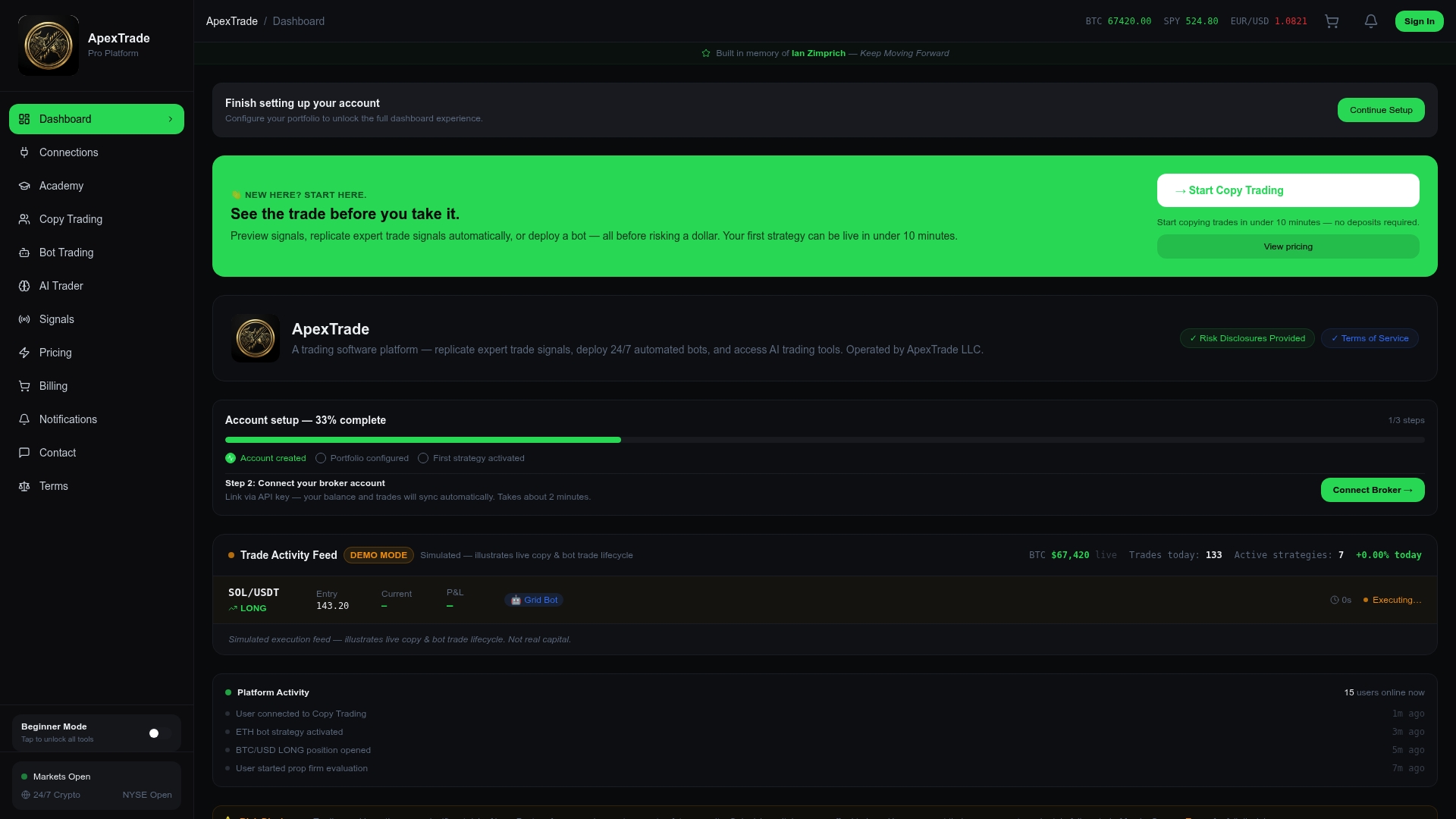
Apex Trade LLC gives you the infrastructure to run multiple strategy types simultaneously through automated bots, trading signals, and copy trading. Whether you're deploying a swing trading bot on crypto pairs, running a mean reversion algorithm on forex, or replicating a proven trader's position trading approach, the platform handles execution 24/7 so your strategies keep working while you don't. With built-in portfolio management, trade history tracking, and multi-account integration, you get the tools to run a serious, adaptive trading operation from one place. Explore Apex Trade LLC and put your strategies to work.
Frequently asked questions
What are the main categories of trading strategies?
The main trading strategy categories include holding period-based types such as scalping, day trading, swing trading, and position trading, plus behavioral approaches like trend following, breakout, mean reversion, and advanced algorithmic methods such as statistical arbitrage and machine learning models.
How do I match a trading strategy to market conditions?
Identify the market regime first: trend vs. ranging conditions determine whether trend following, breakout, or mean reversion logic applies, and using the wrong one in the wrong environment is the most common cause of consistent losses in automated systems.
What are key risk management rules for automated trading?
Production automated systems should include hard-coded risk kill-switch rules such as a daily loss limit around 5%, a maximum drawdown cap near 15%, a per-trade stop loss of roughly 1.5%, and a maximum portfolio risk per trade of about 2%.
How important is backtesting quality for automated strategies?
Backtesting requires clean data, realistic cost modeling covering spreads, fees, and slippage, and out-of-sample validation to prevent overfitting and ensure real-world reliability before live deployment.