

Most traders assume that plugging in an AI bot is like hiring a tireless employee who prints profits around the clock. That assumption leads to costly surprises. AI's practical role in trading is actually "augmented" across multiple stages of the trading pipeline, not a single model making every decision end-to-end. Understanding where AI genuinely helps, where it stumbles, and how to build the right workflow around it is what separates traders who scale profitably from those who blow up their accounts chasing automation myths.
Table of Contents
- How AI fits into the modern trading pipeline
- What AI actually does and what it can't do yet
- Risks, automation pitfalls, and how to control them
- Best practices for embedding AI in your trading strategy
- Why AI alone isn't enough: Our perspective after years in algorithmic trading
- Elevate your trading with AI-powered tools
- Frequently asked questions
Key Takeaways
| Point | Details |
|---|---|
| AI is an enabler | AI's role in trading is to automate and speed up parts of the workflow, not replace human decision-making. |
| Know the limitations | Current AI tools excel at some tasks but often fall short in robust price reasoning and adapting to new markets. |
| Human oversight required | Consistent results depend on ongoing validation, human intervention, and scenario awareness. |
| Risk management is crucial | Proper controls—testing, monitoring, and boundaries—help prevent catastrophic automation errors. |
| Embed AI in your workflow | Long-term advantage comes from integrating AI thoughtfully into a disciplined trading process. |
How AI fits into the modern trading pipeline
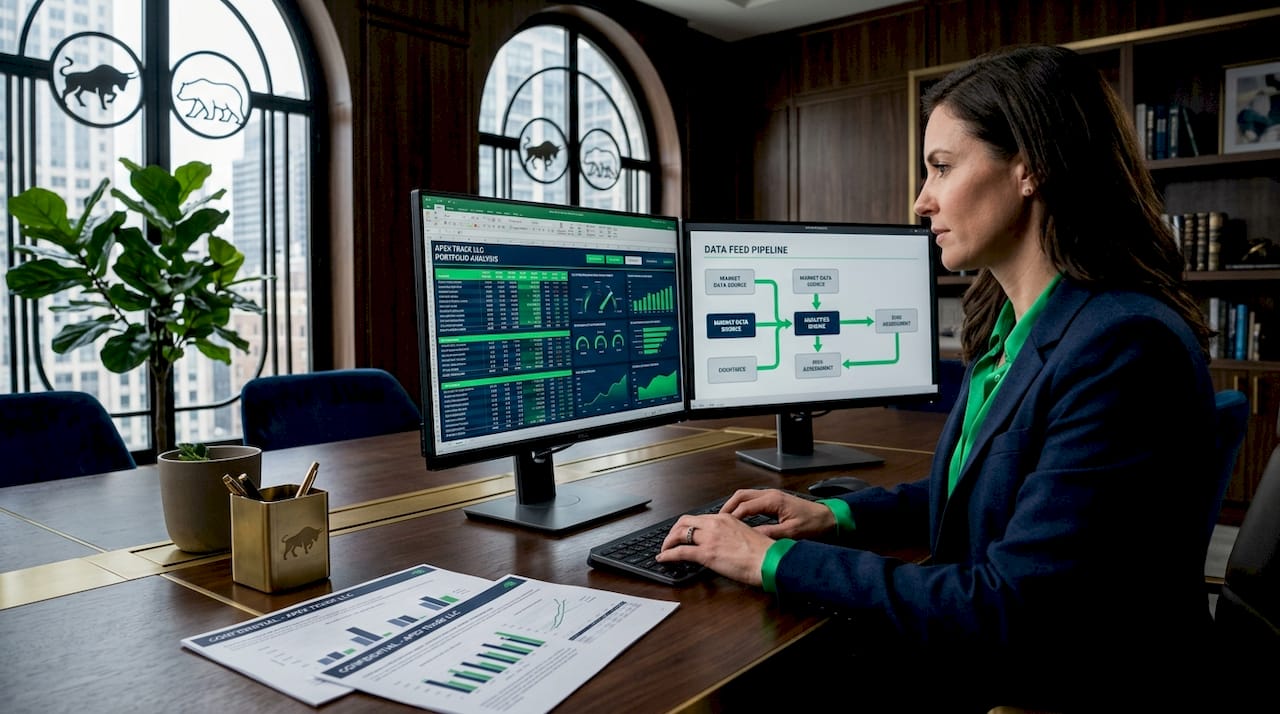
After showing the true complexity behind "AI in trading," let's clarify where it fits into real trading operations. The pipeline is not a single button. It is a sequence of interconnected stages, each with its own data requirements, failure modes, and opportunities for AI to add measurable value.
The AI-augmented trading pipeline breaks down into five distinct stages. Each stage has a specific job, and AI plays a different role at each one.
| Stage | What happens | AI techniques applied |
|---|---|---|
| Data ingestion | Collecting price, volume, news, and alternative data | NLP parsers, data normalization models |
| Signal extraction | Identifying patterns and generating trade signals | ML classifiers, deep learning, LLMs |
| Risk management | Sizing positions, setting stops, managing drawdown | Reinforcement learning, statistical models |
| Trade execution | Routing orders, minimizing slippage, timing fills | Execution algorithms, latency optimization |
| Performance review | Analyzing results, detecting drift, retraining models | Anomaly detection, attribution models |
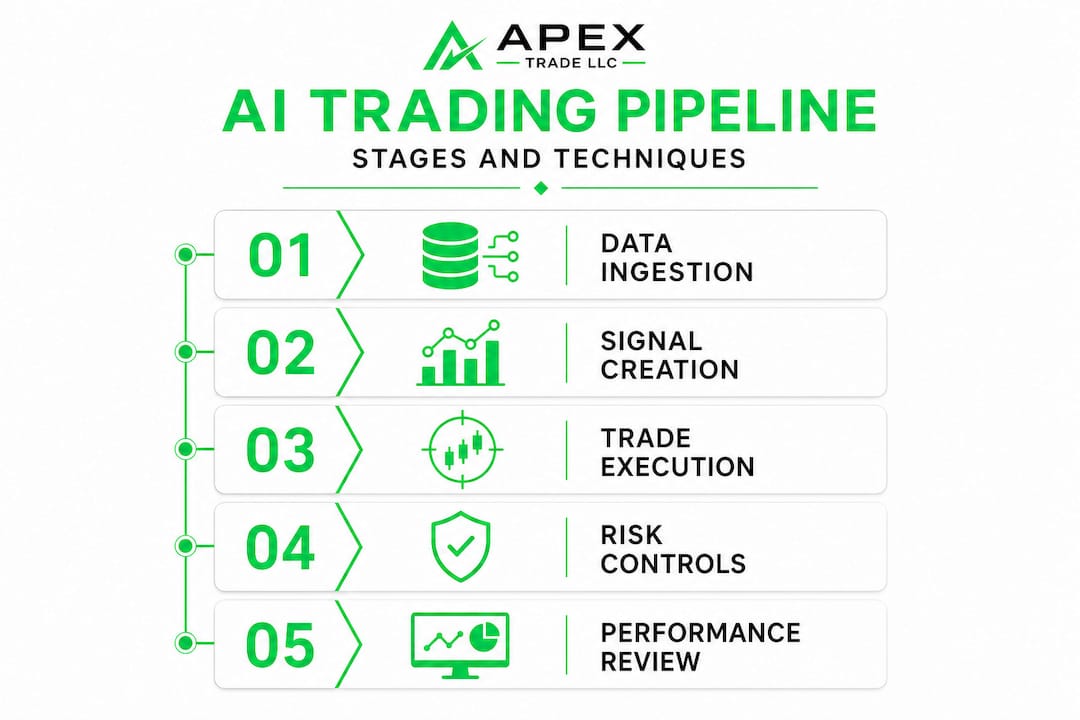
The key insight here is that AI-powered bot trading shines most at data ingestion and signal extraction, where it can process volumes of information no human could handle manually. A bot scanning 500 crypto pairs for momentum signals at 3 a.m. is genuinely useful. A bot "deciding" how much of your portfolio to risk without guardrails is genuinely dangerous.
Critical considerations for each stage:
- Data ingestion: Garbage in, garbage out. AI cannot fix bad data. Survivorship bias in historical datasets will produce signals that look great in backtests and fail in live markets.
- Signal extraction: More features do not mean better signals. Overfitting is the silent killer of AI trading strategies, especially when training on limited crypto data.
- Risk management: Position sizing rules must be hardcoded as constraints, not left entirely to a model that has never experienced a black swan event.
- Trade execution: Slippage and fees eat small edges fast. Always factor realistic transaction costs into any AI-generated signal evaluation.
- Performance review: Model drift is real. Markets change, and a model trained on 2022 volatility regimes may behave erratically in a low-volatility 2026 environment.
Pro Tip: Even the most sophisticated embedding AI tools in trading workflows require a human in the loop for scenario planning and override decisions. Automation accelerates execution; it does not replace judgment.
What AI actually does and what it can't do yet
Knowing the pipeline, let's separate the hype from the reality, detailing which trading problems AI solves well and where it falls short.
AI and large language models (LLMs) have genuinely transformed parts of the trading workflow. They can generate backtesting code in seconds, parse earnings reports for sentiment, and help traders prototype strategies faster than ever before. But there is a hard ceiling on what current AI can reliably do.
Research shows that LLMs can scaffold trading infrastructure like generating code for backtesters, but they still struggle with robust reasoning about prices, inventory, and risk, with error rates that differ by orders of magnitude compared to human experts. That is not a minor gap. It means you should use AI to build and accelerate your workflow, not to outsource the core reasoning about whether a trade makes sense.
| Capability | AI strength | AI limitation |
|---|---|---|
| Processing large datasets | Excellent | Requires clean, structured input |
| Generating code/infrastructure | Strong | May produce plausible but incorrect logic |
| Sentiment analysis | Good for broad signals | Misses sarcasm, context, market nuance |
| Price/risk reasoning | Weak | High error rates in edge cases |
| Market adaptation | Poor under stress | Behaves like fixed strategy under adversarial conditions |
| Pattern recognition | Strong in stable regimes | Breaks down in regime changes |
The adaptability problem is particularly striking. Many AI agents behave like fixed strategies under adversarial conditions. In crypto stress tests, 7 of 12 models scored around 33 with less than a 1-point variation, meaning they essentially behaved identically regardless of what the market threw at them. That is the opposite of adaptive trading.
"Simple strategies have high pass rates in controlled benchmarks, but performance degrades sharply when complexity, adversarial conditions, or real market frictions are introduced. Benchmark scores do not translate directly to live trading performance."
This matters enormously for anyone evaluating AI-powered trading strategies. A model that scores well on a benchmark may still fail spectacularly in live markets because benchmarks rarely capture the full spectrum of market microstructure, liquidity gaps, and regime shifts you will actually encounter.
Pro Tip: Always run your own out-of-sample validation before trusting any AI strategy. Published benchmark results are a starting point for research, not a guarantee of real-world performance.
Risks, automation pitfalls, and how to control them
With AI's promise comes new risks. Here's how to recognize and proactively mitigate the biggest hazards of trading automation.
Automation amplifies both your edge and your mistakes. A manual trader who makes a bad call loses on one trade. An automated system running the same bad logic across dozens of positions simultaneously can wipe out a significant portion of a portfolio before you even notice. AI pipelines can fail due to market microstructure frictions, and costs and slippage can erase small edges entirely, while automated systems can produce large losses if not monitored and validated continuously.
The top automation risks every trader needs to understand:
- Lack of oversight: Automated systems running without real-time monitoring can compound errors at machine speed.
- Overfitting: A model that learned the past perfectly often fails the future. More parameters mean more ways to fit noise.
- Slippage and transaction costs: A strategy showing 0.3% edge per trade can turn negative once realistic spreads and fees are applied.
- Runaway losses: Without hard position limits and drawdown circuit breakers, a malfunctioning bot can exhaust capital rapidly.
- Model staleness: Markets evolve. A model trained six months ago may be operating on stale assumptions today.
Here is a practical risk-control workflow you can implement right now:
- Test rigorously in simulation. Run your strategy across multiple historical periods, including crisis periods like March 2020 and the 2022 crypto winter.
- Validate with out-of-sample data. Reserve at least 20% of your data for validation that the model never saw during training.
- Paper trade before going live. Forward testing in a simulated environment catches real-time edge cases that backtests miss.
- Monitor live performance daily. Set alerts for drawdown thresholds, unusual trade frequency, or unexpected position sizes.
- Intervene decisively. If a system behaves outside expected parameters, shut it down first and investigate second. Never assume it will self-correct.
Warning signs that require immediate attention:
- Trade frequency suddenly doubles or drops to zero without a market explanation
- Drawdown exceeds your predefined maximum threshold within a single session
- Slippage on fills is consistently higher than backtested assumptions
- The system takes positions in correlated assets simultaneously, amplifying directional risk
- Performance diverges sharply from backtested expectations in the first two weeks of live trading
"Rigorous backtesting and continuous live monitoring are not optional steps in AI trading. They are the infrastructure that keeps automation from becoming a liability."
Setting up risk management for automated trading with proper account controls, position limits, and real-time monitoring is not a luxury. It is the foundation that makes everything else sustainable.
Best practices for embedding AI in your trading strategy
Moving from risks to practical action, here's how you can embed AI safely and effectively into your own trading approach.
The traders who extract durable value from AI are not the ones with the most sophisticated models. They are the ones who build disciplined workflows around those models. Established asset managers frame AI's differentiator as speeding information processing, and they emphasize that durable edge comes from oversight, embedding AI into workflows, and human judgment, not from treating AI as a turnkey autopilot.
Follow these steps to integrate AI into your strategy effectively:
- Define your objectives clearly. Are you building a signal generator, an execution optimizer, or a risk monitor? Each requires a different architecture and different success metrics.
- Build a clean data pipeline first. Before any model training, establish reliable data feeds with proper normalization, timestamp alignment, and outlier handling. This step takes longer than most traders expect and is worth every hour invested.
- Start with simple, interpretable models. A well-tuned moving average crossover with an AI-generated filter often outperforms a black-box deep learning model in live trading because you can understand and fix it when it breaks.
- Always include realistic transaction costs. Model every strategy with actual spread estimates, exchange fees, and expected slippage. If the edge disappears after costs, the strategy is not viable regardless of how impressive the raw signals look.
- Forward test before committing capital. Run your strategy in live market conditions with paper money for at least four to six weeks. This catches regime-specific failures that historical data cannot reveal.
- Monitor for model drift continuously. Set up automated alerts that flag when live performance deviates from expected statistical ranges. Markets shift, and your model must be updated to match.
The critical mindset shift is treating AI as a living component of your workflow, not a static deployment. Analyzing unstructured data with AI, like news feeds, earnings transcripts, and social sentiment, is one of the highest-value applications because it processes information you simply cannot read fast enough manually. But even that requires regular recalibration as language patterns and market narratives evolve.
Pro Tip: Human judgment remains most critical at the edges: during major macro events, earnings seasons, and sudden liquidity crises. These are exactly the moments when AI models trained on "normal" market behavior are most likely to fail. Keep your override protocols ready and practiced.
Why AI alone isn't enough: Our perspective after years in algorithmic trading
You've got the blueprint for leveraging AI. Now here is an honest perspective you won't often hear elsewhere.
Most of the conversation around AI trading focuses on capability: what models can do, how fast they execute, how many data points they process. That framing misses the deeper challenge. The real question is not whether AI can generate signals. It is whether your entire system, including the human layer, can stay profitable as markets adapt to the fact that AI is now everywhere.
Here is the uncomfortable truth: when AI strategies become widespread, they start competing with each other. If AI agents become widespread and behave in correlated ways, scenario analysis becomes crucial because those agents could amplify market selloffs in ways that no individual model's risk parameters anticipated. This is the herding problem, and it is not hypothetical. It is the logical endpoint of everyone running similar optimization objectives on similar data.
What does this mean practically? It means your edge increasingly comes from the parts of your workflow that are not commoditized. Your data sources, your risk framework, your execution logic, and critically, your ability to recognize when the market environment has changed and your model is now part of the problem rather than the solution.
We have seen traders deploy sophisticated AI trader strategies that worked brilliantly for six months and then failed suddenly, not because the model was bad, but because enough other participants had converged on similar signals. The edge was arbitraged away. The traders who survived that transition were the ones who had built monitoring systems sensitive enough to detect the decay early and human judgment disciplined enough to act on it.
AI is a genuine force multiplier in trading. It processes more information, executes faster, and removes emotional bias from rule-based decisions. But force multipliers amplify the quality of your underlying framework. A weak framework automated is just a faster way to lose money. A strong framework, built on clear objectives, disciplined validation, and honest risk management, becomes genuinely scalable with AI behind it.
The traders who win long-term are not the ones who trust AI the most. They are the ones who understand it deeply enough to know exactly when not to trust it.
Elevate your trading with AI-powered tools
If you've read this far, you understand that AI in trading is about building the right infrastructure, not flipping a switch. The next step is putting that infrastructure to work with tools designed for serious traders.
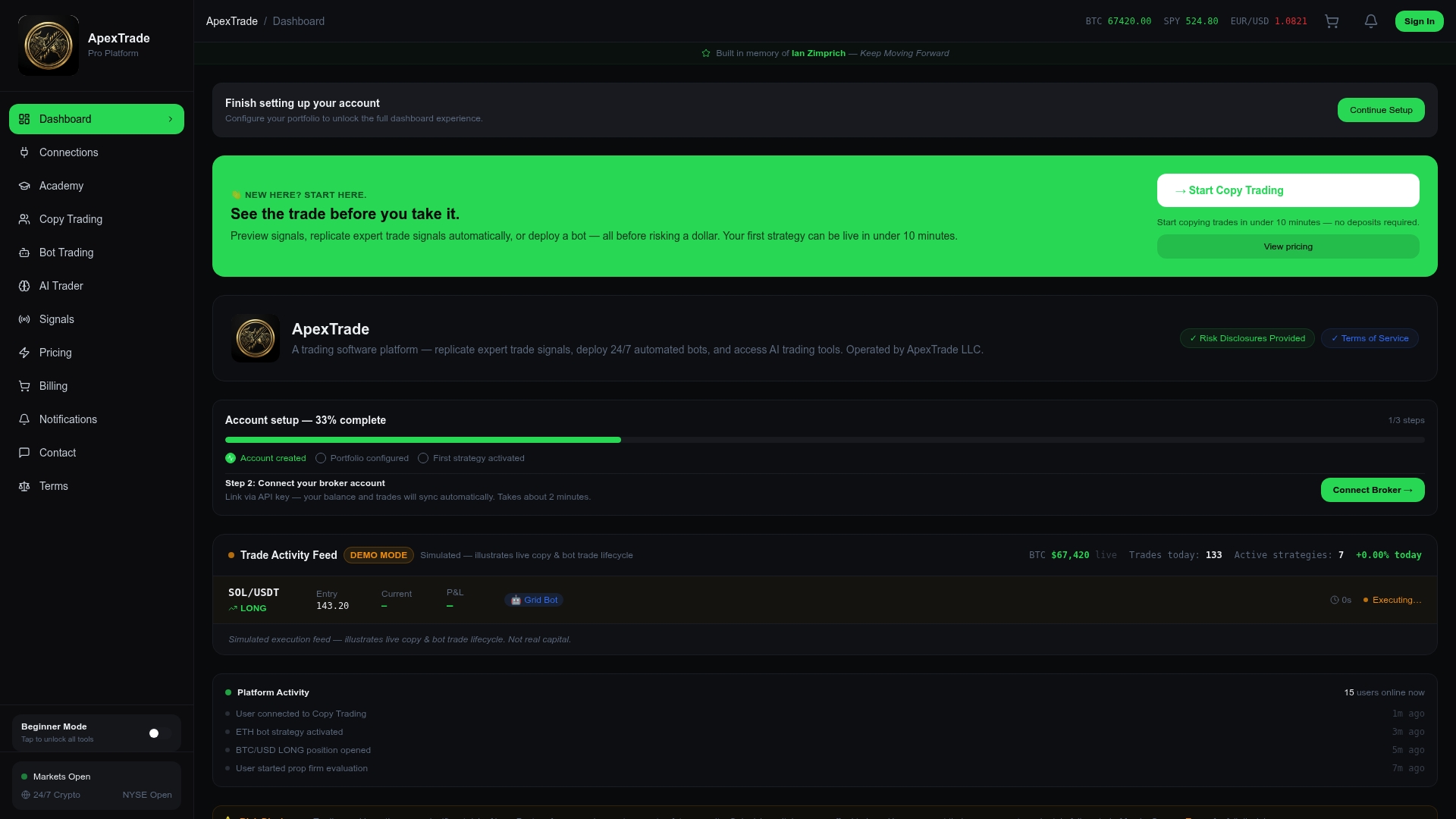
Apex Trade LLC Platform gives you the building blocks to implement everything covered in this article. Deploy automated bot trading strategies that run 24/7 across crypto, stocks, and forex, with the controls and monitoring capabilities that keep automation safe. Use AI-driven copy trading to replicate proven strategies while you build your own edge. Connect and manage multiple markets through secure connected trading accounts with portfolio-level visibility. The platform is built for traders who take automation seriously and want the infrastructure to match their ambition.
Frequently asked questions
Can AI fully automate my trading with no human oversight?
Current AI tools still require human guidance and oversight for reliable results, especially in volatile or shifting markets. AI's role in trading is augmented across the pipeline rather than fully autonomous, meaning human judgment remains a critical layer.
What are the main risks of using AI in trading?
Main risks include automation errors, unanticipated market shifts, and losses from models that fail in edge cases. AI pipelines can fail due to market microstructure frictions, and without proper monitoring, those failures can escalate quickly.
How can I ensure my AI trading system adapts to new market conditions?
Embed ongoing validation, monitor for model drift, and regularly update your infrastructure for market shifts. LLMs and AI agents struggle with robust market adaptation, which means the human oversight layer is what keeps your system current.
Is it possible to gain a long-term edge with AI trading?
Yes, but long-term edge depends on embedding AI in disciplined workflows and leveraging human judgment alongside the models. Durable edge comes from oversight and workflow integration rather than treating AI as a turnkey trading autopilot.
What markets are best suited for AI-powered trading strategies?
AI strategies are actively used in cryptocurrencies, stocks, and forex, but performance depends heavily on data quality, liquidity, and how well the model fits the specific market's behavior patterns.