
Consistent profitability in forex trading is harder than most people expect, especially when you layer in automated tools and algorithmic systems that can execute hundreds of decisions per day. The promise of automation is real: bots never sleep, they remove emotional bias, and they can scan multiple currency pairs simultaneously. But automation also amplifies every flaw in your strategy. A poorly sized position executed 500 times a week does far more damage than a single bad manual trade. This article delivers field-tested, expert-backed tips that combine disciplined risk management with smart algorithmic practices to help you trade better, not just faster.
Table of Contents
- Understand position sizing and risk management
- Integrate stop-losses and dynamic exposure controls
- Backtest rigorously and mind real-world execution costs
- Avoid overfitting and enhance strategy robustness
- Monitor, control, and adapt live algorithmic performance
- Why the best forex systems thrive on discipline, not magic formulas
- Boost your forex results with smart automation
- Frequently asked questions
Key Takeaways
| Point | Details |
|---|---|
| Limit risk per trade | Never risk more than 2–3% of your account on a single position for long-term survival. |
| Account for real costs | Backtesting must include slippage, spread, and commissions to reflect real-world returns. |
| Avoid overfitting | Keep algorithms simple and always validate performance on out-of-sample data. |
| Use automated controls | Deploy drawdown limits and kill-switches to halt trading and avoid catastrophic loss. |
Understand position sizing and risk management
With the core challenge defined, the first step is mastering risk control. Position sizing is not a secondary concern. It is the single most important variable that determines whether your account survives long enough to be profitable.
Position sizing in forex is central to risk management, and most professional guides recommend limiting risk per trade to roughly 2% or less of your total account balance, with size calculated from your stop-loss distance. That 2% rule is not arbitrary. It means you would need to lose 50 consecutive trades to wipe out your account, a scenario that gives your edge time to play out over a large sample of trades.
Here is a straightforward process for calculating position size before every trade:
- Define your account risk in dollars. If your account is $10,000 and you risk 1.5%, your maximum loss per trade is $150.
- Set your stop-loss distance in pips. Suppose your stop is 30 pips away from entry.
- Calculate pip value. For a standard lot on EUR/USD, each pip is worth approximately $10. For a mini lot, it is $1.
- Divide dollar risk by pip value times stop distance. $150 divided by (30 pips x $1 per pip) equals 5 mini lots.
- Confirm the position before entry. Never estimate. Run the calculation every time.
Oversized trades are the top killer of forex accounts, and this is especially true in automated systems. A bot that places trades without a position-sizing module can blow through your portfolio risk controls during a volatile news event in minutes. The fix is to hard-code your risk percentage into the algorithm so that every order is sized correctly regardless of market conditions.
"The goal of position sizing is not to maximize profit on any single trade. It is to keep you in the game long enough for your statistical edge to produce results over hundreds of trades."
Pro Tip: Build a simple spreadsheet or use a position-size calculator that pulls live pip values. Pre-calculate every trade before you submit the order, even when using a bot. Audit your bot's sizing logic monthly to confirm it is still within your risk parameters.
One common pitfall is the difference between discretionary and automated sizing. In discretionary trading, emotions push traders to increase size after a winning streak. In automated systems, the risk is that a poorly coded formula uses a fixed lot size instead of a percentage of current equity. As your account grows or shrinks, a fixed lot size becomes either too conservative or dangerously large. Always use dynamic sizing tied to current account equity.
Integrate stop-losses and dynamic exposure controls
Once you have risk sizing set, automating and refining exits is the next priority. A stop-loss is not just a safety net. It is the mechanism that translates your risk percentage into a real, enforceable limit on every trade.

Position size from account risk and stop-loss placement work together: your stop-loss distance determines the maximum loss per trade, and your position size is calculated backward from that number. This means your stop placement must be logical, based on market structure, not on how much you want to lose.
Here is a step-by-step method for setting stops programmatically:
- Identify the nearest structural level. Use swing highs, swing lows, or key support and resistance zones as your stop anchor.
- Add a volatility buffer. Use the Average True Range (ATR) indicator to add a cushion beyond the structural level. A common formula is: stop distance = structural level + 0.5 x ATR.
- Calculate position size from the stop distance. Feed the stop distance into your sizing formula from the previous section.
- Code the logic into your bot. Every new trade order should trigger the ATR calculation and sizing function automatically.
- Review and adjust weekly. Market volatility changes. A stop that worked in a low-volatility environment may be too tight during high-impact news weeks.
Dynamic exposure control goes one step further. When volatility spikes, your ATR-based stop distance increases, which automatically reduces your position size. This means your bot naturally trades smaller during chaotic markets and larger during calm, trending conditions. That is a powerful built-in risk management feature that most retail traders overlook.
Pro Tip: Use ATR on a 14-period setting as your baseline volatility measure. If the current ATR is more than 50% above its 20-day average, consider reducing your maximum risk per trade from 2% to 1% until conditions normalize.
"Discipline with stops consistently beats the 'wide stop, hope for recovery' approach. Every account that has blown up on a single trade had one thing in common: the stop was either absent or ignored."
Using portfolio structuring techniques that enforce stop-loss logic at the account level, not just the trade level, adds another layer of protection. This means capping total open risk across all positions, not just individual trades.
Backtest rigorously and mind real-world execution costs
With protective controls in place, it is essential to validate any strategy before live deployment. Backtesting is where most algorithmic traders develop false confidence, and it is one of the most misunderstood parts of the process.
Backtests commonly overstate performance when they omit realistic execution assumptions. Live degradation from slippage, spread widening, latency, and news-driven gaps can be substantial. A strategy that shows 40% annual returns in a backtest may deliver 15% to 20% in live trading, if it survives at all.
Institutional-grade backtesting consistently emphasizes that execution cost assumptions, including spread, slippage, and commission, change results materially. Ignoring these factors is not a minor oversight. It can cut expected profit in half.
Here is what a robust backtest model must include:
- Spread costs: Use realistic average spreads, not the minimum tick spread shown in your data feed.
- Slippage: Model at least 1 to 3 pips of slippage on entry and exit for liquid pairs. More for exotic pairs.
- Commission: Include broker commissions per lot, both entry and exit.
- Latency: Simulate a realistic order execution delay, typically 50 to 200 milliseconds for retail connections.
- News gaps: Exclude or flag periods around major economic releases where fills are unpredictable.
| Factor | Backtest assumption | Realistic live assumption | Impact on annual return |
|---|---|---|---|
| Spread | 0.1 pip | 1.2 pips average | Reduces return by 8-15% |
| Slippage | 0 pips | 1-2 pips per trade | Reduces return by 5-10% |
| Commission | $0 | $3-7 per lot round trip | Reduces return by 3-8% |
| Latency | Instant | 50-200ms delay | Reduces return by 2-5% |
Reviewing live trading performance data against your backtest projections is the only honest way to calibrate your expectations. If your backtesting and simulations show a smooth equity curve with a profit factor above 3.0, treat that as a warning sign, not a green light. Real markets produce drawdowns, losing streaks, and regime changes that no historical dataset fully captures.
The impact of trading costs on high-frequency strategies is especially severe. A scalping bot that targets 3 to 5 pips per trade can see its entire edge erased by a 2-pip spread plus slippage. Always run a sensitivity analysis: what happens to your strategy if spread doubles? If slippage increases by 1 pip? If the answer is "the strategy stops being profitable," you do not have a robust edge.
Avoid overfitting and enhance strategy robustness
With backtesting in perspective, the next step is developing systems that endure changing markets. Overfitting is the silent killer of algorithmic forex strategies. It happens when you optimize a strategy so precisely to historical data that it stops working the moment market conditions shift even slightly.
Overfitting is a primary failure mode in expert advisor (EA) development. Too many optimized parameters cause strategies to fail out-of-sample, meaning they look brilliant in testing and collapse in live trading.
Here is a checklist of overfitting red flags to watch for:
- More than 5 to 7 free parameters. Each additional parameter gives the optimizer more ways to curve-fit noise.
- Profit factor above 3.0 in backtests. Real strategies rarely sustain this in live markets.
- Very short testing period. A 6-month backtest is not sufficient to validate a strategy across multiple market regimes.
- No out-of-sample testing. If you optimized on all available data, you have no honest performance benchmark.
- Strategy only works on one specific pair or timeframe. Robust strategies tend to show some edge across related instruments.
| Trait | Overfit strategy | Robust strategy |
|---|---|---|
| Parameter count | 10 or more | 3 to 5 |
| Backtest profit factor | 3.5+ | 1.5 to 2.5 |
| Out-of-sample performance | Collapses | Holds within 30-40% of in-sample |
| Market regime adaptability | Fails in new conditions | Degrades gradually |
| Live trading outcome | Sharp drawdown quickly | Performs near backtest expectations |
Walk-forward analysis is the gold standard for strategy validation. The process divides your historical data into sequential windows. You optimize on the first window, then test on the next unseen window, then roll forward and repeat. This simulates how the strategy would have performed as it encountered new data over time, giving you a far more honest performance picture.
Pro Tip: Limit your strategy to a maximum of 5 free parameters. Test every version on at least 12 months of out-of-sample data before considering live deployment. Use EA robustness training resources to build a systematic validation workflow.
Monitor, control, and adapt live algorithmic performance
Even the best-developed system needs vigilant ongoing control. Deploying a bot and walking away is one of the most dangerous mistakes in algorithmic trading. Markets evolve, broker conditions change, and even a well-built strategy will drift from its expected behavior over time.
Risk controls for live bots must include drawdown limits and kill-switch style halts that trigger after repeated failures. These are not optional features. They are mandatory safeguards.
Key monitoring metrics and live adaptation methods include:
- Daily drawdown limit: Set a maximum daily loss, typically 3% to 5% of account equity. If the bot hits this limit, it stops trading for the day automatically.
- Weekly drawdown limit: A broader limit, often 8% to 10%, that triggers a full review before trading resumes.
- Win rate deviation: If your live win rate drops more than 10 percentage points below your backtest average over 50 trades, investigate immediately.
- Average trade duration: Significant changes in how long trades stay open can signal a regime change or execution issue.
- Slippage tracking: Log actual fill prices versus expected prices on every trade. Rising slippage is an early warning sign.
"Drawdown limits and kill switches are not pessimistic features. They are the difference between a temporary losing streak and an account-ending event."
Managing drawdowns proactively means reviewing your bot's behavior daily, not just when something goes wrong. Use trade monitoring signals to get real-time alerts when your system deviates from expected parameters.
Pro Tip: Keep a daily deviation log. Every time your bot behaves differently from what you expected, write it down. After 30 days, review the log for patterns. You will almost always find actionable insights that improve your system's long-term performance.
Why the best forex systems thrive on discipline, not magic formulas
Here is the uncomfortable truth that most algorithmic trading content avoids: no automated system is a set-it-and-forget-it solution. Every "magic formula" that traders discover eventually degrades. Markets adapt, liquidity conditions shift, and the edge that worked brilliantly in 2023 may be arbitraged away by 2025.
The traders who sustain long-term success are not the ones who find the best algorithm. They are the ones who build the best process around their algorithms. That process includes weekly strategy reviews, monthly parameter audits, quarterly out-of-sample validation, and a willingness to retire strategies that no longer perform.
Expect live underperformance relative to backtests unless you model execution frictions and guard against overfitting. Treat smooth equity curves or extreme profit factors as potential red flags rather than proof of edge. This is not pessimism. It is the realistic mindset that separates professionals from hopeful amateurs.
Seasoned algorithmic traders build workflows that treat every live trade as a data point. They log errors, track deviations, and run continuous improvement cycles. They also know when to stop. Shutting down a strategy that has stopped working is not failure. It is discipline.
The human edge in algorithmic trading is not superior code. It is superior judgment about when to trust the code and when to override it. Reviewing performance realism insights regularly keeps that judgment sharp and grounded in actual results rather than optimistic projections.
Trust your system, but verify it constantly. Not even the best bot can replace the expertise and discipline of a trader who genuinely understands what their algorithm is doing and why.
Boost your forex results with smart automation
Putting these tips into practice requires more than knowledge. It requires the right tools working together in a structured, disciplined environment.
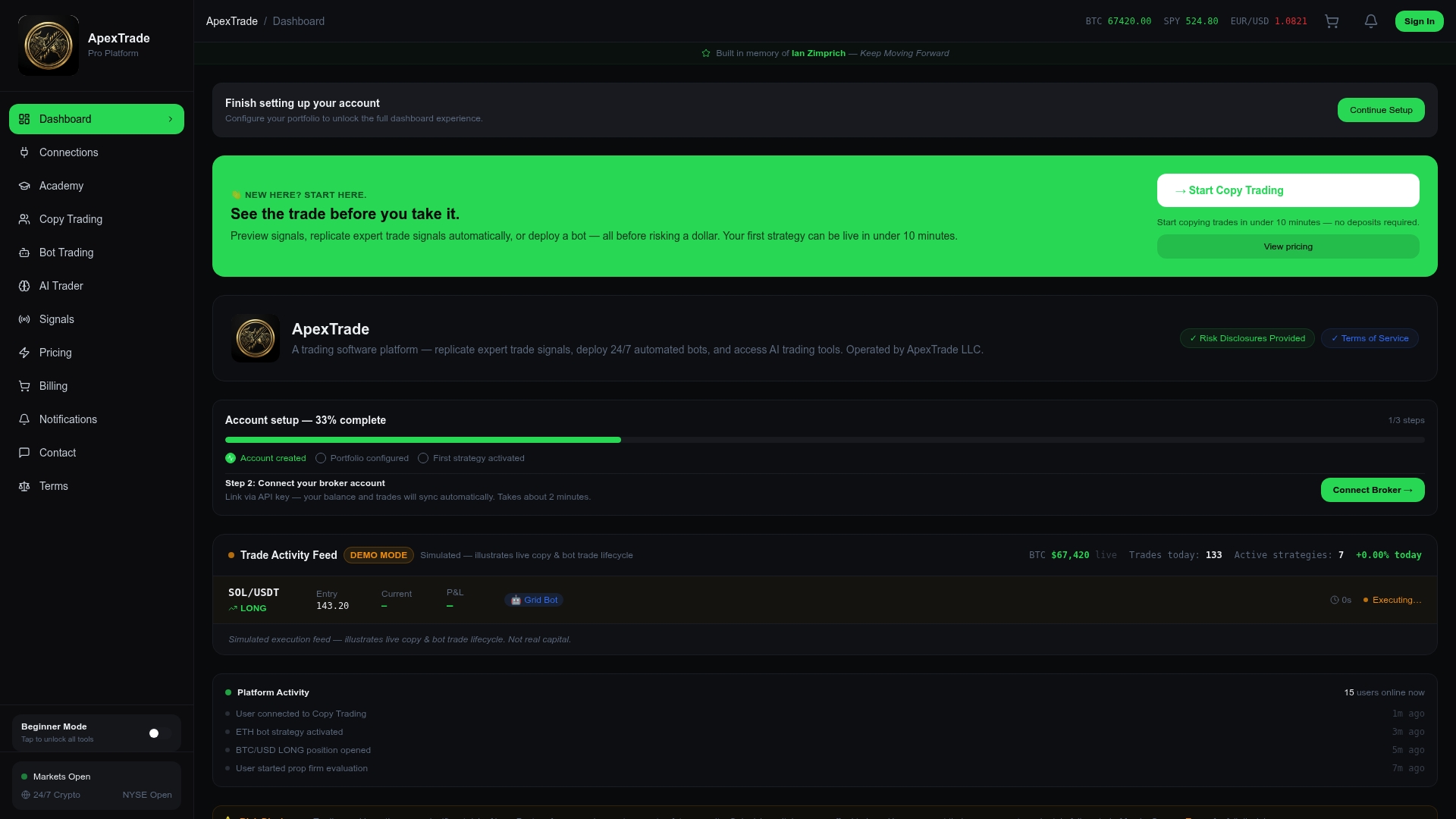
Apex Trade LLC's cutting-edge bot trading solutions are built with these exact principles in mind, offering drawdown controls, dynamic position sizing, and real-time monitoring that align with professional risk management standards. The AI trader platform adds an adaptive layer that adjusts strategy behavior based on live market conditions, helping you avoid the regime-change pitfalls that sink static algorithms. For traders who want to learn from proven performers, copy trading options let you replicate disciplined, vetted strategies while you build your own algorithmic expertise. Every feature is designed to support the kind of structured, process-driven trading that actually produces consistent results over time.
Frequently asked questions
How much should I risk per forex trade?
Most experts recommend risking no more than 2% to 3% of your total account balance on any single trade, with position sizing based on stop-loss distance rather than a fixed lot size.
Why do my backtested results look better than live trading?
Backtests often ignore real-world execution factors like slippage, spread, and latency, and live degradation from these factors can reduce expected performance by 30% to 50% compared to historical results.
What are the signs that my trading algorithm is overfitted?
Too many optimized parameters or a strategy that performs well only on historical data are common signs, and overfitting in EA development almost always causes strategies to fail when exposed to new, unseen market data.
How can I protect my account from major losses using trading bots?
Set strict drawdown limits and implement automatic kill-switches to halt trading after a series of losses, since drawdown limits and kill-switch halts are the most reliable safeguards against catastrophic account damage in live algorithmic trading.