

Social trading is widely misunderstood. Most traders hear the term and picture someone passively copying another person's trades, sitting back, and watching profits roll in. That mental image misses almost everything important about how social trading actually works. The reality is far more active, collaborative, and strategically rich. Whether you're a newer trader building your market intuition or a seasoned professional validating signals against community consensus, social trading offers a distinct layer of intelligence that purely algorithmic or solo approaches simply cannot replicate.
Table of Contents
- Understanding social trading: A community-powered approach
- Social trading vs. copy trading: Key differences
- Benefits and risks: What traders really gain (and can lose)
- How to start with social trading: Practical steps
- Why most traders misjudge social trading's real value
- Take your trading further with automation, signals, and real-time strategies
- Frequently asked questions
Key Takeaways
| Point | Details |
|---|---|
| Community-driven insights | Social trading leverages collective knowledge, but evaluating the quality of crowd input is essential. |
| Hands-on vs. automated | Social trading involves active choice and discussion, while copy trading tends toward automation. |
| Manage risk proactively | Success in social trading relies on setting personal limits and not blindly following popular traders. |
| No guaranteed profits | Market returns vary, with real-world evidence showing follower underperformance is common in social trading. |
Understanding social trading: A community-powered approach
Social trading is not a single feature. It's an ecosystem where traders share ideas, analyze each other's track records, debate strategies, and make their own informed decisions based on what they observe in the community. That's a meaningful distinction. Social trading differs from copy trading in that it emphasizes community engagement, discussion, and manual decision-making for learning, while copy trading is a more automated, hands-off replication of selected traders' exact trades.

Think of social trading as the financial equivalent of a professional forum where you see not just opinions, but verified track records. You watch how experienced traders structure their trading portfolios under real market conditions, ask questions, and absorb reasoning behind decisions rather than just mirroring the output.
Core elements that define social trading:
- Transparency: Traders share open performance histories, not just cherry-picked wins.
- Community validation: Ideas get tested against collective experience before execution.
- Real-time discussion: Market events are analyzed as they unfold, not after the fact.
- Manual decision input: You observe, evaluate, and then decide. Nothing is forced.
- Cross-asset learning: Discussions span crypto, forex, and stocks simultaneously.
Managing your connected accounts within a social trading context adds another layer of value, letting you compare performance across multiple assets while seeing how community sentiment shifts across markets.
"The traders who extract the most value from social trading are those who treat every shared strategy as raw material, not as a finished instruction."
Pro Tip: Before trusting any community insight, check the trader's drawdown history and consistency over at least 90 days. High returns with extreme drawdowns are red flags regardless of follower counts.
The learning advantage here is compounding. Newer traders absorb decision frameworks, risk management approaches, and market timing logic by watching skilled practitioners explain their thinking in real time. That context is priceless and unavailable from any technical indicator alone.
Social trading vs. copy trading: Key differences
With a foundation in what social trading means, it's essential to clarify how it differs from similar models like copy trading. Both involve learning from other traders, but the mechanics, engagement level, and outcomes are quite different.
| Feature | Social trading | Copy trading |
|---|---|---|
| Decision-making | Manual, informed by community | Automated, mirrors leader's trades |
| Community engagement | High: forums, debates, analysis | Low: set allocations, monitor results |
| Learning curve | Steeper but educational | Shallow, faster to start |
| Control retained | Full | Partial to minimal |
| Ideal user | Learning traders, researchers | Busy professionals, passive investors |
| Risk transparency | High with discussion context | Dependent on platform data |
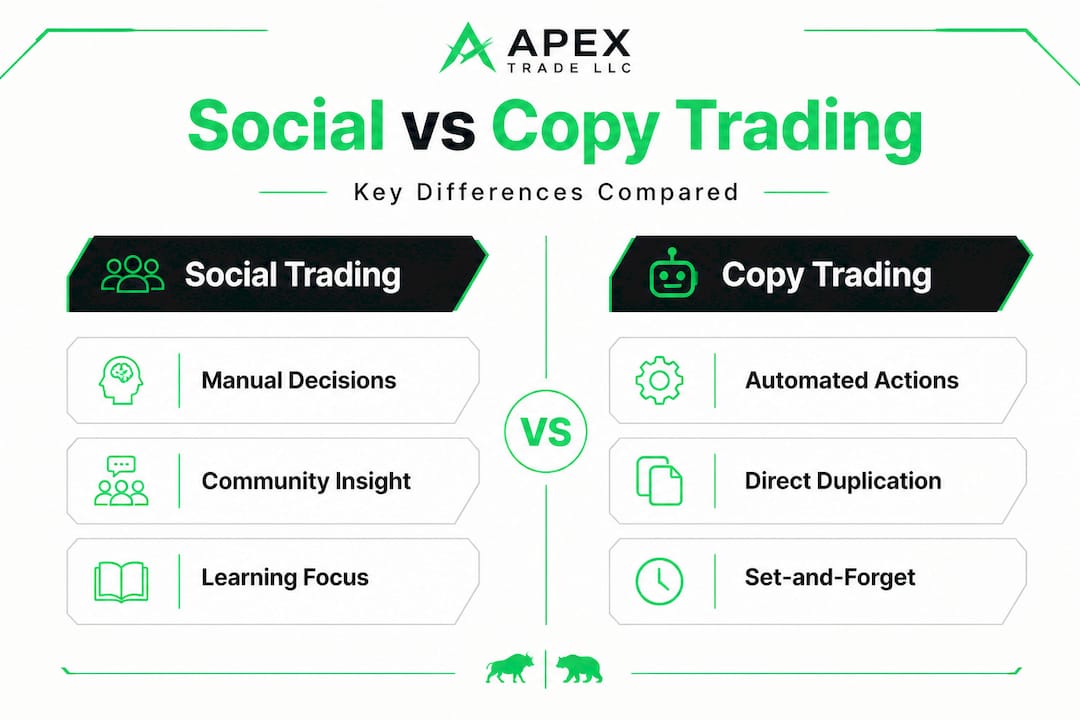
Copy trading works well for traders who want to automate strategy execution without active research. Social trading suits those who want the community's input to sharpen their own thinking. Neither is universally better. The right choice depends entirely on what you're trying to achieve.
When to choose each style based on your goals:
- Choose social trading if you're actively building market knowledge and want to understand why trades happen, not just that they happened.
- Choose copy trading if you have a verified leader whose track record aligns with your risk tolerance and you want hands-free execution.
- Choose social trading when you're operating in volatile conditions and want multiple perspectives before committing capital.
- Choose copy trading when your research time is limited but you still need consistent market exposure.
- Blend both when you want automated execution on a core strategy while reserving capital to act on manual community signals.
Pro Tip: A hybrid approach is often underrated. Using copy trading for your core allocation while actively monitoring a social trading community for emerging setups lets you capture automation efficiency without losing strategic awareness.
The blend of manual and automated elements is genuinely powerful. Many professional traders run automated bots on tested strategies while using community discussions to identify emerging opportunities their algorithms haven't yet been trained to catch. It's systematic and adaptive at the same time.
Benefits and risks: What traders really gain (and can lose)
Understanding the differences sets up a crucial discussion: What can you realistically expect to gain or risk by embracing social trading? The honest answer is layered.
Social trading enhances strategies for novices via community insights and automation but requires active risk management. Professionals can leverage it for signal validation, while common pitfalls include overconfidence from audience size and noisy social signals.
Tangible benefits worth noting:
- Accelerated learning: Watching experienced traders reason through positions compresses years of solo learning into months.
- Signal validation: Before acting on your own analysis, seeing community consensus or disagreement adds a real-time sanity check.
- Diversification intelligence: Communities often surface opportunities across asset classes you may not actively monitor.
- Behavioral feedback: Reading how others react to the same data helps you recognize and correct your own cognitive biases.
- Access to niche expertise: Some community members specialize in specific sectors or instruments, providing focused knowledge that generalist platforms can't match.
Tracking your historical performance alongside community benchmarks gives you an objective view of whether social inputs are actually improving your results or just adding noise.
Risks that are often underestimated:
- Herd behavior: When everyone piles into the same trade, liquidity and timing advantages evaporate quickly.
- Overconfidence bias: A popular trader with a massive following may be riding a trend rather than demonstrating edge.
- Execution friction: By the time a social signal reaches you and you act, the entry price can be significantly worse than what the original trader captured.
- Information overload: Too many conflicting signals create paralysis or impulsive decision-making, neither of which helps your bottom line.
- False authority: Follower counts and recent win streaks don't equal long-term skill. Survivorship bias is everywhere in public rankings.
"Treating social trading as a passive income stream is the fastest path to disappointment. It's a tool for active learning and signal verification, not a substitute for strategy." This perspective is backed by empirical caution on follower underperformance caused by execution frictions and behavioral biases.
Layering bot trading on top of social insights can help automate risk controls, ensuring you execute with defined parameters rather than emotionally reacting to community momentum.
Pro Tip: Before following any trader, set hard stop-loss limits on your allocated capital. Never let a social signal override a pre-defined risk threshold. The community's enthusiasm is never a substitute for your own risk controls.
How to start with social trading: Practical steps
Now that you know the upsides and challenges, let's cover exactly how to take your first step into social trading. Starting well is more important than starting fast.
Step-by-step guide to getting started:
- Define your goals first. Are you here to learn, to validate signals, or to supplement an existing strategy? Your answer determines which community features matter most.
- Select a platform with verified performance data. Look for platforms that show real trade history, not just curated highlights. Past data should be auditable.
- Start with a demo account. Test how community signals align with actual market movements before committing real capital.
- Evaluate the community quality. A large community isn't always a good community. Look for depth of discussion, not just volume of participants.
- Follow a small number of traders initially. Three to five traders with diverse approaches gives you meaningful signal without overwhelming noise.
- Track your decisions and their outcomes. Keep a log of every community-informed trade, including why you acted and what happened. This builds self-awareness faster than any other method.
- Gradually increase exposure. As confidence and understanding grow, scale your community-informed positions systematically.
Empirical evidence cautions that follower underperformance is common when traders skip the evaluation phase and jump straight to mirroring signals without understanding the underlying reasoning.
Using trading signals as a complementary layer lets you cross-reference what the community is saying with data-driven alerts, giving you a much more complete picture before you act.
| Question to ask | Why it matters |
|---|---|
| Are past trades fully visible and auditable? | Prevents misleading cherry-picking of results |
| What is the maximum historical drawdown? | Reveals real risk tolerance requirements |
| How active is community discussion? | Signals genuine engagement vs. ghost accounts |
| Are risk controls configurable? | Lets you set personal exposure limits |
| Does the platform show execution timestamps? | Identifies whether entry prices are realistic |
Pro Tip: Use platform analytics to compare a trader's raw return figures against their risk-adjusted metrics like Sharpe ratio. A 40% return with extreme volatility is often less valuable than a 20% return with consistent, controlled drawdowns.
The best starting point is always the fundamentals. Reviewing solid trading basics before you layer community insights on top ensures you can evaluate what you're seeing rather than blindly reacting to it.
Why most traders misjudge social trading's real value
Having walked through practical steps, it's time to step back and examine what most traders miss about social trading's true potential and hidden risks.
Here's the uncomfortable truth: most traders approach social trading looking for shortcuts. They want to find the highest-performing account, click follow, and let the profits arrive. What they actually find is a lesson in how behavioral bias and herd mentality can quietly erode capital in ways that don't show up until significant damage is done.
The follower count myth is one of the most persistent problems in this space. A trader with 50,000 followers is not automatically better than one with 500. What matters is consistency of process, adaptability to changing market conditions, and the depth of reasoning behind each decision. Signal validation data consistently shows that overconfidence scales with audience size, not with actual edge. Popular traders are often rewarded for recent performance in favorable conditions, not for durable skill.
Behavioral biases compound this problem dramatically. When a respected community member posts a strong conviction trade, followers tend to increase position sizes beyond their normal parameters, ignoring their own pre-set risk limits. That's not community intelligence working for you. That's social pressure overriding disciplined thinking.
Another overlooked truth: the real value of social trading isn't in the signals themselves. It's in the reasoning behind them. A trader who explains why they're entering a position, what market structure they're reading, and where they'd exit at a loss teaches you something permanent. A trader who just posts entry and exit prices without context offers nothing replicable when conditions shift.
We've seen traders dramatically improve their independent performance after a period of active social trading engagement, not because they kept copying signals, but because they internalized frameworks for reading market conditions. That's the compounding return on social trading most people never discover because they quit too early or never engage deeply enough.
Your actual performance data is the most honest judge of whether community insights are genuinely improving your results. Review it regularly against your pre-social trading baseline, and adjust your level of community reliance accordingly.
Align social trading with evidence-based strategy building, not with trend chasing or follower worship. When you treat it as an ongoing education platform with real stakes attached, it becomes one of the most powerful tools available in your trading arsenal.
Take your trading further with automation, signals, and real-time strategies
If you've read this far, you understand that social trading's real power lies in combining community intelligence with disciplined, systematic execution. That's exactly the philosophy behind how Apex Trade LLC is built.
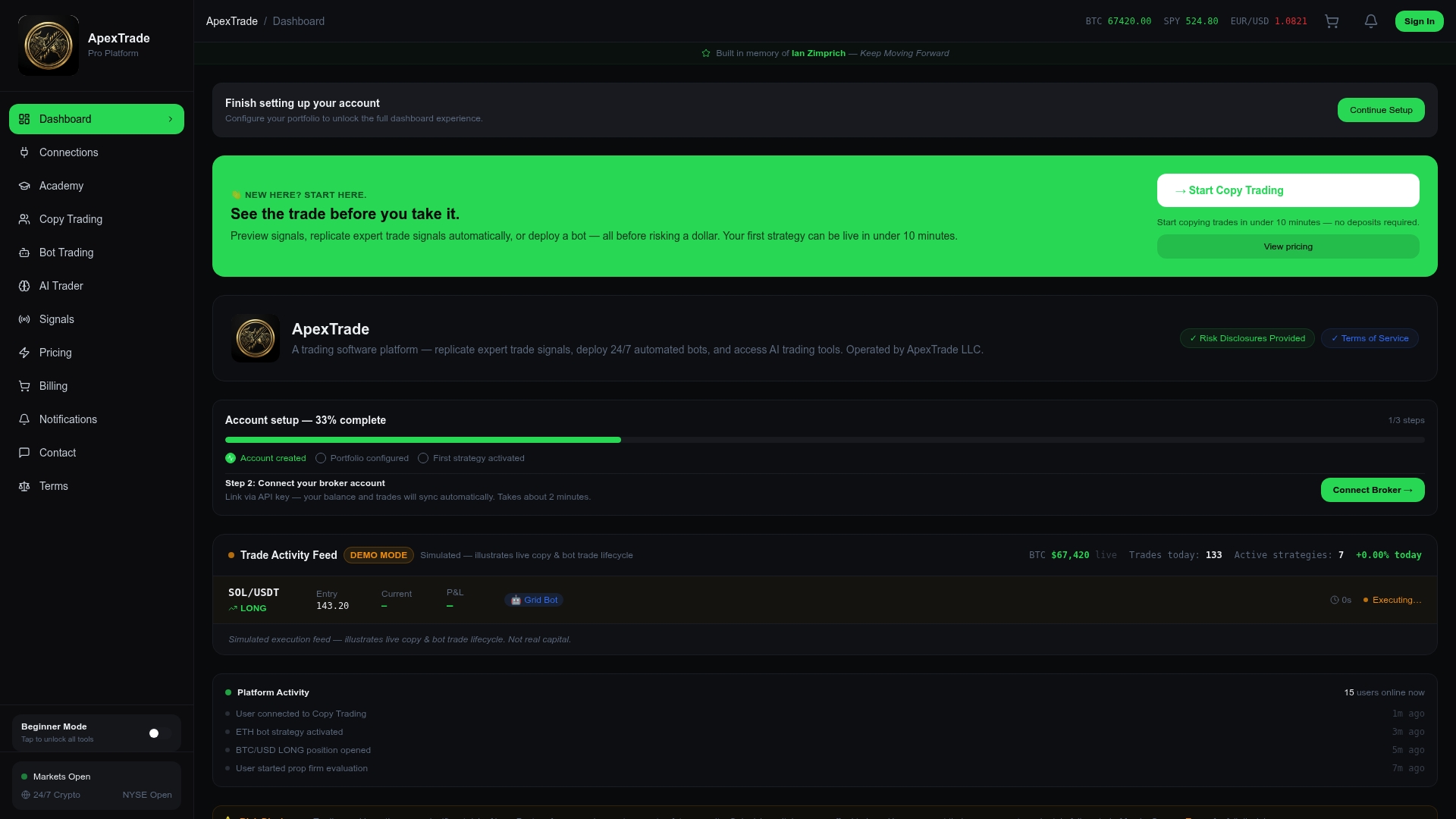
Apex Trade LLC gives you access to bot trading platforms that run 24/7 across crypto, forex, and stocks, so your automated strategies never miss an opportunity while you're engaged in community research. Our copy trading features let you replicate verified trader activity with full control over risk parameters, position sizing, and asset allocation. And when you're ready to go deeper, our full suite of explore trading tools connects signals, bots, and portfolio tracking into one seamless environment built for traders who want results, not just activity.
Frequently asked questions
Is social trading safe for beginners?
Social trading enhances strategies for novices via community insights and automation, but it requires active risk management. Beginners should start small, use demo accounts, and never treat community signals as guaranteed guidance.
Can you make guaranteed profits with social trading?
There are no guaranteed profits in social trading. Empirical evidence shows follower underperformance is common due to execution frictions and behavioral biases that erode the returns seen by the original trader.
How does social trading differ from copy trading?
Social trading emphasizes community discussion, learning, and manual decision-making, while copy trading focuses on automated replication of a selected trader's exact positions with minimal active input required from the follower.
What should I look for in a social trading platform?
Prioritize real-time transparency with auditable trade histories, configurable risk controls, diverse and active community discussions, and robust analytics that distinguish genuine performance from short-term luck.