
Manual trading is a constant battle against yourself. You hesitate on a setup you spent hours planning, overtrade when you're bored, or freeze when markets move fast. These aren't character flaws — they're predictable human responses to uncertainty and financial pressure. Automated trading replaces those impulse decisions with rule-based execution, running your strategy without emotion, fatigue, or distraction. This guide walks you through what automated trading actually is, the tools you need, a step-by-step workflow to get live safely, and the real pitfalls most traders don't talk about until it's too late.
Table of Contents
- What is automated trading and why use it?
- What you need to automate trading: Essential tools and requirements
- The core workflow: How to automate trading in 5 steps
- Integration and execution: Making your strategy work in real markets
- Measuring and refining your automated trading performance
- The uncomfortable truths about automating your trading
- Automate smarter with ApexTrade's proven solutions
- Frequently asked questions
Key Takeaways
| Point | Details |
|---|---|
| Automate step-by-step | Start with a strategy, backtest it, optimize, simulate, and only then go live for safe, structured automation. |
| Use solid safeguards | Protect your capital by enabling demo trading modes, kill switches, and drawdown limits at all times. |
| Monitor performance metrics | Review profit, Sharpe ratio, drawdown, and trade-level results regularly to catch and fix problems quickly. |
| Expect ongoing adjustments | Markets change—no automation is set-and-forget, so refine your strategy with real-world feedback. |
What is automated trading and why use it?
Automated trading, often called algorithmic trading, is the practice of using software to execute trade decisions based on pre-defined rules. As Investopedia explains, automated trading involves coding entry, exit, and position sizing rules, then running them continuously with live market data and safeguards. The software monitors your markets, detects qualifying signals, and submits orders without you needing to be present.
The mechanics are straightforward in concept. You define your conditions — say, "buy Bitcoin when the 20-period moving average crosses above the 50-period moving average, and exit when price drops 2% below entry." The system watches the market, detects when those conditions are true, and acts immediately. There's no hesitation, no second-guessing, and no emotional override.
Here's why traders move to automation:
- Discipline: The system follows your rules every time, not just when you're confident
- Speed: Algorithms execute in milliseconds, far faster than any human reaction
- 24/7 availability: Crypto markets never close; a bot doesn't need sleep
- Multi-market coverage: One system can monitor 10 pairs simultaneously while you focus elsewhere
- Backtesting capability: You can test a strategy on years of historical data before risking a dollar
Understanding AI in trading and how it integrates with rule-based systems gives you a major edge when designing your first automated strategy.
| Feature | Manual trading | Automated trading |
|---|---|---|
| Execution speed | Seconds | Milliseconds |
| Emotion-free execution | No | Yes |
| 24/7 operation | No | Yes |
| Backtestable | No | Yes |
| Multi-market at once | Limited | Yes |
| Consistent rule adherence | Inconsistent | 100% |
Pro Tip: Always simulate your first system in paper mode (a risk-free environment using real market data) before committing real capital. Live markets behave differently than you expect.
What you need to automate trading: Essential tools and requirements
Before writing a single line of code or activating a single bot, you need the right infrastructure. Effective automation requires a reliable platform or broker, access to live market data feeds, clearly defined strategy rules, a robust backtesting engine, and real risk controls in place before going live.
On the hardware side, you need a stable computer with reliable internet. Latency matters. If your bot triggers an order and your connection drops for two seconds, you could miss fills or end up with an unintended open position. Many traders eventually move their bots to cloud servers that stay online 24/7 regardless of local conditions.
For software and platform access, your options fall into three main categories:
| Approach | Best for | Examples | Coding required? |
|---|---|---|---|
| Code your own | Full control, custom strategies | Python with broker API | Yes |
| Third-party bots | Speed, pre-built logic | Bot marketplaces, trading apps | No or minimal |
| Broker platform tools | Beginner-friendly, integrated | Built-in strategy builders | No |
Use trading integration tools to connect your strategy to a broker cleanly and reduce technical friction when setting up your first automated system.
Your broker must support automation specifically. That means API access for programmatic order submission, multiple order types (limit, stop, OCO), and ideally a paper trading or demo environment to test before going live.
Must-have risk controls before you press go:
- Demo mode: Run the strategy without risking real money first
- Kill switch: A manual or automated shutoff that halts all trading instantly
- Drawdown limit: Stop trading automatically if losses exceed a preset threshold
- Position size caps: Prevent the system from betting too large on any single trade
- Alert notifications: Get notified when something unexpected happens
Pro Tip: Not a coder? Choose a broker or platform with built-in visual strategy builders or access to a bot marketplace. You can deploy powerful automated strategies without writing a single line of code.
The core workflow: How to automate trading in 5 steps
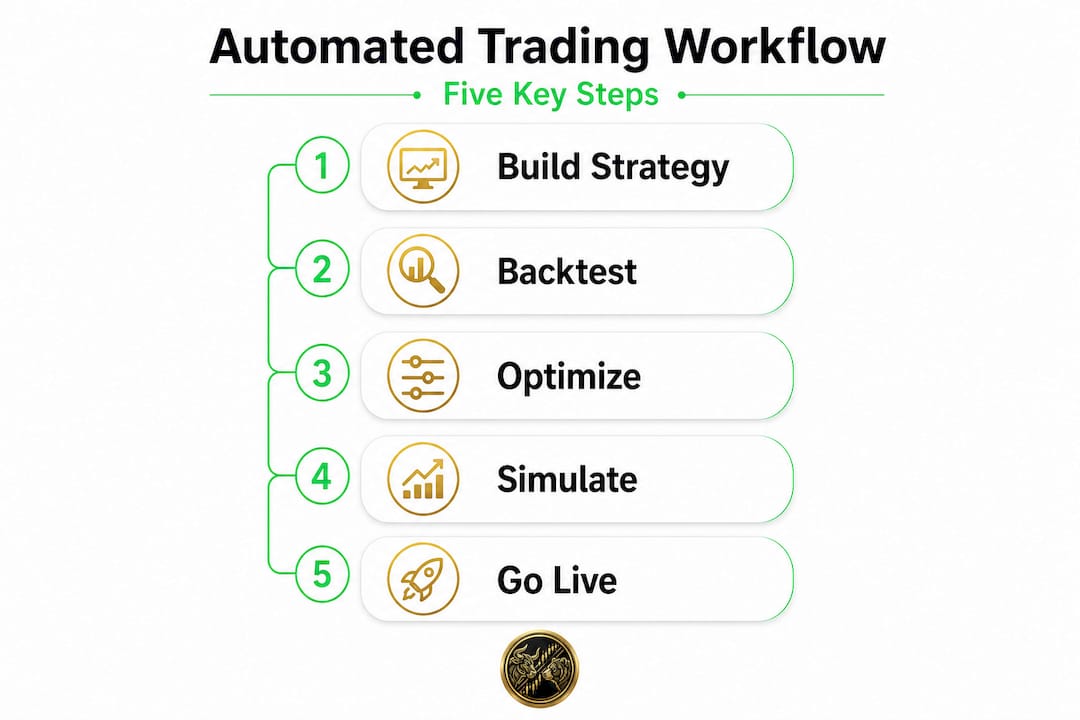
Now that your foundation is ready, here's a step-by-step workflow to safely and effectively automate your trading. A solid quantitative trading approach follows a defined sequence: design the strategy, backtest it, optimize it, validate it through simulation, then implement it live only when results justify the risk.
Here are the five steps in detail:
-
Define your strategy rules clearly. Write out every condition: what triggers an entry, what triggers an exit, how much you risk per trade, and what market conditions disqualify a trade. Vague rules produce inconsistent systems. Be specific — "RSI below 30 on a 4-hour chart AND price above the 200-day moving average" is better than "buy when oversold."
-
Backtest on historical data. Run your rules against past market data to see how they would have performed. Most platforms offer built-in backtesting engines. Look at more than just total return — check how many trades the system made, the distribution of wins and losses, and how it behaved during volatile periods like 2020 or 2022.
-
Optimize and guard against overfitting. Overfitting means tuning your strategy so precisely to historical data that it fails in real markets. Use out-of-sample testing: train your strategy on one time period, then test it on a separate period it has never seen. If performance collapses on the new data, the strategy is overfit and needs rethinking.
-
Simulate live with paper trading. Deploy your strategy in a demo environment using real-time market data but no real money. This reveals issues that backtests miss — slippage on order fills, data feed delays, or unexpected behavior during news events. Run paper trading for at least two to four weeks before considering going live.
-
Go live with hard limits in place. Start with reduced position sizes. Set a daily or weekly drawdown limit that shuts the bot down automatically if losses mount. Monitor the first week closely. As trading bot risk research confirms, backtests often overestimate real performance, and you should always expect some degradation when moving from simulation to live execution.
Warning: The biggest mistake traders make is skipping the paper trading phase because "the backtest looks great." Backtests cannot replicate real-world conditions perfectly. Slippage, partial fills, and data anomalies will affect live results. Never assume backtest results translate directly to live profits.
Reviewing trading workflow steps and forex automation tips gives you a more granular view of how professionals structure this process for different markets.
Pro Tip: When evaluating your backtest, don't just look at win rate. Use multiple metrics together: Sharpe ratio (risk-adjusted return), maximum drawdown (worst peak-to-trough loss), and average win compared to average loss. A system with a 40% win rate can be highly profitable if winners are three times larger than losers.
Integration and execution: Making your strategy work in real markets
Once your system is ready to deploy, here's how to ensure smooth execution and real-world integration for consistent results. Connecting your strategy to a live broker requires API credentials, careful configuration, and a clear understanding of how your platform routes orders.
Start by generating your broker's API keys (unique credentials that allow software to act on your behalf). Most serious brokers, including Interactive Brokers, offer multi-asset API access covering stocks, forex, futures, and crypto with a wide variety of automation and order routing tools. Store your API keys securely — never hardcode them in shared scripts.
Understanding order types is critical for execution quality:
- Market orders: Execute immediately at the best available price; fast but vulnerable to slippage
- Limit orders: Execute only at your specified price or better; preferred for precise entries
- Stop orders: Trigger a market or limit order when price reaches a threshold; used for exits and risk management
- OCO (One Cancels the Other): Pair a take-profit and stop-loss order together so that filling one automatically cancels the other
| Broker/platform feature | Why it matters |
|---|---|
| REST or FIX API access | Enables direct programmatic order submission |
| Paper trading environment | Essential for pre-live testing |
| Multiple order types supported | Gives flexibility for entries, exits, and risk |
| Real-time data feed quality | Affects signal accuracy and execution timing |
| Webhook or alert integration | Allows third-party signals to trigger trades |
| Alert and monitoring system | Notifies you of unexpected behavior quickly |
Once live, set up monitoring alerts that notify you when the bot opens or closes trades, when drawdown thresholds are approached, or when the system hasn't executed in an unusually long time. Automation doesn't mean "set and forget" — the live environment needs eyes on it, even if less frequently than manual trading.
Explore bot trading platforms and the platform summary to understand what integration features a purpose-built automated trading platform provides versus a generic broker interface.
Measuring and refining your automated trading performance
With your strategy running, continual measurement and adjustment are critical for mastering automation and avoiding costly missteps. Many traders launch a bot and check back in a month expecting clean results. What they find instead is a strategy that worked beautifully in testing but has slowly bled money in live conditions. The difference is lack of measurement.
As OANDA's trading research outlines, effective performance evaluation goes well beyond simple profit and loss. Key metrics include the Sharpe ratio (which tells you how much return you're generating per unit of risk), maximum drawdown (the worst loss period the system experienced), win rate, and average trade result. Together, these metrics paint a full picture of whether your system is performing as designed or quietly deteriorating.
Here are the key action steps to improve an existing automated system:
- Review performance weekly, not monthly. Catching a problem after two weeks is far better than discovering it after two months of steady losses.
- Adjust position sizing based on volatility. If the market is more volatile than when you built your strategy, reduce position size proportionally to maintain similar risk levels.
- Add filters to reduce low-quality signals. If you notice the system trades poorly during certain market conditions (say, news events or very low-volume periods), add a filter that prevents trading during those windows.
- Rebalance strategy parameters when market conditions shift. A strategy tuned for 2023 trending markets may perform poorly in a range-bound 2025 environment. Periodic re-optimization (without overfitting) keeps the strategy relevant.
- Pause and investigate before increasing capital. If drawdown is accelerating or win rate drops sharply, halt the bot and review before adding funds. The worst decision is doubling down on a failing system.
A critical insight most guides avoid: even well-tested, profitable strategies eventually stop working. Markets are adaptive. When too many traders use similar signals, the edge disappears. The traders who survive long-term treat their automated system as a living process, not a finished product. Constant refinement using the crypto automation checklist keeps your approach current as market dynamics shift.
The uncomfortable truths about automating your trading
Most automation guides stop at the technical steps. Here's what they skip over, and what we've learned from watching traders navigate this space.
Automated systems are not passive income machines. They are rule-based tools that reflect the quality of the thinking behind them. A poorly designed strategy, when automated, just fails faster and more consistently than a human would. Automation amplifies whatever your strategy already is — good or bad.
Overfitting is the silent killer. Traders spend weeks perfecting a backtest, watching returns climb as they tweak parameters. What they're actually doing is building a system that memorizes history rather than reads patterns. The result: a backtest showing 80% win rate and a live account losing money from week one. Robust risk controls and out-of-sample testing are the only real defense.
Algorithmic trading can cause market volatility during extreme conditions, and even sophisticated institutional systems have contributed to flash crashes. This is exactly why kill switches and automated drawdown halts aren't optional extras — they're foundational. Without them, a runaway bot during a volatile period can wipe an account in minutes.
The most successful automated traders we observe share one trait: they treat their bots like employees, not set-it-and-forget-it appliances. They review performance, make adjustments, and occasionally shut down a strategy entirely when the market has changed too much for the original logic to apply. Automation is evolution, not magic.
Pro Tip: Schedule a monthly "strategy review" where you evaluate metrics, compare live performance to backtest expectations, and decide whether the system still deserves your capital. This one habit separates long-term automation success from short-term experiments.
Automate smarter with ApexTrade's proven solutions
You now have the framework to build, test, and refine an automated trading system from scratch. If you want to accelerate that process without starting from zero, purpose-built tools make a real difference.
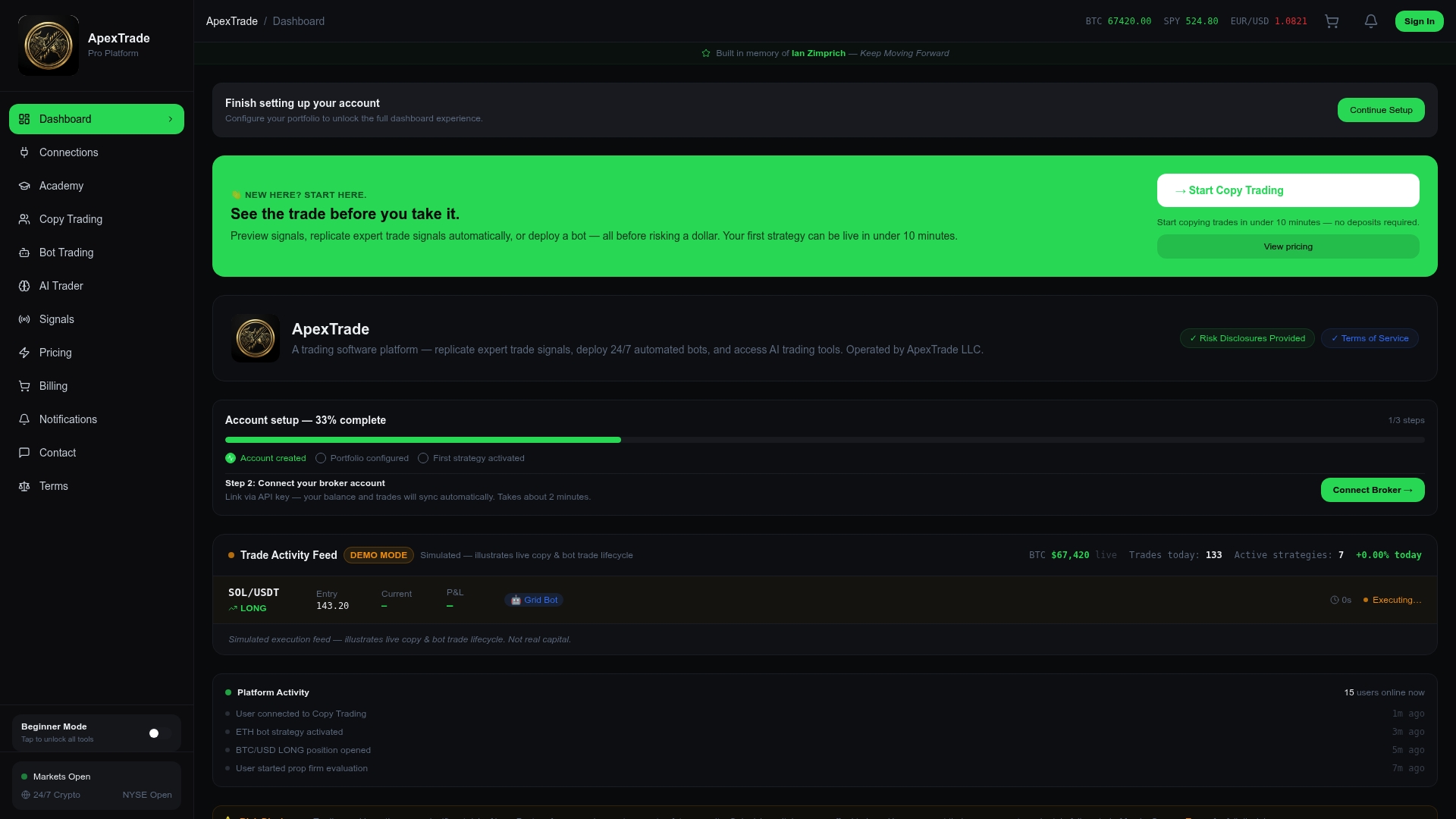
ApexTrade bot trading gives you access to pre-built, deployable bots designed for real market conditions, complete with risk controls already embedded in the architecture. You don't need to build kill switches from scratch or manually configure drawdown limits. The platform also offers copy trading solutions that let you replicate the strategies of experienced traders, so you can benefit from proven execution while you're still developing your own approach. You can review live trades in real time, track performance metrics, and manage multiple strategies across crypto, stocks, and forex from one unified dashboard.
Frequently asked questions
Do I need to know programming to automate my trading?
No — many platforms offer visual builders and bot marketplaces that allow full automation without coding. As Investopedia confirms, broker platforms with built-in bots or visual tools make automation accessible to non-coders.
What markets can I automate trading on?
You can automate strategies for stocks, forex, cryptocurrencies, futures, and more via a supporting broker. Algorithms can execute trades across multiple asset classes when integrated with a multi-market platform.
How safe is automated trading?
Automated trading carries real risks, but paper trading and hard-risk controls like kill switches and drawdown limits are essential to reduce live execution risks in automated systems.
Can automated trading work while I'm asleep or unavailable?
Yes — bots follow programmed rules 24/7, even when you're completely offline. Algorithmic systems execute trades automatically per code, without human intervention, throughout the day and night.
Is backtesting alone enough to trust an automated trading strategy?
No — backtests can significantly overestimate real performance. Live performance can degrade versus backtests, so always use simulated trading and hard risk limits before committing real capital.