

The forex market is the largest financial market on earth, and most people have no idea they interact with it every time they travel, shop online from overseas retailers, or follow international news. Average daily turnover hit an all-time high of roughly $9.5 trillion in April 2025, dwarfing every stock exchange on the planet. Yet a persistent myth keeps beginners on the sidelines: that forex is only for banks, hedge funds, and seasoned professionals. This article breaks that myth apart, walking you through everything from the basic mechanics of a trade to real performance data that will sharpen how you think about risk and strategy.
Table of Contents
- What is forex trading?
- Forex market types: Spot, forwards, and futures
- Leverage and margin: How forex traders amplify risk and reward
- Forex trading strategies: Scalping, day trading, and swing trading
- Performance realities: Why most retail forex traders lose money
- A practical perspective: Why discipline beats prediction
- Ready to trade smarter? Tools and next steps
- Frequently asked questions
Key Takeaways
| Point | Details |
|---|---|
| Global market scale | Forex is the world's largest financial market with over $9 trillion traded daily. |
| Trading basics | Trading involves buying one currency and selling another to profit from exchange rate movement. |
| Leverage risks | Leverage can amplify profits but also rapidly magnifies losses and can trigger margin calls. |
| Strategy matters | Choosing a trading strategy that fits your goals and risk tolerance is essential. |
| Discipline is key | Success in forex is built on consistent risk management and learning from real market performance. |
What is forex trading?
At its core, forex trading is the buying of one currency while simultaneously selling another to profit from changes in exchange rates. You are never buying a currency in isolation. Every transaction involves a pair, such as EUR/USD (euro versus US dollar) or GBP/JPY (British pound versus Japanese yen).
The first currency in a pair is called the base currency, and the second is the quote currency. If EUR/USD is priced at 1.0850, it means one euro buys 1.0850 US dollars. If you believe the euro will strengthen against the dollar, you buy the pair. If you think it will weaken, you sell it. Your profit or loss comes from the difference between your entry price and your exit price, multiplied by the size of your position.
Mechanically, placing a forex trade involves selecting a currency pair, placing buy or sell orders, and managing risk using tools like stop-loss and take-profit levels. Here is what each of those tools does:
- Buy order: Opens a long position, meaning you profit when the pair rises in price.
- Sell order: Opens a short position, meaning you profit when the pair falls in price.
- Stop-loss: Automatically closes your trade at a predetermined loss level to protect your account.
- Take-profit: Automatically closes your trade when it hits a target gain, locking in your earnings.
"The goal in forex is not to be right every time. The goal is to make more when you are right than you lose when you are wrong." This principle, simple as it sounds, separates profitable traders from those who blow up their accounts.
If you want to build a solid foundation before placing your first trade, start with forex training basics to understand order types, pair selection, and risk principles in a structured way.
Forex market types: Spot, forwards, and futures
Once you understand how a trade works, you need to know which version of the forex market you are trading. Spot, forwards, and futures are the three major market types used to trade FX exposure, and each serves a different purpose.
Spot market: This is the most straightforward. Trades are settled almost immediately, typically within two business days. When retail traders talk about trading forex, they usually mean the spot market. Prices reflect current exchange rates in real time.
Forwards market: A forward contract is a private agreement between two parties to exchange currencies at a specific rate on a future date. Corporations use forwards heavily to hedge against currency risk. For example, a US company expecting payment in euros six months from now might lock in today's rate to avoid an unfavorable move. Forwards are customizable but not traded on a centralized exchange, which means they carry counterparty risk.
Futures market: Futures are similar to forwards but standardized and traded on regulated exchanges like the Chicago Mercantile Exchange (CME). Because they are exchange-traded, they are more transparent and carry less counterparty risk. However, their standardized contract sizes can make them less flexible for smaller traders.
| Feature | Spot | Forwards | Futures |
|---|---|---|---|
| Settlement | Near-immediate (T+2) | Agreed future date | Standardized future date |
| Venue | OTC (over-the-counter) | OTC | Regulated exchange |
| Customization | Limited | Highly customizable | Standardized |
| Counterparty risk | Broker-dependent | High | Low |
| Common users | Retail traders | Corporations, hedgers | Institutional, retail |
| Regulation | Varies by country | Minimal | High |
Pro Tip: If you are a retail trader just starting out, the spot market is your most accessible entry point. As your experience grows, you can explore futures for their transparency and regulated structure. Use trade analysis tools to compare price action across instruments before committing to a market type.
Leverage and margin: How forex traders amplify risk and reward
Here is where forex gets both exciting and dangerous. Most retail forex trading uses leveraged, margin-based positions rather than physical delivery of currencies. Leverage lets you control a large position with a relatively small deposit. A 100:1 leverage ratio means a $1,000 deposit controls $100,000 worth of currency.
That sounds powerful, and it is. But leverage in forex can amplify both gains and losses and can lead to margin calls or forced closures if your equity falls below the required threshold. Here is how the margin mechanics work step by step:
- Deposit margin: You fund your account with a required minimum, called the initial margin. This acts as collateral for your leveraged position.
- Open a position: Your broker allows you to open a trade many times larger than your deposit based on the leverage ratio offered.
- Monitor floating profit or loss: As the market moves, your account equity changes in real time. A 1% move in your favor at 100:1 leverage doubles your margin. A 1% move against you wipes it out.
- Maintenance margin: If your losses reduce your equity below the broker's maintenance threshold, you receive a margin call.
- Margin call or forced closure: You must either deposit more funds or your broker automatically closes your position to prevent further loss.
Statistic to know: A 50:1 leverage ratio means a 2% adverse move in the market eliminates your entire deposit. Many brokers offer leverage as high as 500:1 in unregulated jurisdictions, which is extraordinarily dangerous for anyone without a tested risk management system.
Pro Tip: Never risk more than 1 to 2 percent of your total account on any single trade. This rule alone keeps you in the game long enough to learn and improve. Track your risk-adjusted performance over time using performance tracking to see whether your leverage usage is helping or hurting your results.

Forex trading strategies: Scalping, day trading, and swing trading
Understanding leverage and market types gives you the foundation. Now you need a strategy that fits your personality, schedule, and risk tolerance. Forex strategies differ significantly by timeframe and trade frequency, and choosing the wrong one for your lifestyle is one of the most common and costly mistakes new traders make.
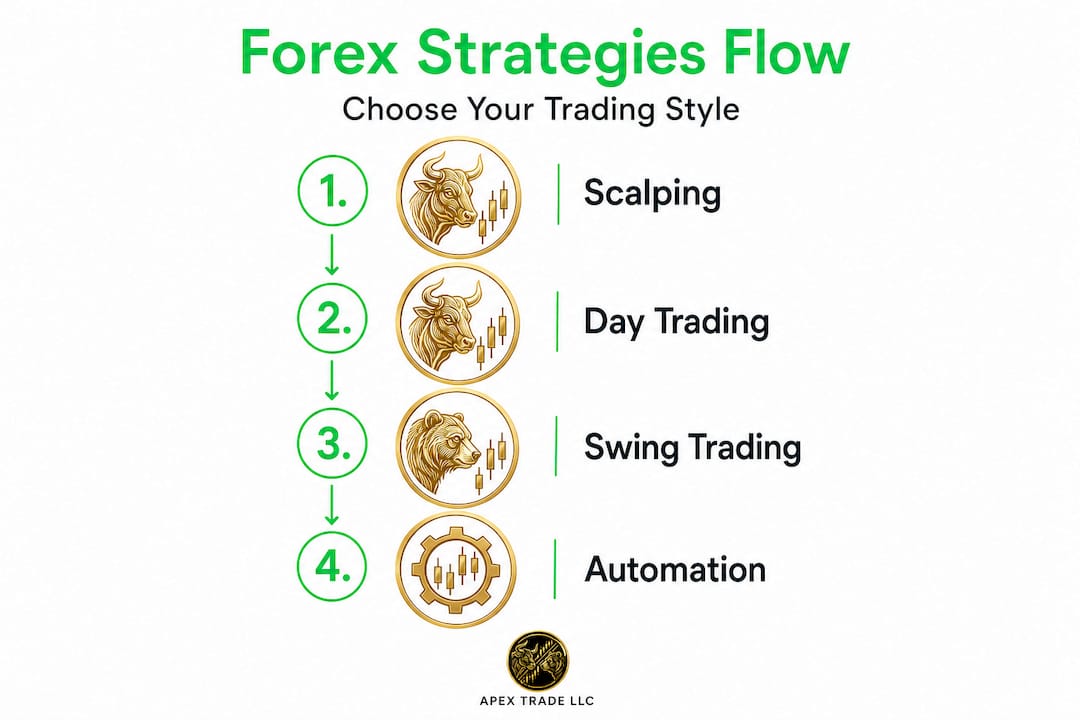
Scalping involves making dozens or even hundreds of small trades per day, targeting tiny price movements of just a few pips (a pip is the smallest standard price move, typically 0.0001 for most pairs). Scalpers need fast execution, tight spreads, and the ability to sit in front of a screen for hours.
Day trading means opening and closing all positions within a single trading session. Day traders avoid overnight risk, which is the risk of a market moving against you while you sleep. They typically target larger moves than scalpers but still require significant screen time.
Swing trading involves holding positions for several days or even weeks, targeting larger price swings driven by technical or fundamental analysis. Swing traders check charts a few times per day rather than constantly, making this approach more compatible with a full-time job or other commitments.
| Strategy | Typical hold time | Trades per week | Screen time required | Risk per trade |
|---|---|---|---|---|
| Scalping | Seconds to minutes | 50 to 200+ | Very high (4 to 8 hrs/day) | Very small |
| Day trading | Minutes to hours | 5 to 25 | High (2 to 6 hrs/day) | Small to medium |
| Swing trading | Days to weeks | 1 to 10 | Low to moderate | Medium |
- Scalping pros: Many opportunities daily; profits accumulate quickly in active markets.
- Scalping cons: High transaction costs from spreads; emotionally exhausting; requires near-perfect execution.
- Day trading pros: No overnight exposure; clear daily results; structured routine.
- Day trading cons: Requires significant time commitment; high stress during volatile sessions.
- Swing trading pros: Lower time commitment; larger potential gains per trade; less noise from short-term volatility.
- Swing trading cons: Exposed to overnight and weekend gaps; requires patience and strong conviction.
For traders who want to automate their strategy execution, especially scalpers who cannot watch the market around the clock, exploring bot trading strategies can remove the emotional element and ensure your rules are followed consistently.
Performance realities: Why most retail forex traders lose money
This section is not meant to discourage you. It is meant to give you an honest picture so you can prepare properly. ESMA-mandated broker disclosures in Europe generally show that a majority of CFD and forex accounts lose money. The disclosed loss rates across European brokers typically range from 54% to 83%, with an average hovering around 76%.
That means roughly three out of four retail forex traders lose money. Why?
- Overleveraging: Traders use maximum available leverage without understanding the risk, and a single bad trade wipes out weeks of gains.
- No defined strategy: Many beginners trade on impulse, news headlines, or social media tips rather than a tested, rules-based approach.
- Poor risk management: Letting losing trades run while cutting winning trades short is the opposite of what profitable trading requires.
- Emotional decision-making: Fear and greed drive most retail trading decisions, overriding logic and strategy.
- Undercapitalization: Starting with too little capital means even normal drawdowns feel catastrophic and force premature exits.
"Surviving your first year in forex is not about making money. It is about not losing so much that you cannot continue. Preservation of capital is the first skill to master."
The traders who beat the odds share a few consistent traits: they use small position sizes, they have a written trading plan, they review their trades regularly, and they treat losses as tuition rather than failures. Managing your portfolio management with discipline and tracking every trade helps you identify patterns in both your wins and your losses. For those who prefer to learn from proven performers rather than trial and error, copy trading solutions offer a way to mirror expert strategies while you build your own skills.
A practical perspective: Why discipline beats prediction
Here is something most trading content will not tell you directly: the ability to predict market direction is far less important than the ability to manage your response when you are wrong.
The forex market is influenced by central bank decisions, geopolitical events, economic data releases, and millions of individual participants making decisions simultaneously. No one, not even the most sophisticated institutional trader, gets it right consistently. What separates long-term profitable traders from the rest is not a magical indicator or a secret strategy. It is behavioral consistency.
We have seen traders with genuinely insightful market analysis blow up their accounts because they could not accept a loss and moved their stop-loss further away. We have also seen traders with relatively simple strategies compound their accounts steadily over years because they followed their rules without exception, every single trade.
The uncomfortable truth is that most beginners spend 90% of their energy searching for the perfect entry signal and almost no time designing a system for managing losing trades. But losing trades are inevitable. The question is not whether you will lose, but how much you will lose when you do, and whether you can stay in the game long enough to let your edge play out.
Starting small is not a sign of weakness. It is the smartest thing a new trader can do. A $500 account trading micro-lots teaches you everything a $50,000 account does, without the catastrophic downside. Track every trade, note your reasoning, and review your results weekly. Over time, patterns emerge. You will see which setups actually work for you and which ones you take out of boredom or impatience.
The traders who survive and eventually thrive are the ones who treat forex as a skill to develop over years, not a lottery ticket to cash in overnight. If you are serious about building that skill, investing time in advanced forex training gives you a structured path to develop the technical knowledge and behavioral habits that actually move the needle.
Ready to trade smarter? Tools and next steps
Understanding forex theory is one thing. Executing it consistently in live markets is another challenge entirely, and that is where the right tools make a measurable difference.
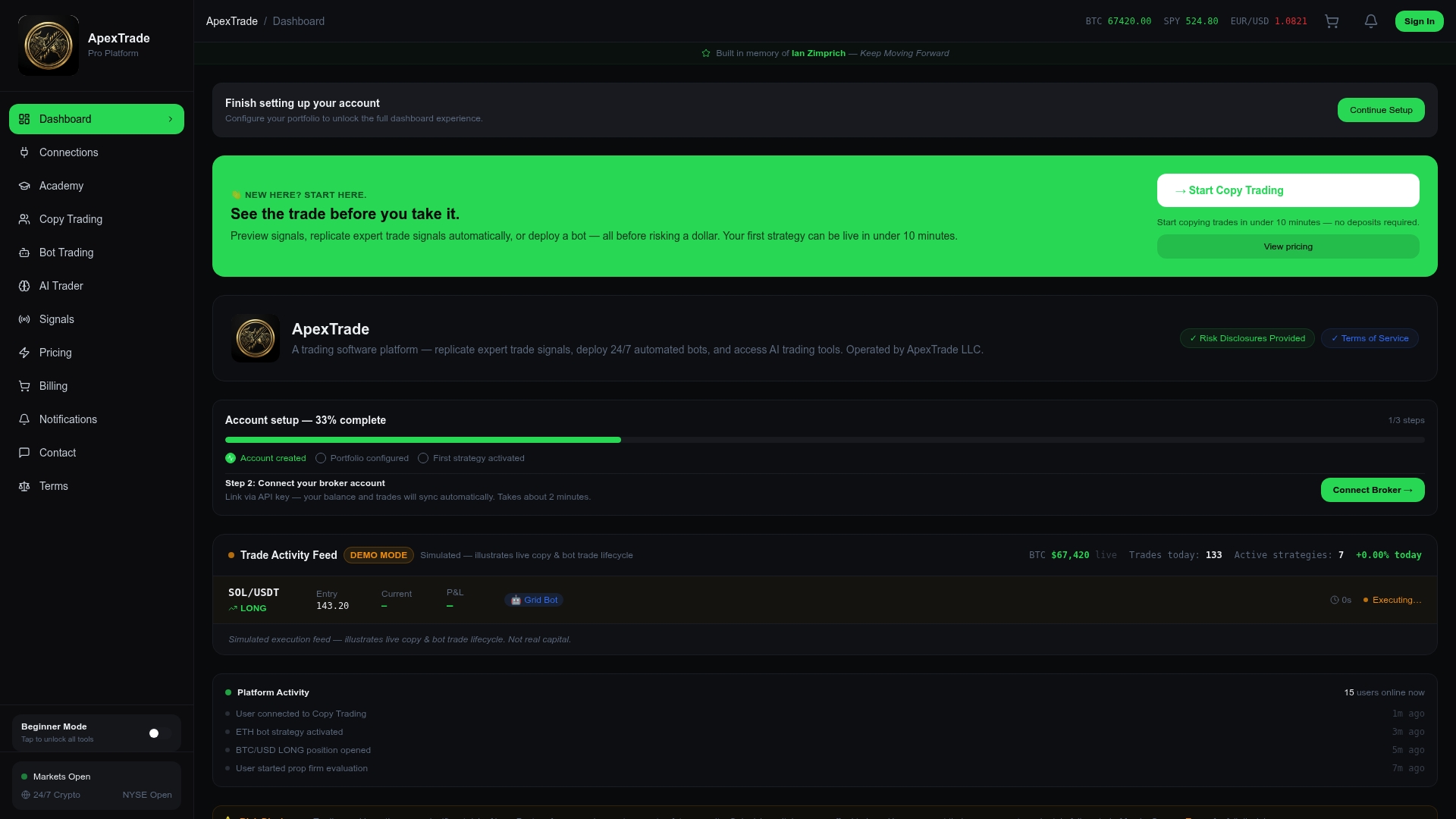
Apex Trade LLC Platform gives you access to bot trading solutions that execute your strategy around the clock without emotional interference, and copy trading features that let you replicate the moves of experienced traders while you develop your own edge. Whether you are a beginner who wants to learn by watching real trades unfold or an experienced trader ready to automate a proven strategy, the platform's tools are built to meet you where you are. Portfolio management, performance analytics, and multi-account integration mean you always know exactly where you stand. Take the next step and start trading with tools designed for serious results.
Frequently asked questions
Is forex trading risky for beginners?
Forex trading is risky, especially due to leverage. As leverage amplifies both gains and losses, beginners must practice strict risk management, use small position sizes, and start with a demo account before risking real capital.
What types of forex products can I trade?
You can trade spot, forwards, and futures in the forex market, each differing in settlement timing, exchange venue, level of regulation, and suitability for different trader profiles.
Why do most retail forex traders lose money?
Because most retail traders use high leverage without adequate risk controls, ESMA-mandated disclosures consistently show that the majority of CFD and forex accounts lose money, with average loss rates around 76% across European brokers.
How do I choose the right forex trading strategy?
The best strategy depends on your schedule, risk tolerance, and personality. Since forex strategies differ by timeframe and trade frequency, scalping suits active traders with lots of screen time, while swing trading fits those with limited availability.
Can forex trading be automated with bots or copied from experts?
Yes. Automation and copy trading are increasingly accessible to retail traders, allowing you to deploy algorithmic bots that execute strategies 24/7 or replicate the trades of verified expert traders in real time.