

Forex trading moves more money in a single day than most stock exchanges handle in a month, yet there is no building, no floor, and no central scoreboard showing you the "official" price. Most traders come from a stock market background where a central exchange sets the rules, but forex markets are decentralized and operate OTC, meaning every transaction flows through a global network of banks, dealers, and electronic platforms rather than one regulated hub. That reality changes everything about how you read prices, manage execution costs, and build automated strategies that hold up in live conditions.
Table of Contents
- What is the forex market?
- Key structure and segments of forex markets
- How pricing and execution work: Spreads, swaps, and liquidity
- Empirical benchmarks: The BIS survey and measuring FX markets
- A trader's perspective: What most guides miss about forex markets
- Enhance your trading with ApexTrade tools
- Frequently asked questions
Key Takeaways
| Point | Details |
|---|---|
| Decentralized marketplace | Forex markets are global, decentralized OTC networks, not centralized exchanges. |
| Trading in pairs | You buy one currency and sell another, with prices reflected in market pairs. |
| Market segmentation | Spot, forward, and futures segments serve different trading and hedging needs. |
| Execution matters | Bid-ask spreads, swap rates, and liquidity conditions can shape trade outcomes. |
| Reliable benchmarks | Empirical market size is best measured via BIS surveys, not marketing claims. |
What is the forex market?
At its core, the forex market is where one currency is exchanged for another. Simple concept, complex execution. Unlike buying a share of stock on the NYSE, you are not interacting with a centralized order book. Instead, you are accessing a layered network of liquidity providers, brokers, and institutional counterparties.
"Forex markets are decentralized, global marketplaces for trading one currency for another," operating entirely outside the walls of any single exchange.
That decentralized design matters more than most introductory guides admit. The New York Fed has noted that the forex market is not one-size-fits-all and has no physical location where all currencies converge. Your EUR/USD quote on one platform can differ from the quote another trader sees on a competing platform at the exact same millisecond.
Here is what makes the structure unique:
- Currency pairs: Every trade involves two currencies. EUR/USD, GBP/JPY, USD/JPY. The first is the base currency; the second is the quote currency. Buying EUR/USD means buying euros and selling dollars simultaneously.
- OTC structure: Most forex volume clears over-the-counter, meaning directly between counterparties, without a centralized clearinghouse mandating terms.
- Participants: Major commercial banks are the dominant players. Beyond them, hedge funds, central banks, multinational corporations, retail brokers, and individual traders all participate at different tiers of the market.
- 24-hour operation: Because the market is global, it does not close when New York does. It rolls from Sydney to Tokyo to London and back again, five days a week.
Understanding the forex market basics gives you the conceptual foundation, but to trade effectively you need to understand what segment of that market you are actually operating in. This is where most retail traders skip ahead too fast, and it costs them. Knowing how each tier connects to automated trading integration helps you align your bot logic with the actual pricing environment you are executing in.
Key structure and segments of forex markets
Once you understand the overall market design, the next step is breaking down the structural segments. The forex market does not operate as one monolithic instrument. It runs across at least three distinct segments, each with its own mechanics, participants, and risk profiles.
Forex has multiple market segments for different contract types, including spot, forwards, and futures. Here is how they compare:
| Segment | Settlement | Regulation | Primary users | Typical use case |
|---|---|---|---|---|
| Spot | T+2 (immediate) | OTC, varies by broker | Banks, retail traders | Direct currency conversion |
| Forwards | Custom date | OTC, bilateral | Corporations, hedgers | Locking in future rates |
| Futures | Standardized date | Exchange-regulated | Institutions, speculators | Speculation and hedging |
Breaking these down further:
- Spot market. This is where most retail forex traders operate. You buy or sell a currency pair at the current market rate, and settlement technically happens in two business days, though your broker handles that in the background. The spot market is where price discovery happens and where your automated bot is most likely executing trades.
- Forward market. A forward contract locks in an exchange rate for a future date. A US company expecting a euro payment in 90 days can use a forward to guarantee they receive a specific dollar amount, regardless of where EUR/USD moves. Forwards are privately negotiated and carry counterparty risk because no exchange stands between the two parties.
- Futures market. Currency futures are standardized contracts traded on regulated exchanges like the Chicago Mercantile Exchange (CME). Because an exchange clears these, counterparty risk is minimized. Institutional traders and sophisticated retail traders often use futures alongside spot positions to hedge or speculate with defined leverage constraints.
Pro Tip: If you are running algorithmic forex strategies, start with spot market data as your primary signal source. Futures commitment-of-traders (COT) reports can serve as a sentiment overlay that gives your algorithm broader market context without overcomplicating execution logic.
Knowing which segment your capital lives in also determines your cost structure, which brings us directly to execution and pricing. Tools like bot trading platforms and copy trading systems interact primarily with the spot market, so spot pricing dynamics are the ones you need to understand most deeply.

How pricing and execution work: Spreads, swaps, and liquidity
This is where forex trading gets personal. Your strategy can be technically sound, but if you are not accounting for execution costs, your live results will consistently underperform your backtests. This gap frustrates traders constantly, and it is almost always a cost-structure problem.
Cost is largely reflected in the bid-ask spread plus other costs like swaps and overnight funding. Let's unpack each one.
Bid-ask spread. Every quote you see in forex has two prices: the bid (what the market will pay you to sell) and the ask (what you pay to buy). The difference is the spread. On major pairs like EUR/USD during peak London or New York hours, spreads can be as tight as 0.1 to 0.5 pips. On exotic pairs or during off-hours, spreads can widen to 5, 10, or even 20 pips. For high-frequency algorithmic strategies, spread variation alone can determine profitability.
Swap and rollover costs. When you hold a forex position past the daily rollover time (typically 5 PM EST), you either pay or receive a swap, which is an interest rate differential based on the two currencies involved. Strategies that hold positions for days or weeks must model swaps carefully. A carry trade designed to profit from interest rate differentials lives or dies on accurate swap modeling.
Liquidity and market depth. The BIS reported average daily OTC FX turnover of about $9.5 trillion in April 2025. That is an almost incomprehensible number, and it reflects the deepest, most liquid market on the planet. But liquidity is not uniform. It concentrates during market overlaps, particularly London and New York, and thins out dramatically during Asian off-hours or around major news events.
| Session | Active pairs | Typical spread (EUR/USD) | Liquidity level |
|---|---|---|---|
| Sydney | AUD, NZD pairs | 0.5-1.5 pips | Low |
| Tokyo | JPY crosses | 0.5-1.2 pips | Moderate |
| London | All majors | 0.1-0.5 pips | Very high |
| New York | USD pairs | 0.1-0.5 pips | Very high |
| London-NY overlap | All majors | 0.1-0.3 pips | Peak |
Even in a market this large, liquidity conditions remained resilient during turbulence in April 2025, a period marked by major macro volatility. That resilience comes from internalization by large dealers and the fragmented, multi-venue nature of the OTC market. When one venue tightens, capital often flows to another.
Pro Tip: Build your automated strategy's backtesting around session-specific spread assumptions. Using a fixed 0.5-pip spread across all hours will dramatically overstate performance on trades that fire at 3 AM EST. Use your platform's forex pricing details to calibrate realistic cost assumptions before deploying any bot live.
Refining your trading workflow around these cost dynamics is not optional for serious traders. It is the difference between a strategy that looks good on paper and one that actually earns money in live markets.
Empirical benchmarks: The BIS survey and measuring FX markets
Understanding cost and structure gets you far, but understanding scale and how it is measured keeps you grounded in reality. The financial industry is full of promotional claims about forex market size and opportunity. Empirical benchmarks cut through the noise.
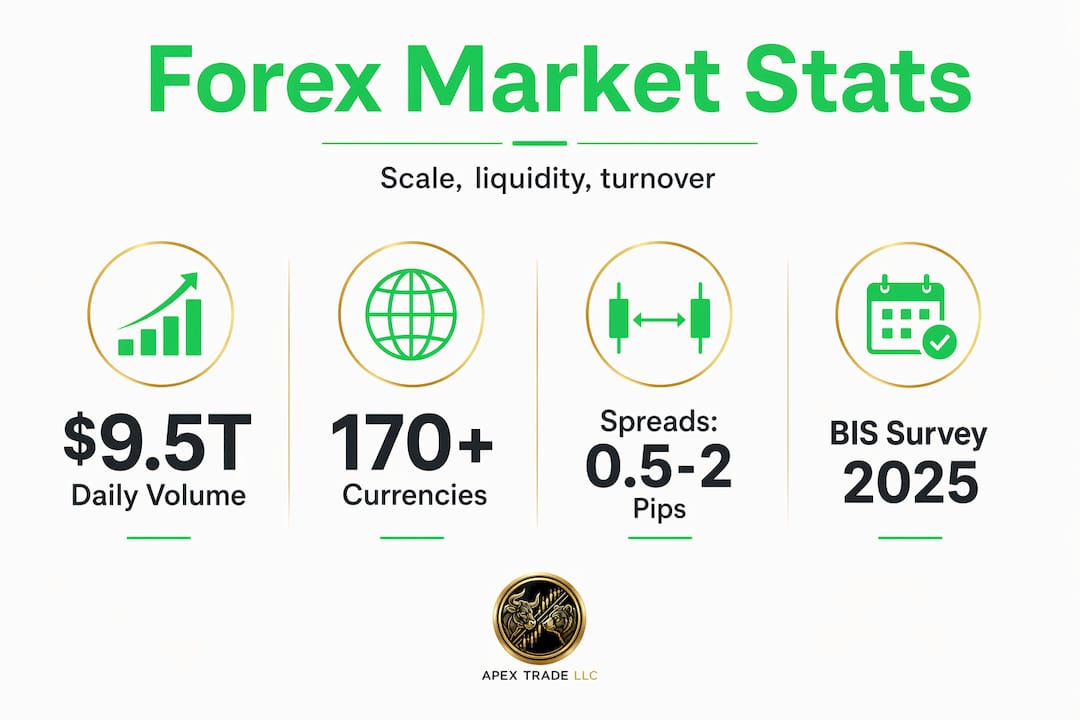
The Bank for International Settlements (BIS) conducts its Triennial Central Bank Survey every three years and it is the most authoritative source for global forex market data. The BIS Triennial survey collected data from over 1,100 banks and dealers across 52 jurisdictions in April 2025. No marketing deck or broker white paper comes close to that methodological rigor.
Why should you care as a trader? Because market size data directly informs your execution assumptions:
- Volume concentration reveals liquidity windows. When the BIS data shows that USD-denominated instruments dominate global turnover, that confirms where tightest spreads and deepest books live.
- Instrument mix shows where capital actually flows. Spot, FX swaps, and outright forwards each carry different cost and execution profiles.
- Volatility-driven volume spikes matter. The BIS estimated a $1.5 trillion turnover surge attributable to US tariff announcements in April 2025. That kind of event-driven volume expansion changes liquidity dynamics temporarily and can either benefit or destroy automated strategies depending on how they are designed.
Empirical data from sources like the BIS gives you the honest picture of forex market conditions. Promotional claims from trading services rarely tell you about liquidity regime shifts, spread widening under stress, or cost realization gaps.
Traders who use benchmarks to validate strategy assumptions tend to perform more consistently over time. If your bot performed well during the unusually deep liquidity of the 2024 London session but was never tested against April 2025 tariff-driven volatility, your backtests do not reflect real market risk. The BIS data can help you identify those stress periods and build more resilient systems.
Keeping a close eye on your portfolio management strategies alongside these macro benchmarks creates a feedback loop that keeps your risk model current rather than historical.
A trader's perspective: What most guides miss about forex markets
Here is what the textbooks rarely say clearly enough: the forex market does not reward knowledge of structure alone. It rewards traders who understand how structure, costs, and execution quality interact under changing conditions.
Most introductory guides spend pages on pip definitions and lot sizes. Very few force you to confront the fact that your backtested strategy is running against historical bid prices, not real fill conditions. When you model a trade in backtesting, you are often assuming you got filled at the exact signal price. In live markets, slippage, spread widening, and partial fills are the norm, not the exception.
Treat FX cost and execution as part of your trading model; regime shifts can alter realized performance versus backtests in ways that make a profitable-looking system suddenly lose money consistently. This is not a theoretical concern. It is one of the leading causes of why algorithmically backtested strategies fail in live deployment.
There is also the issue of liquidity regime shifts. A strategy built during a period of tight spreads and deep books will react very differently when a macro event like a central bank surprise or a trade policy announcement suddenly widens spreads and thins order books. If your automated system does not have dynamic cost filters, it will keep firing trades at exactly the wrong moment.
The practical takeaway is this: validate your strategy using real BIS benchmark data to identify stress periods, build session-aware spread assumptions into every backtest, and never trust a backtest that uses uniform conditions across all 24 hours. The forex algorithmic trading principles that consistently work share one trait: they are honest about costs and adaptive to changing market regimes. Build that honesty into your system architecture from day one, not as an afterthought.
Enhance your trading with ApexTrade tools
Understanding forex market structure is step one. Putting that understanding to work through well-designed tools is step two.
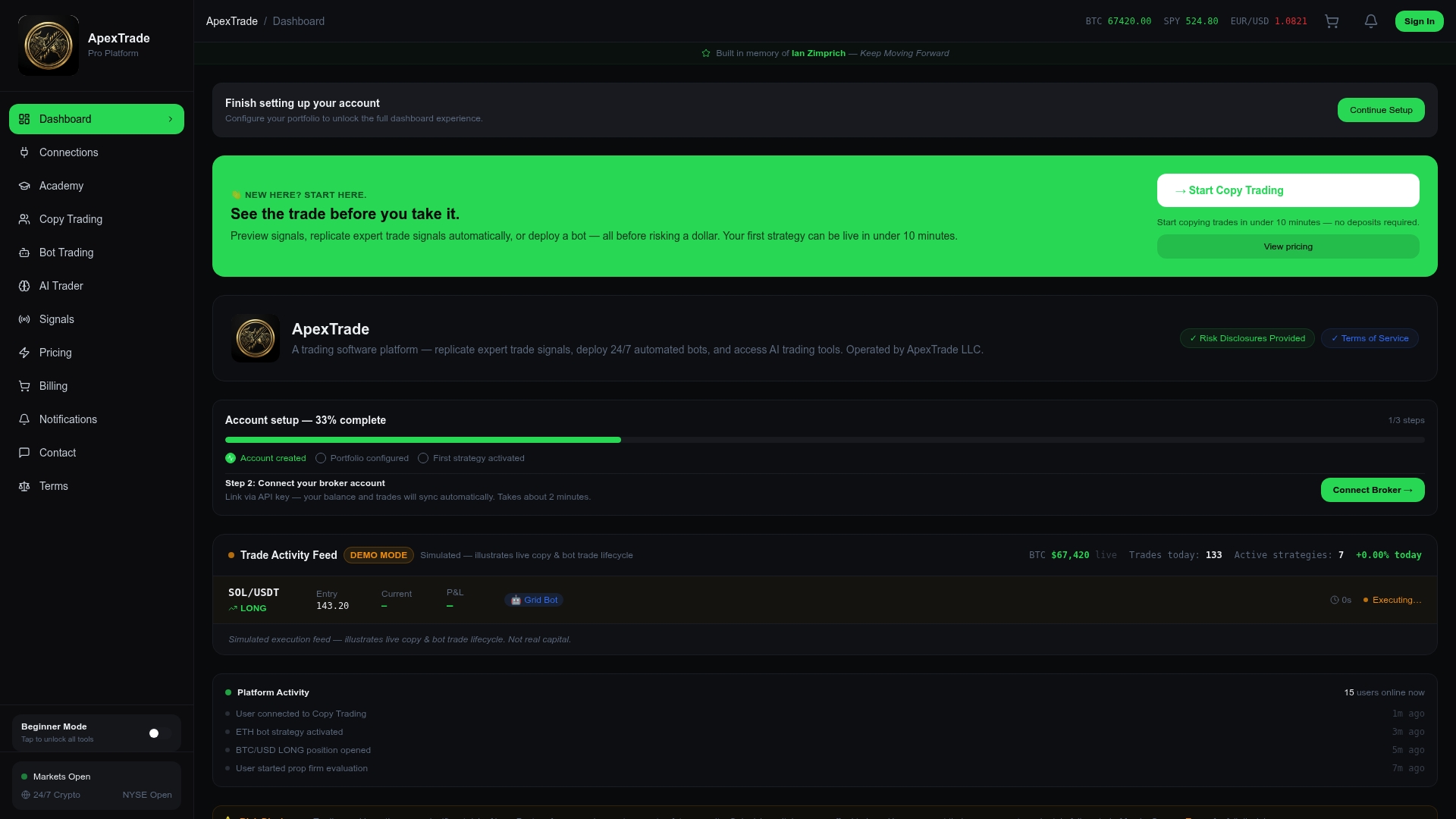
Apex Trade LLC gives you access to automated trading tools built specifically for the complexity of live forex markets. The platform's bot trading features let you deploy algorithmic strategies that account for session-based spread conditions, while the copy trading platform allows you to replicate the execution of experienced traders in real time. For portfolio-level risk management, the portfolio solutions help you monitor exposure, track performance against benchmarks, and adjust allocations as market conditions shift. Whether you are building your first automated strategy or refining a sophisticated multi-instrument system, ApexTrade provides the infrastructure to execute with precision.
Frequently asked questions
How does forex trading differ from stock trading?
Forex is decentralized and OTC, meaning trades happen across a global network of banks and brokers rather than on a central exchange with fixed hours and a single order book. Stock trading operates through regulated central exchanges with standardized rules and a single price at any given moment.
Why are exchange rates not always the same across platforms?
Because the forex market is decentralized, each platform connects to different liquidity providers, and exchange rates vary by venue, instrument, and counterparty. This is why shopping execution quality across brokers actually matters for active traders.
What accounts for most forex trading volume globally?
The BIS Triennial Survey attributes global volumes primarily to OTC spot and derivatives trading, and recent volume surges were tied to specific macro events, including US tariff announcements that drove an estimated $1.5 trillion spike in daily turnover in April 2025.
Are automated trading strategies affected by market structure and liquidity?
Yes, significantly. Liquidity and pricing regime shifts can change realized performance versus backtests in material ways, which is why automated strategies must model real execution costs, session-specific spread conditions, and event-driven volatility as core inputs rather than footnotes.