
Automated trading promises to remove emotion, work around the clock, and execute strategies faster than any human could. But many traders discover that running multiple bots across crypto, forex, and stocks creates a new set of problems: unexpected losses from overexposure, poor diversification, and strategies that quietly drift out of alignment. The good news is that systematic portfolio management can close those gaps. This guide walks you through every layer, from setting clear objectives and sizing positions correctly, to rebalancing efficiently and catching algorithmic risks before they erode your capital.
Table of Contents
- Set the foundation: Defining objectives and structure
- Control risk: Position sizing and portfolio heat
- Boost resilience: Diversification and allocation best practices
- Stay aligned: Rebalancing and tax optimization strategies
- Verify, adapt, and safeguard: Monitoring and troubleshooting automated portfolios
- Expert insight: What most traders overlook in portfolio management
- Optimize your trading portfolio with ApexTrade
- Frequently asked questions
Key Takeaways
| Point | Details |
|---|---|
| Position sizing is critical | Always keep risk per trade at 1-2% of your portfolio and adapt position size as your account balance changes. |
| Diversification boosts resilience | A portfolio of 10-20 stocks across multiple sectors reduces unsystematic risk and protects against losses. |
| Rebalancing maintains alignment | Using threshold-based rebalancing keeps your portfolio allocations on target while minimizing unnecessary costs. |
| Tax efficiency matters | Contribution-first rebalancing and careful allocation adjustments can help reduce tax consequences. |
| AI risks require vigilance | Monitor for herding and governance issues in automated portfolios to avoid unexpected systemic losses. |
Set the foundation: Defining objectives and structure
Before a single bot places a single order, you need a clear answer to one question: what is this portfolio actually for? Growth-focused portfolios look nothing like income-generating ones, and hedging portfolios are built on completely different logic. Trying to optimize all three goals with one undifferentiated pool of capital is a fast path to mediocre results across the board.
Start by writing down your primary goal. Then choose the asset classes that serve that goal. A growth-oriented trader might combine high-volatility crypto with trending equities. An income trader leans toward dividend stocks, bonds, and forex carry trades. A hedging portfolio might hold inverse ETFs, commodities, or correlated pairs. Each choice shapes your allocation targets.
Core portfolio structure considerations:
- Identify your primary goal: growth, income, or risk hedging
- Select 2 to 4 asset classes that align with that goal
- Define your risk tolerance on a scale of conservative to aggressive
- Set a trading frequency range (high-frequency bots vs. swing trading)
- Assign percentage targets to each asset class before deploying capital
| Asset class | Typical role | Risk level | Suggested allocation range |
|---|---|---|---|
| Equities (stocks) | Growth | Medium | 30 to 50% |
| Forex pairs | Income or hedging | Medium to High | 20 to 35% |
| Cryptocurrencies | High growth | High | 10 to 25% |
| Bonds or stablecoins | Capital preservation | Low | 5 to 20% |
Your portfolio strategy should be written down, reviewed periodically, and treated as a living document. Markets change. Your objectives may shift. The structure needs to flex with reality, not calcify around assumptions you made six months ago.
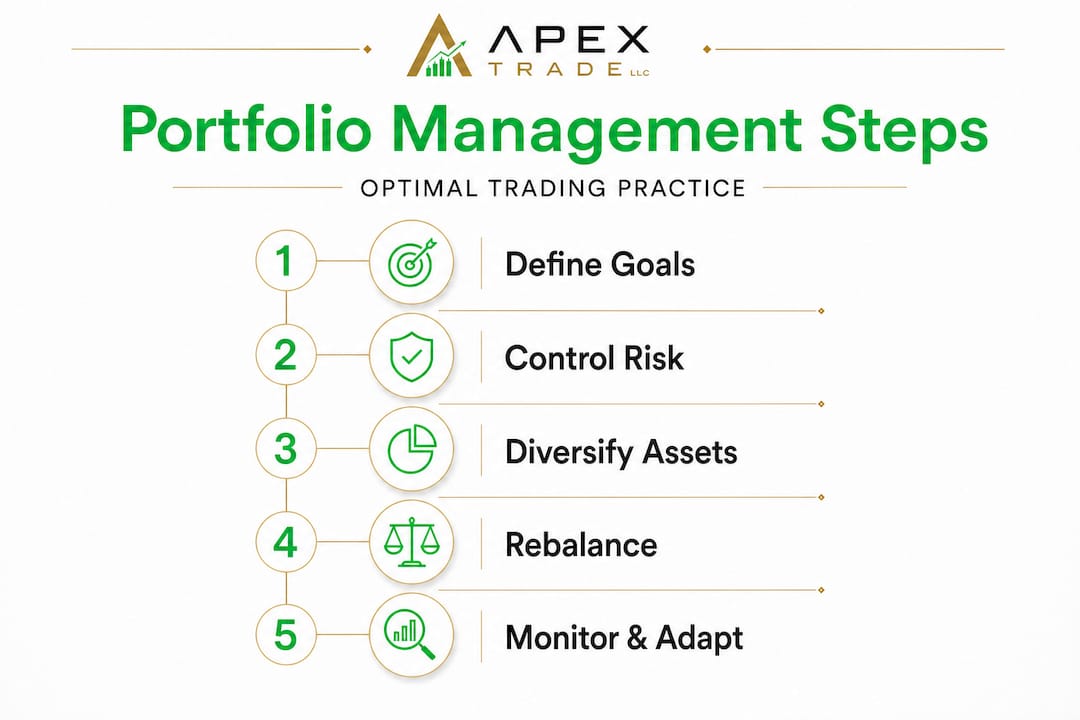
With your broader portfolio goals in mind, the next key step is controlling risk on each trade.
Control risk: Position sizing and portfolio heat
Position sizing is where most traders lose control without ever realizing it. Gut-feel sizing leads to overexposure on winners and underexposure on setups that actually deliver. Evidence-based sizing removes that inconsistency.
The standard rule: position sizing limits risk per trade to 1 to 2% of your total portfolio value, adjusted for your stop-loss distance and current market volatility. That means on a $50,000 portfolio, no single trade should put more than $500 to $1,000 at risk. This is not arbitrary. It is the threshold at which a losing streak of 10 trades in a row still leaves your account intact enough to recover.
For traders who want a more precise framework, the Kelly Criterion calculates optimal position size using the formula f = (bp - q) / b, where p equals your win probability, q equals your loss probability, and b equals your win/loss ratio. Most experienced traders use a fractional Kelly approach, applying only 25 to 50% of the full formula output. Full Kelly sizing is mathematically optimal but produces drawdowns that are psychologically brutal.
Step-by-step position sizing process:
- Calculate your risk amount: 1 to 2% of current portfolio value
- Determine your stop-loss distance in dollars or pips for that specific trade
- Divide risk amount by stop-loss distance to get your position size
- Adjust downward if current volatility is elevated (wider stop = smaller position)
- Run a Kelly Criterion check as a second opinion and cap the output at half the Kelly recommendation
"Amateurs focus on returns. Professionals obsess over position sizing. The size of your positions determines whether you survive long enough to see your edge play out."
| Sizing method | Complexity | Best for | Key limitation |
|---|---|---|---|
| Fixed 1 to 2% rule | Low | All traders, beginners | Ignores edge quality |
| Volatility-adjusted | Medium | Active bot traders | Requires real-time vol data |
| Full Kelly Criterion | High | Experienced quants | Produces extreme drawdowns |
| Fractional Kelly (50%) | Medium-High | Professional traders | Requires accurate win rate data |
Portfolio heat is the total percentage of your portfolio currently at risk across all open trades. Limit portfolio heat to 6% maximum at any given time. If your bots are running 8 simultaneous trades at 1% risk each, you are already overheated. Check your performance metrics regularly to keep this number visible and manageable.
Pro Tip: Every time your portfolio grows or shrinks by more than 10%, recalculate your position sizes. A bot set to risk $500 per trade when your account was $50,000 is risking 2% but will risk 4% if your account drops to $25,000 without adjustment. Automate this recalculation or set calendar reminders to review it monthly. Your portfolio risk controls should include this recalibration trigger as a standard checkpoint.
Once risk limits are in place, diversification becomes the next pillar of robust portfolio management.
Boost resilience: Diversification and allocation best practices
Diversification is often misunderstood. Holding 20 correlated assets is not diversification. It is the illusion of diversification. Real diversification reduces unsystematic risk, meaning the risk specific to one company, sector, or currency pair, while keeping your exposure to broader market trends intact.
Research is clear on what actual diversification looks like: holding 10 to 20 stocks across at least 3 to 4 distinct sectors, with no single sector exceeding 25 to 30% of the total portfolio. Beyond that threshold, adding more positions delivers diminishing returns in risk reduction but increases complexity and monitoring burden.
Diversification rules for automated traders:
- Hold between 10 and 20 positions across different instruments and asset classes
- Spread across at least 3 to 4 non-correlated sectors (tech, energy, financials, healthcare)
- Cap each sector at 25 to 30% maximum regardless of performance
- Cap any single position at 20% of the total portfolio
- Include at least one uncorrelated alternative: commodities, volatility instruments, or macro bots
Statistic spotlight: Studies consistently show that portfolios holding fewer than 10 diversified positions carry 2 to 3 times more unsystematic risk than portfolios with 15 to 20 well-spread holdings. After 20 positions, additional holdings reduce risk by less than 1% per position added.
The concept of crisis-resistant allocation goes one step further by incorporating alternative strategies alongside traditional positions. This might mean pairing a trend-following bot in equities with a mean-reversion bot in forex, or adding a small allocation to an inverse ETF strategy that gains when markets sell off. These layers of non-correlation protect your portfolio during black swan events when most conventional assets drop together.
Pro Tip: Correlation is not static. Two assets that were uncorrelated during normal markets often move together during a market crisis. Review your correlation matrix quarterly, especially if you run crypto alongside equity bots. What looked diversified in calm conditions may be dangerously concentrated during a volatility spike.
With a diversified allocation set, rebalancing ensures your portfolio stays aligned over time.
Stay aligned: Rebalancing and tax optimization strategies
Rebalancing is the discipline of restoring your portfolio to its target allocation when market movements cause drift. Without it, a strong bull run in crypto can quietly push your crypto allocation from 15% to 35% of your portfolio, making you far more exposed to a correction than you intended.
Threshold-based rebalancing uses drift bands, typically 5%, to trigger rebalancing actions. If your target allocation for equities is 40% and it drifts to 45% or falls to 35%, that 5% breach becomes your signal to act. This approach typically generates 1 to 2 rebalancing events per year, which keeps transaction costs manageable while maintaining risk control. Research on optimal rebalancing frequency confirms that more frequent rebalancing often costs more in fees than it saves in risk reduction.
Rebalancing methods compared:
| Method | Trigger | Avg. annual rebalances | Tax efficiency | Cost efficiency |
|---|---|---|---|---|
| Threshold (5% bands) | Drift exceeds target | 1 to 2 | High | High |
| Calendar (quarterly) | Fixed schedule | 4 | Medium | Medium |
| Calendar (monthly) | Fixed schedule | 12 | Low | Low |
| Contribution-first | New capital added | Variable | Very high | Very high |
Tax-smart rebalancing tactics:
- Always rebalance using new contributions first before selling existing positions
- Harvest losses strategically to offset gains when selling is unavoidable
- Use tax optimization tools to identify the most tax-efficient assets to trim
- Hold rebalancing actions in tax-advantaged accounts where possible
- Track cost basis carefully across all bot trades to simplify tax reporting
Copy trading rebalancing adds another layer, since following multiple signal providers can cause unintended concentration. If three providers all favor the same sector, you may be far less diversified than your allocation table suggests. Review this overlap regularly.
Pro Tip: Set automated alerts for when any position or sector drifts 5% beyond its target. Most portfolio platforms support threshold alerts. Pair this with contribution-first rebalancing logic, meaning direct new funds toward underweighted positions before ever selling anything. This single habit cuts taxable events dramatically over a full year.
Portfolio maintenance is ongoing; next, focus shifts to verifying and troubleshooting your strategies.
Verify, adapt, and safeguard: Monitoring and troubleshooting automated portfolios
Automated portfolios can run quietly in the background while problems accumulate. A bot can be live and trading while its edge has completely eroded due to changing market conditions. Without active monitoring, you often discover the problem only after significant damage.
Key monitoring checkpoints:
- Review performance metrics weekly: win rate, average return per trade, max drawdown
- Compare actual allocation to target allocation monthly
- Check correlation between your active bots and strategies every quarter
- Audit bot logic and signal provider settings after any major market event
- Confirm that position sizing parameters reflect your current account balance
One of the most underappreciated risks in automated trading is algorithmic herding. Systematic risks in AI trading include herding from shared signal providers, where dozens or hundreds of accounts receive identical signals simultaneously and execute the same trade at the same moment. This creates artificial liquidity crunches and amplifies slippage. Monitoring governance and staying informed on evolving regulations around AI trading is increasingly important as regulators scrutinize algorithmic strategies worldwide.
"Automated doesn't mean autonomous. Even the best-designed trading bot requires human oversight to catch what the algorithm cannot see about its own changing environment."
Your AI trading risks dashboard should include governance checks: which providers are generating your signals, how many other accounts share those signals, and whether regulatory updates in your jurisdiction affect your bot's permissible actions. These are not optional checks. They are part of professional portfolio stewardship.
Having covered step-by-step management, let's turn to unique expert perspectives that challenge industry norms.
Expert insight: What most traders overlook in portfolio management
Most traders talk about returns. Professionals talk about process. The single biggest gap between consistently profitable traders and everyone else is not strategy selection, signal quality, or even market timing. It is the discipline to follow a systematic process even when it feels counterintuitive.
Take rebalancing. The data consistently favors threshold-based rebalancing over calendar rebalancing when transaction costs are factored in. Yet the majority of traders default to quarterly schedules out of habit, not analysis. Switching to a 5% drift trigger is a straightforward change that improves net returns and reduces unnecessary tax drag. Most traders simply never make it because they never examine the assumption behind their current method.
The contribution-first approach to rebalancing is even more underused. Rather than selling an overweight position (and generating a taxable event), you direct incoming capital toward underweight positions until balance is restored. The outcome is identical. The tax bill is dramatically lower. This is not a sophisticated strategy. It is a systematic habit that tax-efficient management tools can help you enforce automatically.
On the AI risk side: herding is a genuine systemic threat, not a theoretical one. When every bot on a platform receives the same signal and executes within milliseconds, you are not trading the market. You are trading alongside a crowd that moves as one. If you use copy trading or signal-based bots, audit your providers regularly. Overlapping exposure is invisible at the position level but glaringly obvious at the portfolio level if you look for it.
The deepest lesson in portfolio management is this: chasing the highest return is almost always the wrong priority. Building a process that survives bad periods, limits drawdowns, and compounds steadily over years is what actually generates wealth. Every element in this guide, from the 1 to 2% position sizing rule to the 5% drift trigger, exists to keep your portfolio alive long enough for your edge to work. Respect the process more than the returns, and the returns will take care of themselves.
Optimize your trading portfolio with ApexTrade
Managing a sophisticated trading portfolio across multiple asset classes takes the right tools in your corner. ApexTrade is built specifically for traders who want to move beyond guesswork and run systematic, automated portfolios with real precision.
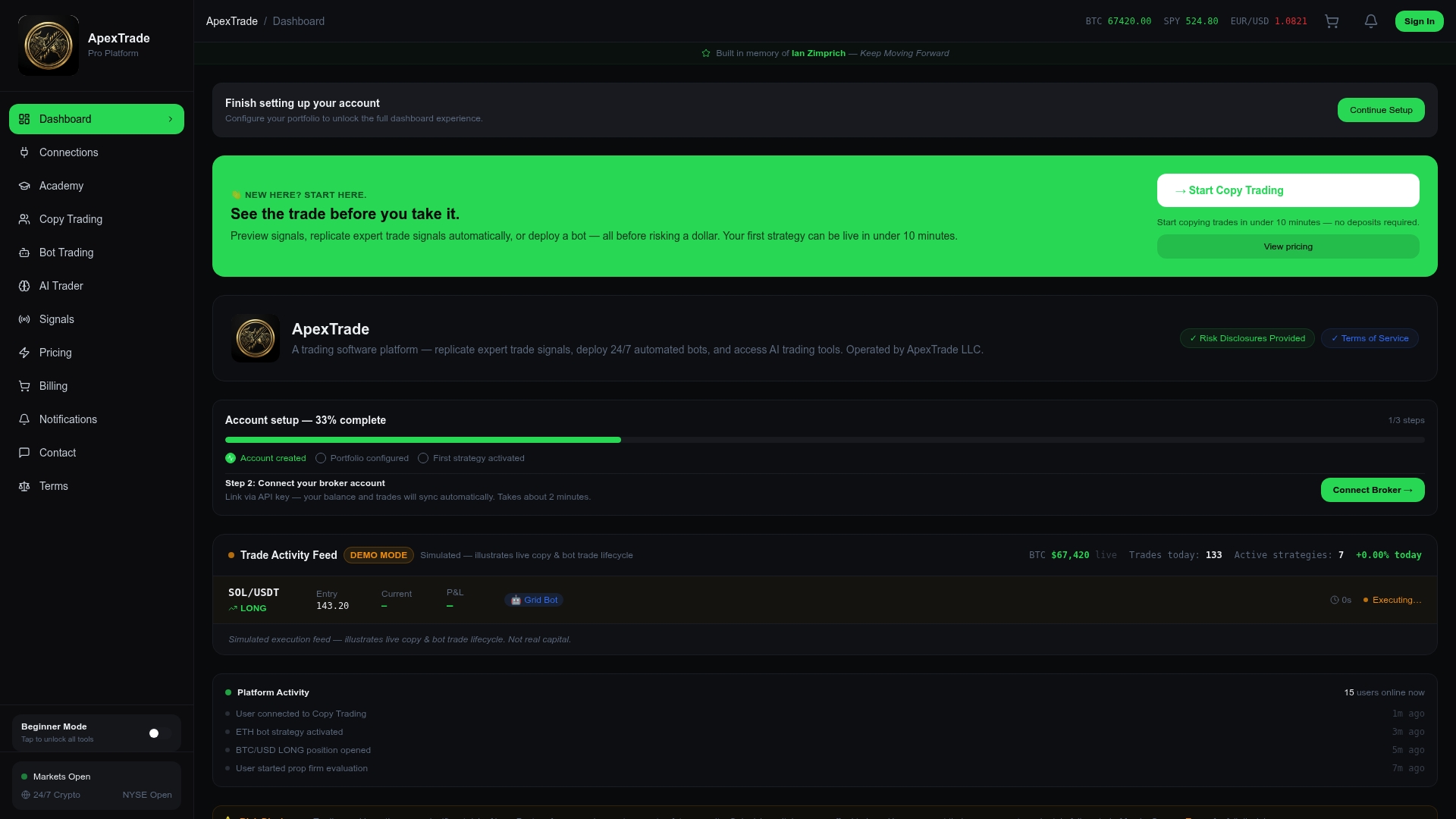
Whether you need bot trading tools to execute your position sizing strategy around the clock, copy trading solutions to diversify across multiple signal providers, or a full trading platform to centralize your portfolio monitoring, ApexTrade brings all of it together in one place. The platform's automation layer handles rebalancing triggers, risk alerts, and trade execution so you can focus on strategy rather than manual upkeep. If you're ready to apply everything in this guide with tools designed for exactly this purpose, ApexTrade is the logical next step.
Frequently asked questions
How do I determine the right position size for each automated trade?
Limit risk per trade to 1 to 2% of your total portfolio value, then adjust the actual position size based on your stop-loss distance and current market volatility to keep each trade within that risk threshold.
How often should I rebalance my trading portfolio?
Use threshold-based rebalancing with 5% drift triggers, which typically results in just 1 to 2 rebalances per year, or opt for quarterly calendar rebalancing if you prefer a fixed schedule.
What's an optimal diversification strategy for automated portfolios?
Hold 10 to 20 positions across at least 3 to 4 different sectors, capping each sector below 30% and keeping any single position below 20% of your total portfolio value.
What risks are unique to automated and AI-driven trading portfolios?
Systematic AI trading risks include algorithmic herding from shared signal providers, which creates slippage and amplifies losses; actively monitor your provider overlap and stay current on regulatory changes affecting automated strategies.