

Managing trades across crypto exchanges, stock brokers, and forex platforms simultaneously is genuinely exhausting. You're watching multiple dashboards, manually entering orders, reconciling fills, and hoping nothing slips through the cracks during a fast-moving market. Trading integration solves this by connecting your strategies, signals, and execution into one coherent, automated system. This article breaks down exactly what trading integration meaning covers, how the underlying mechanics work, and what you should demand from any platform claiming to offer it.
Table of Contents
- Defining trading integration: More than just a connection
- How trading integration works: Core building blocks
- Why interface standardization and broker adaptation matter
- What to look for in a trading integration solution
- Real-world examples: Integration in action across markets
- Why most traders underestimate the complexity — and opportunity — of trading integration
- Take the next step: Integrated solutions from ApexTrade
- Frequently asked questions
Key Takeaways
| Point | Details |
|---|---|
| Integration goes beyond connections | Effective trading integration covers both execution and critical risk checks, not just connecting accounts. |
| Safety features are essential | Look for integration solutions with idempotency, state tracking, and robust error handling to avoid costly mistakes. |
| Adaptability is key | Broker APIs change often, so versioned adapters and interface standardization prevent service disruptions. |
| Choose by execution quality | Prioritize trading integration platforms that offer reliable execution and complete support for multiple asset classes. |
Defining trading integration: More than just a connection
Many traders assume trading integration simply means linking a brokerage account to a third-party app. In reality, it's a far more layered concept that determines whether your automated strategies actually execute safely and reliably, or fall apart at the worst possible moment.
True trading integration covers the entire lifecycle of a trade, from signal generation through order submission, fill confirmation, and error recovery. It's not enough to pass an order to a broker's API. The system needs to know what to do when the broker returns an ambiguous response, when a network drops mid-order, or when a partial fill leaves your position in an undefined state.
As documented in technical trading system design, integration reliability also commonly covers reliability and edge-case engineering: idempotency (avoiding duplicate orders), state machines for partial fills, cancel/replace races, and operational safety checks like market hours and circuit breakers.
"The difference between a connected account and a truly integrated trading system is the difference between a door that opens and a door that opens, locks, handles fire exits, and logs who entered."
This distinction matters enormously in volatile markets. When Bitcoin drops 8% in four minutes or a stock triggers a halt, your integration layer is the only thing standing between a controlled response and a cascade of duplicate orders, missed fills, or unintended open positions. These are not hypothetical edge cases. They happen regularly, and platforms that treat integration as a simple API handshake leave traders exposed.
Key components that separate real trading integration from basic account linking:
- Idempotency controls: Ensures the same order intent doesn't get submitted twice if a network retry occurs
- State machine logic: Tracks every stage of an order (pending, partially filled, canceled, rejected) and handles each transition deliberately
- Safety checks: Validates orders against market hours, position limits, and circuit breaker conditions before submission
- Error semantics: Interprets broker-specific error codes and responds with the correct action rather than a generic failure
How trading integration works: Core building blocks
With an understanding of what trading integration covers, it's important to see how these systems actually function under the hood.
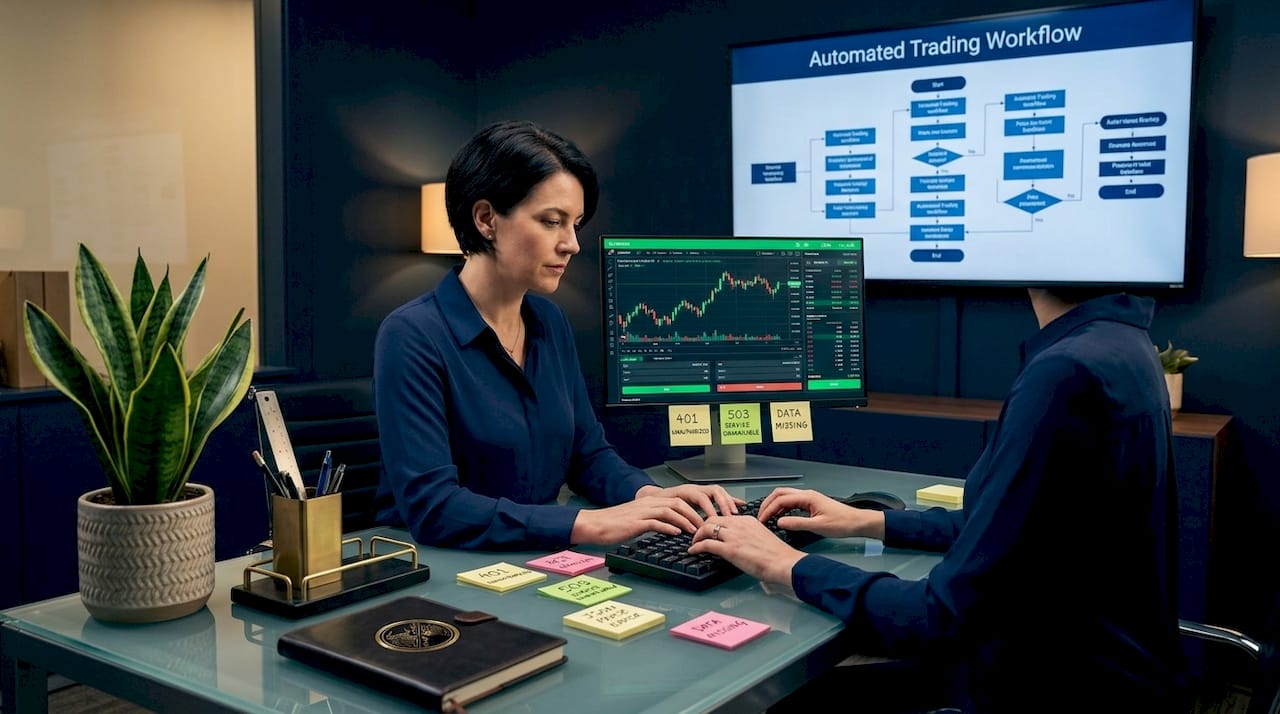
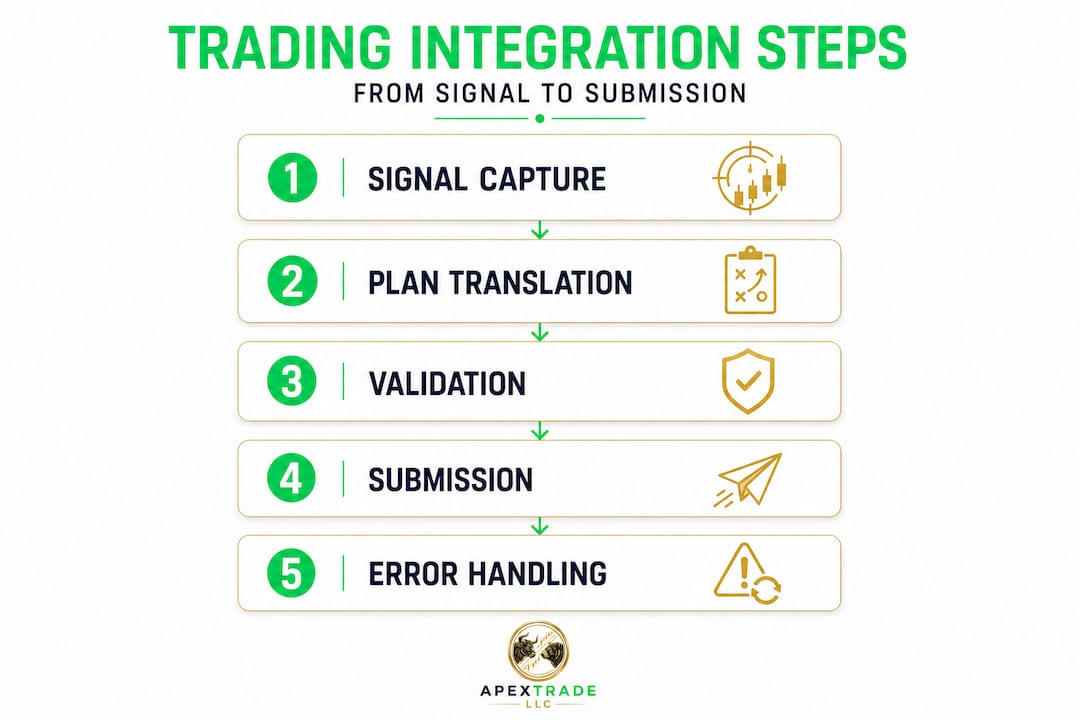
A well-designed integration follows a clear, sequential path for every trade. Each step serves a specific purpose, and skipping any one of them introduces risk.
- Signal generation: A strategy, bot, or external alert identifies a trade opportunity based on technical indicators, price thresholds, or model outputs.
- Plan construction: The system translates the signal into a structured order intent, specifying asset, direction, size, order type, and any conditional parameters.
- Validation: Before touching any broker API, the system checks position limits, available margin, market status, and risk rules. This is where bad orders get stopped.
- Submission: The validated order is sent to the broker or exchange with a unique idempotency key attached, so retries don't create duplicates.
- Fill state management: The system monitors the order's status, handles partial fills, and manages any cancel/replace logic if conditions change.
- Logging and analytics: Off the critical execution path, every action is recorded for audit, performance analysis, and debugging.
A documented integration pattern emphasizes a low-latency critical path (signal to plan to validate to submit), off-path logging and analytics, plus idempotency keys per order intent and fill-state handling for partially filled orders and cancel/replace behavior.
Pro Tip: Keep your critical execution path as lean as possible. Every extra process you add between signal and submission adds latency. Move logging, analytics, and notifications off the main path so they never delay order entry.
The table below illustrates how each building block maps to a real operational concern:
| Integration layer | What it does | Risk if missing |
|---|---|---|
| Signal to plan translation | Converts strategy logic to order parameters | Mismatched order types, wrong size |
| Validation engine | Checks risk rules before submission | Overleveraged positions, rejected orders |
| Idempotency keys | Prevents duplicate submissions on retry | Double orders, unintended exposure |
| Fill state machine | Tracks partial fills and cancels | Orphaned positions, inaccurate P&L |
| Off-path logging | Records every action for audit | No visibility into failures or slippage |
Using automated trading bots without these layers in place is like driving at high speed with no seatbelt. The system may work perfectly most of the time, but when something unexpected happens, the consequences are severe. Connecting linked broker accounts through a platform that manages all five layers gives you execution control that manual trading simply cannot match.
Why interface standardization and broker adaptation matter
Understanding core mechanics leads naturally to a key operational challenge: how do integrations stay robust when broker systems constantly evolve?
Every broker and exchange exposes its own API with its own conventions, error codes, order types, and rate limits. A crypto exchange might use REST with WebSocket order updates. A stock broker might use a proprietary FIX protocol. A forex venue might have its own session management quirks. If your integration layer talks directly to each of these without abstraction, every API change becomes a potential system failure.
From a systems perspective, interface standardization is often about creating a stable internal contract for actions like place, cancel, and query, and versioning broker adapters because broker APIs and their error semantics change over time.
The practical implication is significant. When a broker updates their API, only the adapter for that broker needs to change. The rest of your trading system, including your strategies, risk rules, and logging, remains untouched. Without this separation, a single broker API update can require you to rewrite core logic across your entire stack.
| Approach | Stability | Maintenance load | Scalability |
|---|---|---|---|
| Direct broker API calls | Low | High (each change breaks logic) | Poor |
| Standardized internal interface | High | Low (only adapters update) | Excellent |
| Mixed approach | Medium | Unpredictable | Limited |
Pro Tip: When evaluating a trading platform, ask specifically how it handles broker API version changes. Platforms that manage this through versioned adapters will have far fewer outages and execution failures than those that connect directly without abstraction.
Robust integration error handling is equally critical. When a broker returns an error, the system needs to distinguish between a retryable error (like a temporary rate limit) and a fatal error (like an invalid order parameter). Treating all errors the same way leads to either missed orders or runaway retry loops. Thoughtful API standardization at the platform level means individual traders don't have to solve these problems themselves.
What to look for in a trading integration solution
Now that you know what enables a stable integration, here's how to practically choose or vet an integration solution.
The market is full of platforms that describe themselves as "integrated" without delivering the execution layer reliability that term implies. Here's what actually separates a serious integration solution from a marketing claim.
When evaluating any platform for crypto, stocks, or forex trading, focus on execution quality rather than the word "integration" itself. Specifically, look for whether the stack includes a real execution layer, correct translation of order intent to venue and broker order types, and safety around partial fills, reconnects, and duplicate submissions.
Use this checklist when evaluating any integration platform:
- Real execution layer: The platform actually submits and manages orders, not just relays data signals to you for manual entry
- Order type translation: The system correctly maps your strategy's intent (market, limit, stop, bracket) to the specific order types each venue supports
- Partial fill handling: When an order fills partially, the system tracks the remaining quantity and manages it according to your strategy rules
- Reconnect logic: If the connection to a broker drops, the system recovers gracefully without creating duplicate orders or leaving positions unmanaged
- Multi-venue support: The platform connects to crypto exchanges, stock brokers, and forex venues through a unified interface, not separate disconnected modules
- Audit trail: Every order action is logged with timestamps, IDs, and outcomes for performance review and compliance
A platform that handles copy trading integration well demonstrates these qualities clearly. Copy trading requires the system to translate one trader's order into potentially hundreds of replicated orders across different account sizes, venues, and position limits, all in near real time. If the integration layer can handle that, it can handle your individual strategy execution too.
One important statistic worth noting: research consistently shows that execution quality, not signal quality, is the primary differentiator between profitable and unprofitable automated trading systems at scale. A great signal executed poorly loses money. A good signal executed reliably makes money. The integration layer is where execution quality is won or lost.
Real-world examples: Integration in action across markets
To make these concepts tangible, let's walk through a few real-world examples across the three major asset classes.
Crypto: Handling order book fragmentation and arbitrage
- A bot detects a price discrepancy between two exchanges and generates a simultaneous buy and sell signal.
- The integration layer submits both orders with separate idempotency keys to prevent duplicates if either connection retries.
- One order fills fully, the other fills partially due to thin liquidity.
- The state machine flags the partial fill, calculates the remaining exposure, and either submits a follow-up order or cancels based on the strategy's rules.
- Both outcomes are logged off-path without delaying any subsequent signal processing.
Stocks: Market hours, circuit breakers, and regulatory checks
- A signal fires at 9:29 AM Eastern, one minute before the U.S. market opens.
- The validation layer checks market hours and holds the order in a pending queue rather than submitting to a closed market.
- At 9:30 AM, the order is released and submitted with the correct order type for the opening session.
- If a circuit breaker halts the stock mid-session, the integration layer detects the halt status and pauses related order activity automatically.
Forex: Managing reconnects and overlapping sessions
- A strategy runs across the London and New York session overlap, the highest-volume period in forex.
- A brief connectivity interruption occurs during a news event.
- The integration layer reconnects, queries open order status from the broker, reconciles against its own state records, and resumes without submitting duplicate orders.
As the low-latency integration pattern documents, fill-state handling for partially filled orders and cancel/replace behavior is essential across all these scenarios. Each market has its own timing, liquidity, and regulatory context, but the underlying integration requirements are consistent.
Exploring integrated trading solutions that cover all three asset classes from a single platform eliminates the operational overhead of managing separate integrations for each market.
Why most traders underestimate the complexity — and opportunity — of trading integration
Here's an uncomfortable truth: most traders spend 80% of their platform evaluation time on the user interface and alert features, and almost no time examining the execution layer. This is exactly backwards.
A beautiful dashboard that shows you real-time P&L is worthless if the underlying order management system drops fills, creates duplicate positions, or fails silently during high-volatility periods. We've seen traders attribute months of underperformance to their strategies when the actual problem was integration failures they couldn't see because the platform had no proper audit trail.
The opportunity in this is real. Traders who invest time in understanding and selecting platforms with robust integration quality gain a genuine edge. Not because they have better signals, but because their signals actually execute as intended. Lower failure rates, fewer surprise positions, and accurate fill records compound into meaningfully better performance over time.
Managing your portfolio automation insights through a platform that takes integration seriously also means you spend less time firefighting and more time refining your strategies. The operational overhead of manual error recovery is a hidden cost that most traders never quantify until they've already paid it many times over.
The traders who thrive with automation are not necessarily the ones with the most sophisticated models. They're the ones who built or chose systems where the execution layer is as carefully designed as the strategy layer.
Take the next step: Integrated solutions from ApexTrade
ApexTrade was built specifically for traders who understand that execution quality matters as much as strategy quality. The platform unifies crypto, stocks, and forex trading through a single integrated environment that handles the edge cases, error recovery, and order management complexity described throughout this article.
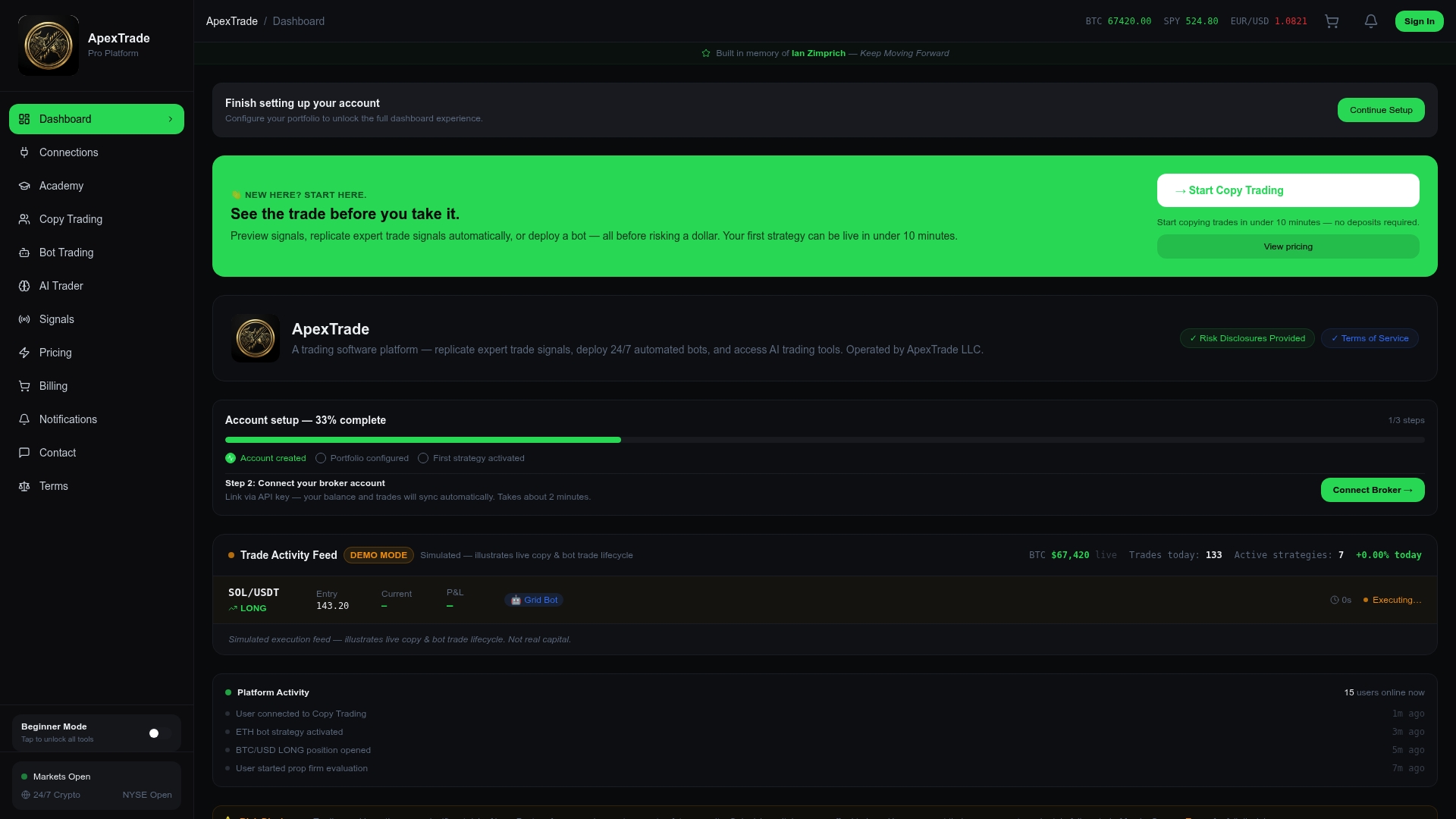
Whether you're deploying bot trading tools that run 24/7 across multiple markets, using the copy trading platform to replicate proven strategies with precision, or looking to connect your accounts across multiple brokers and exchanges, ApexTrade provides the execution infrastructure to do it reliably. The platform handles idempotency, fill state management, broker adapter versioning, and error handling so you can focus on strategy, not system maintenance. Onboarding is straightforward, multi-market compatibility is built in, and the audit trail gives you full visibility into every order action.
Frequently asked questions
What is the main benefit of trading integration?
Trading integration saves time and reduces risk by automating trade execution and ensuring all orders are managed safely across platforms, with the low-latency critical path handling signal to submission without manual intervention.
How does trading integration handle partial fills or duplicate orders?
Advanced integration uses idempotency and state tracking to prevent duplicate orders and carefully manage partial fills, ensuring your position records stay accurate even when broker responses are ambiguous.
Is trading integration only for large institutions?
No. Individual traders and small firms benefit significantly, especially when using platforms that support robust multi-venue connections with proper execution layers built for retail account sizes.
What should I look for in a trading integration platform?
Prioritize execution quality and error handling over interface features, and confirm the platform includes real order management, correct order type translation, and built-in protections against partial fills and duplicate submissions.