
Most traders come to crypto through volatility, then stay for everything else. The question of why trade cryptocurrencies is rarely answered well: generic articles point to "big gains" and move on, leaving out the structural advantages that make this asset class genuinely different. Crypto offers 24/7 liquidity, low correlation to equities, and a market architecture that rewards automation far more than traditional markets do. If you are a trader or investor who wants to understand whether this market fits your strategy, the answer depends on more than price swings.
Table of Contents
- The unique advantages of trading cryptocurrencies
- Understanding crypto market dynamics and volatility
- Lower transaction costs and enhanced trading efficiency
- Harnessing automation: boosted efficiency and risk management
- Navigating risks and strategies for sustainable crypto trading
- Why the nonstop crypto market demands a new trading mindset
- Explore automated crypto trading solutions with ApexTrade
- Frequently asked questions
Key Takeaways
| Point | Details |
|---|---|
| Portfolio diversification | Cryptocurrencies offer low correlation with traditional assets, helping reduce portfolio volatility. |
| Continuous market hours | Crypto markets operate nonstop year-round, providing unmatched trading flexibility. |
| Lower fees | Transaction costs are generally lower for crypto trading versus traditional finance. |
| Automation boosts success | Using automated trading tools improves win rates and risk management in 24/7 markets. |
| Risk discipline needed | Successful trading requires managing volatility, tax obligations, and avoiding emotional decisions. |
The unique advantages of trading cryptocurrencies
The benefits of cryptocurrency trading go well beyond speculation. The market structure itself is built differently from equities or forex, and those structural differences create real, usable edges for traders who understand them.
Portfolio diversification is one of the strongest arguments. Cryptocurrencies show low correlation with traditional equities and fixed income assets, which means they tend to move independently during market stress. Adding even a small allocation to Bitcoin or Ethereum can reduce overall portfolio volatility when stocks and bonds fall together, as they did in 2022.
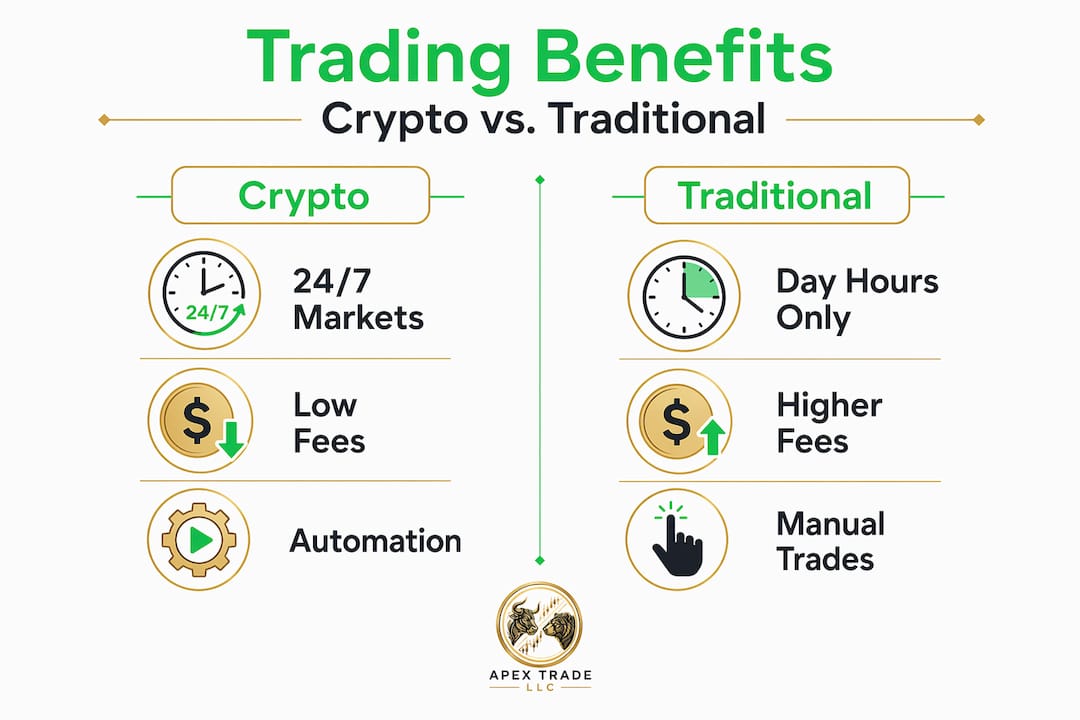
Market access without restrictions is another advantage that often gets undervalued. Crypto markets run 24 hours a day, seven days a week, 365 days a year, with no closing bells. A trader in Tokyo can act on news at 3:00 a.m. the same way a trader in New York can at 3:00 p.m. No waiting for Monday open.
Here is a quick breakdown of why experienced traders find the crypto market worth their attention:
- Volatility with structure. Bitcoin regularly moves 5 to 10 percent in a day. That is noise in crypto and a major event in equities. For traders with defined crypto trading strategies and risks in place, that movement creates frequent, actionable setups.
- Long-term appreciation. Bitcoin grew from under $1,000 in 2017 to over $60,000 by 2024, outpacing most conventional asset classes over that window.
- Accessibility. You can start trading crypto with far less capital than is required to trade most futures or institutional products.
- Decentralization. No single entity controls crypto prices the way central banks influence currency markets, which means price discovery is more purely market-driven.
"The most underrated reason to trade crypto is not the returns. It is the education. Crypto forces you to understand order books, liquidity, and market structure faster than any other market."
Understanding crypto market dynamics and volatility
With the core benefits clear, it is worth slowing down on how this market actually behaves. Knowing the advantages of trading cryptocurrencies means knowing when those advantages appear and when they disappear.
Crypto market capitalization exceeded $4.5 trillion in 2026, with daily trading volumes rivaling the largest stock exchanges. At that scale, major pairs like BTC/USDT and ETH/USDT carry deep liquidity during active sessions. But liquidity is not uniform.
Session overlaps drive the sharpest moves. When US and European trading hours intersect, typically between 8:00 a.m. and noon Eastern Time, order book depth rises and spreads tighten. That is when professional traders are most active, and when large price moves carry the most follow-through.
Key dynamics every crypto trader needs to understand:
- Weekend volatility. Thinner order books on Saturday and Sunday mean smaller orders can move prices more dramatically. This is both a risk and an opportunity depending on your position size.
- Market cycles. Crypto follows four-year halving cycles for Bitcoin, which compress and expand volatility in somewhat predictable patterns. Understanding where you are in the cycle matters for multi-week trades.
- Session timing. Asian session hours (midnight to 8:00 a.m. Eastern) tend to show slower movement, making them useful for setting orders rather than active scalping.
- Funding rates. In perpetual futures markets, funding rates signal sentiment. Extremely positive rates mean the market is heavily long, which often precedes corrections.
"Most retail traders focus on the wrong variable. They obsess over price and ignore timing. In crypto, when you trade often matters as much as what you trade."
Pro Tip: Use a volume heat map tool to identify which hours show the highest activity for your specific trading pair. For BTC, volume consistently peaks during the US open and drops sharply after midnight Eastern. Aligning your active trading hours to those peaks can meaningfully improve fill quality and reduce slippage on entries.
Lower transaction costs and enhanced trading efficiency
One of the less-discussed advantages of trading cryptocurrencies is how cheap it actually is to execute trades compared to traditional finance. That cost difference adds up fast.
Crypto trading fees are meaningfully lower than what you pay in traditional brokerage accounts, and platforms like Binance cut fees by an additional 25 percent when you pay using their native BNB token. For active traders running dozens of trades per week, this is not a minor detail.
Here is a practical fee comparison across market types:
| Market | Typical fee per trade | Settlement time |
|---|---|---|
| Traditional stocks | 0.1% to 0.5% | 2 business days (T+2) |
| Forex (retail) | Spread of 1 to 3 pips | Same day to 2 days |
| Crypto (centralized exchange) | 0.05% to 0.2% | Seconds to minutes |
| Crypto (with exchange token) | 0.0375% to 0.15% | Seconds to minutes |
Settlement speed is where crypto trading cost advantages become clearest. Stock trades settle in two business days. Crypto settles in seconds. That means your capital is not locked up waiting for confirmation, and you can redeploy it immediately after a trade closes.
- Avoiding fiat conversion fees when trading crypto-to-crypto pairs saves 0.5% to 2% per conversion.
- On-chain transfers between wallets often cost less than one dollar for many tokens.
- No commission markups from intermediary brokers.
Pro Tip: If you trade on a centralized exchange more than five times per week, check whether that platform offers a fee-reduction token or a tiered VIP program based on monthly volume. At 30-day volume above $1 million, maker fees on major platforms drop below 0.05%, which is a fraction of what most retail brokerage accounts charge.
Harnessing automation: boosted efficiency and risk management
The 24/7 nature of crypto is its greatest selling point and its hardest challenge. No human trader can watch a market that never closes. That is exactly why automation is not optional in crypto. It is the standard.
- Continuous monitoring. Bots track price, volume, funding rates, and order book depth around the clock. A human checking positions twice a day will miss the move that happens at 2:00 a.m.
- Arbitrage capture. Price differences between exchanges last seconds. Automated bots detect order book imbalances and execute across venues faster than any manual process, with backtested win rates reaching 70 to 75 percent.
- Strategy testing. Running a bot in simulation mode before going live lets you stress-test entries, exits, and position sizing against historical data without risking real capital.
- Emotion removal. Bots follow rules. They do not hold a losing trade longer than the stop-loss says because they feel like the market "has to come back." That discipline is worth more than most traders acknowledge.
The performance data on automated tools supports the case clearly. ARTEMIS automated trading agents improved win rates from 31.2 percent to 41.3 percent over 60 days of live testing in 2026, demonstrating that well-designed bots can adapt to evolving market conditions and refine strategies in real time.
"Automation does not replace trader judgment. It enforces it. A well-configured bot is simply your own trading rules, running without fatigue."
Platforms like ApexTrade offer automated crypto trading bots that execute defined strategies around the clock, and their crypto automation tips blog covers practical setup steps for traders at every experience level.
Pro Tip: Before deploying any bot with real funds, run it for a minimum of 30 days in paper trading mode across at least one full market cycle that includes both a sharp rally and a correction. A bot that only performs in trending markets will fail badly in sideways or mean-reverting conditions.
Navigating risks and strategies for sustainable crypto trading
Understanding reasons to trade crypto also means understanding why many traders fail. Volatility creates opportunity, but it punishes traders who do not respect it.
The most common reason retail traders lose money in crypto is not bad strategy selection. It is overlooked taxes and fees quietly eroding profits on trades that looked profitable in isolation. Every trade is a taxable event in most jurisdictions, and calculating cost basis across dozens of trades requires either dedicated software or a very organized spreadsheet.
Practical rules for sustainable trading:
- Risk 1 percent or less per trade. If you are wrong 10 times in a row (which happens), you still have 90 percent of your capital. Recovering from a 50 percent drawdown requires a 100 percent gain just to break even.
- Set stop-losses before entering. Decide your exit before you enter, not after the trade goes against you when emotions are running hot.
- Use price alerts. Platforms and apps can notify you of significant moves while you are away from your screen. This is especially important for managing crypto trading risks during volatile overnight sessions.
- Paper trade first. Practice on a simulated account until your strategy shows consistent results before committing real capital.
- Store assets securely. Hardware wallets for long-term holdings keep your assets off exchanges and out of reach from potential breaches.
Pro Tip: Track your effective tax rate on crypto gains before you scale position sizes. In the US, short-term crypto gains are taxed as ordinary income, which can reach 37 percent at higher income levels. Running your actual after-tax returns changes the profitability picture significantly.
Why the nonstop crypto market demands a new trading mindset
Here is what most cryptocurrency trading explainers skip: the 24/7 market does not just change your schedule. It changes your psychology.
In traditional markets, the closing bell is a forced reset. Positions close, overnight risk narrows, and traders get a natural pause to review, recalibrate, and sleep without their portfolio moving against them. Crypto eliminates all of that. Positions are exposed continuously, without natural breaks, creating a form of low-grade anxiety that compounds over time if you do not build systems to manage it.
We have seen this pattern repeatedly: traders who do exceptionally well in their first month burn out by month three because they never stop watching. They check prices at dinner, at 2:00 a.m., before coffee. That behavior does not improve results. It destroys them.
The traders who endure in crypto share one habit: they treat their trading like a business with defined hours. They set their stops, configure their alerts, deploy their bots, and then close the screen. Weekend liquidity drops sharply, and thin order books can produce violent moves on minor news. But a trader with hard stops and automated risk controls does not need to watch every candle.
The crypto market nonstop trading mindset is not about being available around the clock. It is about building a system that is available around the clock so you do not have to be. That shift, from manual vigilance to systematic discipline, is what separates traders who last from those who flame out after one bad weekend.
Explore automated crypto trading solutions with ApexTrade
Trading cryptocurrencies at the level this market rewards requires tools built for its specific demands, not adapted from stock trading.
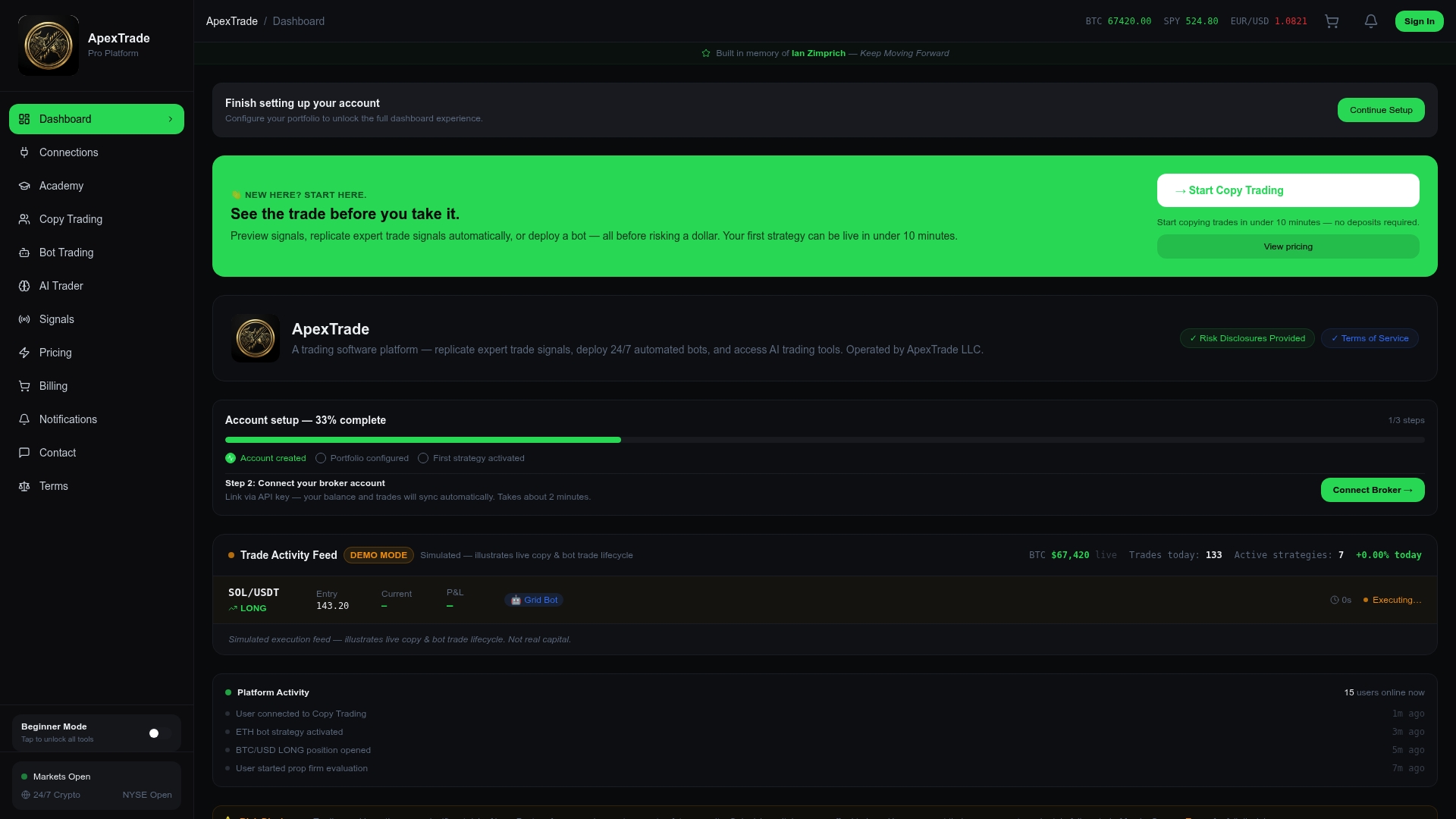
ApexTrade is purpose-built for exactly this environment. The platform's automated bot trading lets you run defined strategies across crypto markets at any hour, without manual oversight. The crypto copy trading features let you mirror the positions of verified, high-performing traders while you build your own strategy knowledge. And account connectivity options make it straightforward to manage positions across multiple exchanges from a single dashboard. Risk controls, stop-loss automation, and real-time alerts are integrated directly into the platform, giving you systematic protection without the manual overhead that burns most traders out.
Frequently asked questions
Why are cryptocurrencies considered good for portfolio diversification?
Cryptocurrencies show low correlation with traditional equities and fixed income, meaning they tend to move independently from stocks and bonds, which reduces overall portfolio volatility when other assets fall in tandem.
How do crypto market trading hours differ from traditional stock markets?
Crypto markets run 24/7 without closing times, allowing price discovery and trading to continue through weekends and holidays, unlike stock exchanges that close daily and remain shut on weekends.
What role does automation play in cryptocurrency trading?
Automation monitors markets continuously and executes rules-based strategies without emotional interference. ARTEMIS automated agents demonstrated win rate improvements from 31.2 percent to 41.3 percent over 60 days, showing measurable performance gains from systematic trading.
What are common risks involved with cryptocurrency trading?
Sharp price swings, taxable events on every trade, and fees that quietly erode profits are the primary dangers. Retail traders most often lose due to overlooked tax obligations and undisciplined position sizing, not bad market selection.
Why is understanding liquidity important in crypto trading?
Liquidity fluctuates significantly by session and time zone. Liquidity varies by active region, and trading during low-liquidity windows exposes you to wider spreads, larger slippage, and more pronounced price swings from smaller order flows.