
Most traders who ask why trade crypto 24/7 expect a simple answer about flexibility. The real answer is more interesting. Cryptocurrency markets never close because no central exchange or regulatory body controls them. That structural difference from stocks and forex creates genuine strategic opportunities, from capitalizing on news events at 3 AM to running automated strategies while you sleep. It also creates real risks that most articles skip. This guide covers the mechanics, benefits, session patterns, automation tools, and hard-won lessons that separate profitable continuous traders from ones who simply burn out.
Table of Contents
- Key takeaways
- Why trade crypto 24/7: the core mechanics
- The real benefits of 24/7 crypto markets
- Challenges and risks in continuous markets
- Session patterns and geographic flow strategies
- Using automation to trade around the clock
- My honest take on trading crypto around the clock
- How Apextradellc supports 24/7 crypto trading
- FAQ
Key takeaways
| Point | Details |
|---|---|
| No market closures, no gap risk | Continuous crypto trading eliminates overnight and weekend price gaps you cannot react to. |
| Volatility creates opportunity | Bitcoin's 3.5% daily volatility far exceeds stock markets, creating more frequent entry points. |
| Session patterns still exist | Liquidity and volume peak during US-Europe overlap, giving traders clear windows to prioritize. |
| Automation is not optional | Bots and automated orders let you cover the market around the clock without constant screen time. |
| Discipline determines profitability | 24/7 trading profitability depends on skill and risk management, not market hours alone. |
Why trade crypto 24/7: the core mechanics
Stock traders deal with a hard constraint: when the market closes, they are frozen out. If Tesla releases bad earnings after the bell, you watch the price fall and can do nothing until 9:30 AM the next day. Crypto has no such constraint. Bitcoin trades on a Tuesday night in Tokyo the same way it trades on a Monday morning in New York.
This is not just a convenience feature. Eliminating market closures directly improves price discovery and reduces the violent gap openings that catch stock traders off guard. When meaningful news hits on a Saturday, crypto price action absorbs it in real time. Equity traders holding long positions over that same weekend have no recourse.
The institutional world has taken notice. CME Group launches 24/7 trading for regulated crypto futures and options starting May 29, 2026, with a brief weekly maintenance window. CME processed over $3 trillion in notional crypto volume in 2025, and institutional demand for real-time risk management drove this move directly.
Here is what continuous trading specifically changes for an active trader:
- You can enter or exit positions at any hour based on technical setups or news triggers.
- You never hold a position helplessly through a weekend gap.
- Automated strategies can run Monday through Sunday without manual restarts.
- You access derivatives and leverage at any hour, not just during exchange windows.
Pro Tip: If you are coming from equities, resist treating Friday evening as a natural "off" period in crypto. Some of the most significant Bitcoin price moves occur over weekends when institutional equity desks are offline and retail flows dominate.
The real benefits of 24/7 crypto markets
The phrase "benefits of trading crypto 24/7" gets thrown around a lot. Most articles stop at "you can trade anytime." That is true but shallow. The substantive benefits run deeper.

Volatility as an asset
Bitcoin's annualized volatility sits at 55 to 65%, compared to the S&P 500's 15 to 20%. For day traders, volatility is inventory. More price movement means more setups, tighter risk-to-reward ratios on breakouts, and more opportunities to capitalize on momentum. A 1% daily move in equities is newsworthy. In crypto, it is a slow day.
No pattern day trader restrictions
Equity traders with accounts under $25,000 face the pattern day trader (PDT) rule, which limits them to three day trades per five-day rolling period. Crypto carries no such restriction. A trader with $5,000 can execute ten trades in a single session legally and without penalty.
React to global events instantly
When a government announces a crypto ban, a major exchange gets hacked, or the Federal Reserve surprises the market, crypto prices move within minutes regardless of day or time. Traders who are awake and positioned correctly can react. Those in traditional markets wait for the opening bell and fight through a gap.
| Metric | Bitcoin | S&P 500 |
|---|---|---|
| Daily volatility | ~3.5% | ~1.1% |
| Annualized volatility | 55–65% | 15–20% |
| Trading hours per week | 168 | ~33 |
| Weekend trading | Yes | No |
| PDT rule applies | No | Yes (under $25K) |
The advantages of 24/7 crypto markets are real, but they are tools. A hammer does not build a house by itself.
Challenges and risks in continuous markets
Trading cryptocurrencies around the clock sounds ideal until you watch a flash crash wipe 8% off a position at 4 AM while you are asleep. The same structural openness that creates opportunity also creates risk.
-
Thin liquidity off-peak. Weekend and overnight liquidity drops 40 to 60% compared to peak hours. Spreads widen, slippage increases, and large orders move prices more than they would during active sessions. A market order at 3 AM EST can fill at a far worse price than the same order at 2 PM EST.
-
Flash crash exposure. Thin order books amplify sudden moves. A single large sell order during low-liquidity hours can cascade into a rapid price drop that triggers stop-losses across the board, accelerating the decline before any buyers step in.
-
Psychological burnout. The absence of a PDT rule tempts newer traders into overtrading. Without natural market breaks built into the schedule, it takes genuine discipline to step away. Many traders who go full-time report exhaustion within six months.
-
Emotional decision-making at odd hours. Fatigue degrades judgment. A trade you would never take at 2 PM looks compelling at 2 AM after a losing session. This is not a character flaw. It is biology.
-
No external forcing function. Stock markets close, which forces traders to step back, review, and reset. Crypto never forces that pause. You have to build it yourself.
Pro Tip: Set defined trading windows for yourself, just as you would for any professional task. Trading between 8 AM and 6 PM EST covers the highest liquidity periods and protects your judgment. Let automation handle the rest.
Session patterns and geographic flow strategies
Crypto markets never close, but they breathe. Volume rises and falls in recognizable patterns tied to global business hours. Understanding this rhythm is how experienced traders optimize entries, reduce slippage, and find exploitable momentum windows.
Liquidity peaks during the US-Europe session overlap, roughly 8 AM to 12 PM EST. This period combines active European institutional participants with the opening of the US trading day. Spreads are tightest, order books are deepest, and price action is most meaningful. The Asian session, centered around Tokyo and Singapore business hours, creates a secondary but still significant liquidity peak. The dead zone runs from approximately 4 AM to 8 AM EST, when liquidity is at its lowest globally.
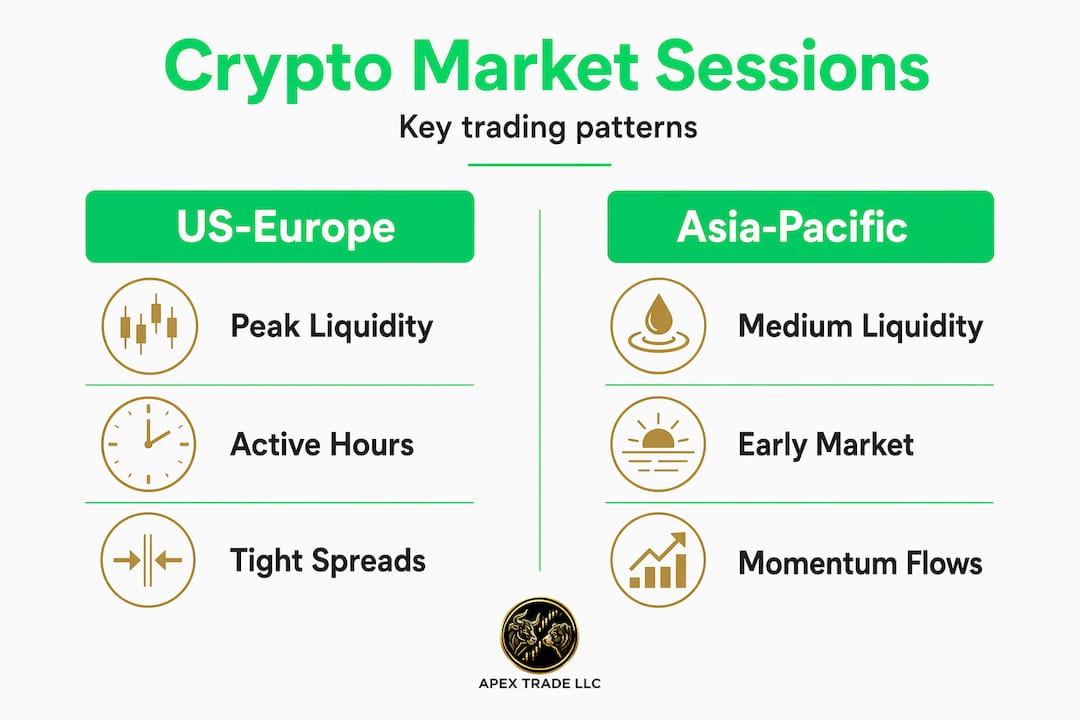
This geographic flow creates exploitable momentum patterns. One documented example: a momentum strategy built on ETH flows from the Europe session into the US session produced a 256% net return over 4.7 years with a Sharpe ratio of 0.808. The strategy did not simply buy and hold. It traded a specific directional bias based on which geographic session was driving volume.
| Session | Time (EST) | Liquidity Level | Key Characteristics |
|---|---|---|---|
| Asian | 8 PM – 4 AM | Medium | Altcoin volatility, secondary BTC flows |
| Dead zone | 4 AM – 8 AM | Low | Wide spreads, flash crash risk |
| European open | 3 AM – 8 AM | Medium-high | Early momentum, institutional positioning |
| US-Europe overlap | 8 AM – 12 PM | Peak | Tightest spreads, most reliable setups |
| US afternoon | 12 PM – 5 PM | High | Trend continuation or reversal |
For traders who want to know how to trade crypto 24/7 without watching every session personally, automated bots tied to session-based entry rules are the most practical solution.
Using automation to trade around the clock
The importance of continuous crypto trading becomes more manageable when you stop trying to do it manually. Professional traders who sustain long-term profitability almost universally rely on automation for positions they hold through overnight and weekend sessions.
Automation in this context means several specific things:
- Automated stop-loss and take-profit orders on every open position, so a flash crash at 4 AM does not become a catastrophic loss before you wake up.
- Trading bots that execute rule-based strategies around the clock without emotional interference. A bot does not revenge-trade after a losing streak.
- Copy trading to mirror verified expert traders' positions in real time, giving you market exposure during sessions you do not actively monitor.
- Portfolio management dashboards that consolidate positions across multiple exchanges into a single view, so you are not logging into five platforms to assess your overall exposure.
Automated stop-loss tools combined with bot trading help traders manage 24/7 markets without the psychological cost of constant vigilance. The goal is not to replace judgment. It is to apply judgment once, encode it in rules, and let the system execute without drift.
You can read more about building this kind of structured approach in a step-by-step trading workflow that covers how to layer manual and automated execution without creating conflicting positions.
My honest take on trading crypto around the clock
I have watched traders approach 24/7 crypto markets the same way someone treats a casino that never closes: with the assumption that more time playing equals more winning. It does not work that way.
In my experience, the traders who profit consistently from continuous crypto access are the ones who treat it as an infrastructure advantage, not a license to trade constantly. They identify two or three sessions where their edge is strongest. They automate everything outside those windows. They sleep.
The institutional shift matters here. When CME launched 24/7 crypto futures, it was not because retail traders wanted to trade at midnight. It was because sophisticated risk desks needed to manage crypto derivatives exposure in real time without gap risk accumulating over weekends. That same infrastructure benefit is available to you, but it requires using it deliberately.
What I have found to be true: the markets being open all the time is an advantage only if your risk management is also running all the time. That means automated orders, defined position limits, and a schedule you actually follow. The traders I have seen burn out were not underskilled. They were undisciplined about when to stop.
My actual advice is to pick your sessions, automate your protection, and treat the rest as background noise that bots can handle. Managing a trading portfolio with that mindset is far more sustainable than trying to watch every candle.
— James
How Apextradellc supports 24/7 crypto trading
If you are serious about trading cryptocurrencies around the clock without the burnout that comes from manual monitoring, you need tools built for that exact problem.
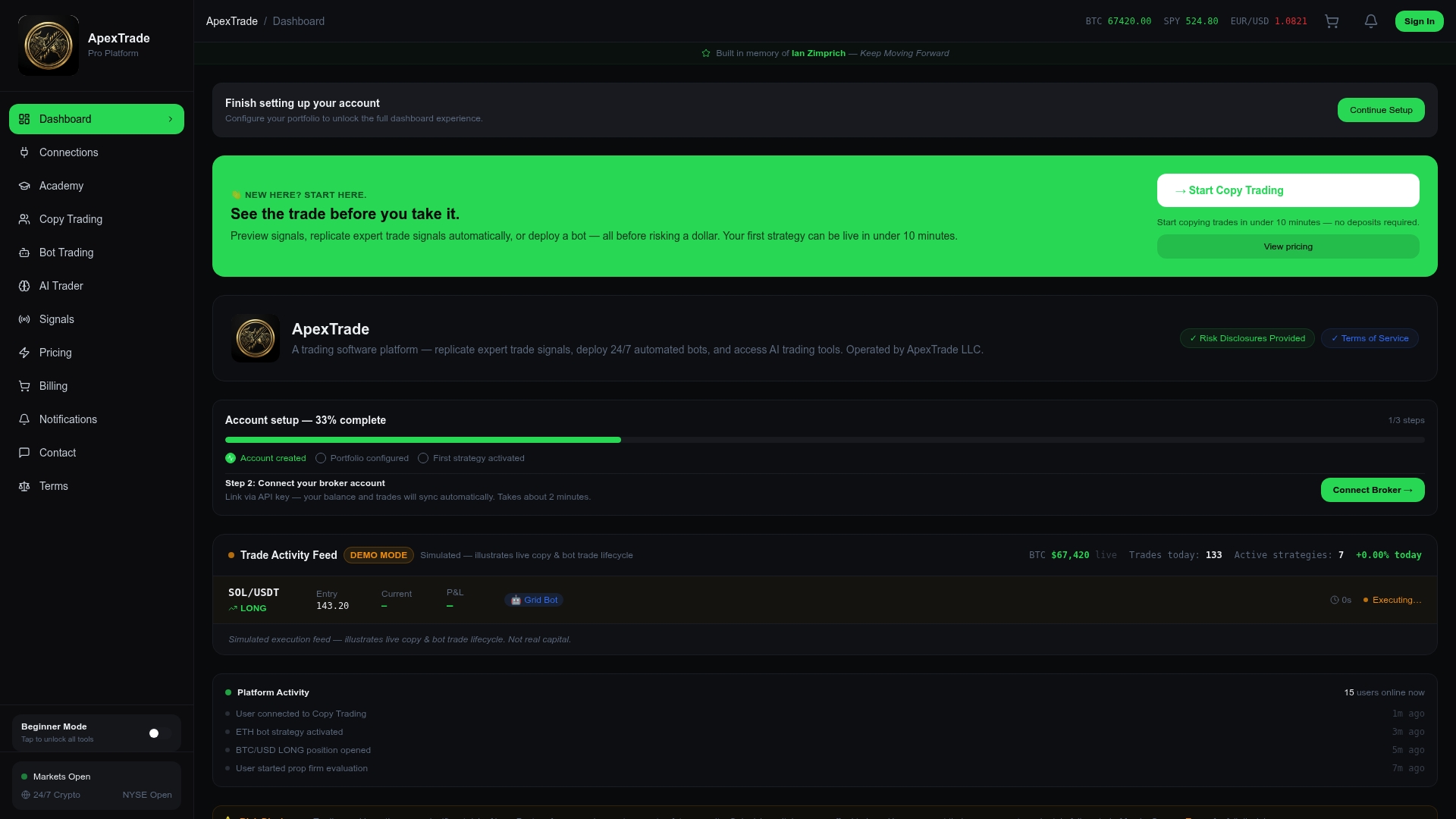
Apextradellc provides a complete toolkit for continuous crypto trading. The bot trading platform lets you deploy automated strategies that execute 24/7 based on the rules you define, covering every session from the Asian open to the US close without requiring your attention. For traders who want expert exposure without building strategies from scratch, the copy trading feature mirrors verified traders' positions in real time. Connected accounts consolidate your exchange exposure into one dashboard, so you always know where you stand. The core trading platform supports real-time execution with the speed and reliability that continuous markets demand. Explore Apextradellc's tools and see which combination fits your trading style.
FAQ
Why do crypto markets trade 24/7?
Cryptocurrency markets operate continuously because they are decentralized networks with no central exchange or regulator that can set closing hours. Trading happens peer-to-peer across global exchanges at all times.
Is crypto trading 24/7 actually profitable?
Profitability in 24/7 crypto markets depends on trader skill, strategy quality, and risk discipline, not on market hours alone. More trading time creates more opportunities but also more exposure to risk.
What are the best hours to trade crypto?
The US-Europe session overlap from approximately 8 AM to 12 PM EST offers peak liquidity and tightest spreads, making it the most reliable window for active traders seeking quality execution.
How do I trade crypto 24/7 without burning out?
Use automated stop-loss and take-profit orders on all open positions, deploy trading bots for sessions you do not monitor personally, and define specific trading hours for your active work rather than watching the market around the clock.
Does 24/7 trading mean I should always be in a position?
No. Being in a position at all times is not a strategy. Sitting out low-liquidity periods, particularly the 4 AM to 8 AM EST dead zone, often protects capital better than forcing trades into thin markets.