
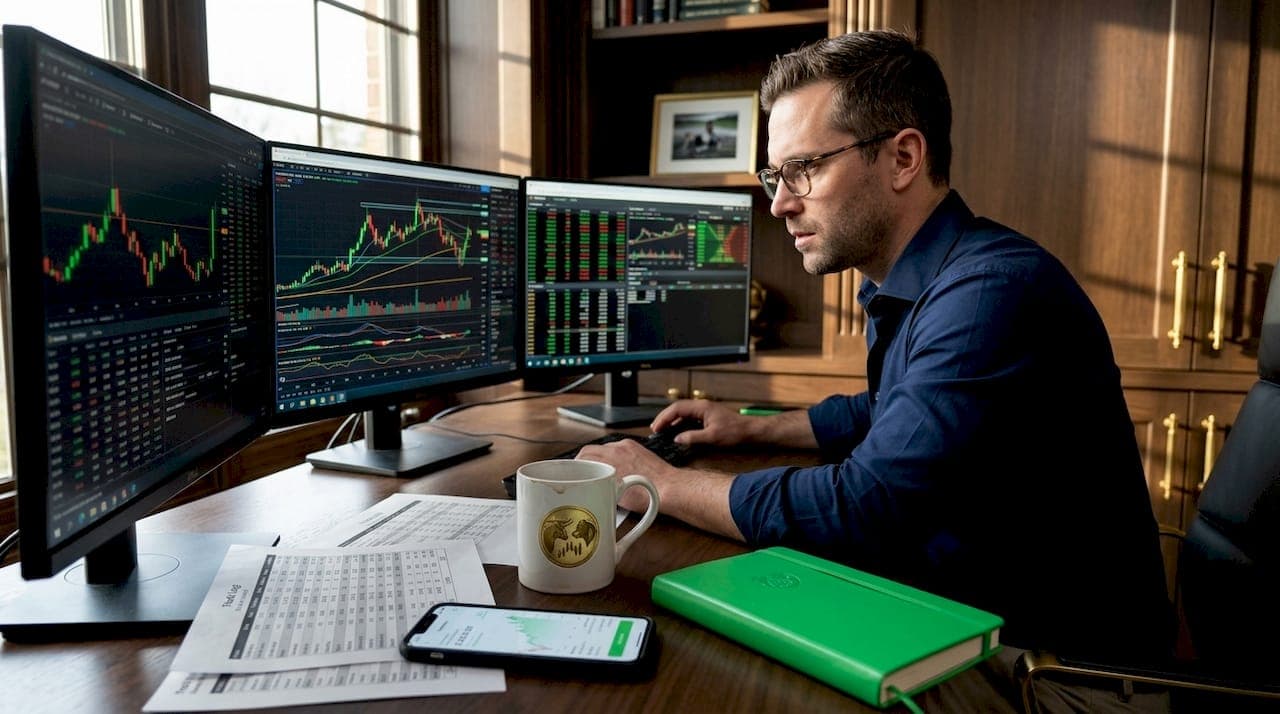
Trading psychology is the mental and emotional framework that determines how traders make decisions, manage risk, and respond to market pressure. Most traders lose money not because their strategy is flawed, but because their emotions override their plan at the worst possible moment. Fear, greed, overconfidence, and regret are not personality defects. They are predictable, measurable forces that distort rational decision-making in real time. Understanding these forces, and building systems to contain them, is what separates consistent traders from those who blow up accounts with solid setups. This guide covers the core concepts, behavioral research, and practical routines that form the foundation of disciplined trading in 2026.
What is trading psychology and why does it matter?
Trading psychology is the study of how emotions, cognitive biases, and mental habits shape every decision a trader makes, from entry and exit timing to position sizing and risk tolerance. It is not a soft skill. Behavioral biases distort rationality in ways that produce consistent, measurable losses across asset classes and experience levels. A trader can have a statistically sound system and still underperform because psychology causes them to deviate from it under pressure.
The most common emotional forces in trading are fear, greed, regret, pride, and overconfidence. Fear triggers premature exits on winning trades. Greed pushes traders to hold too long or size up recklessly. Regret causes revenge trading after a loss. Pride prevents traders from cutting a losing position because admitting the trade was wrong feels like a personal failure. Each of these emotions has a direct behavioral consequence that shows up in your trade log.
"The market doesn't care about your feelings. But your feelings care deeply about the market, and that asymmetry is where most losses are born."
Three behavioral patterns account for the majority of psychology-driven losses:
- Disposition effect: Selling winners too early and holding losers too long, driven by the desire to lock in a "win" and avoid confirming a loss
- Panic selling: Liquidating positions during volatility based on emotional discomfort rather than analysis
- Overtrading: Taking low-quality setups out of boredom, FOMO, or the urge to recover losses quickly
These are not random mistakes. They are predictable responses to emotional triggers, which means they can be anticipated, tracked, and reduced with the right structure.
How do behavioral biases and personality traits shape trading decisions?
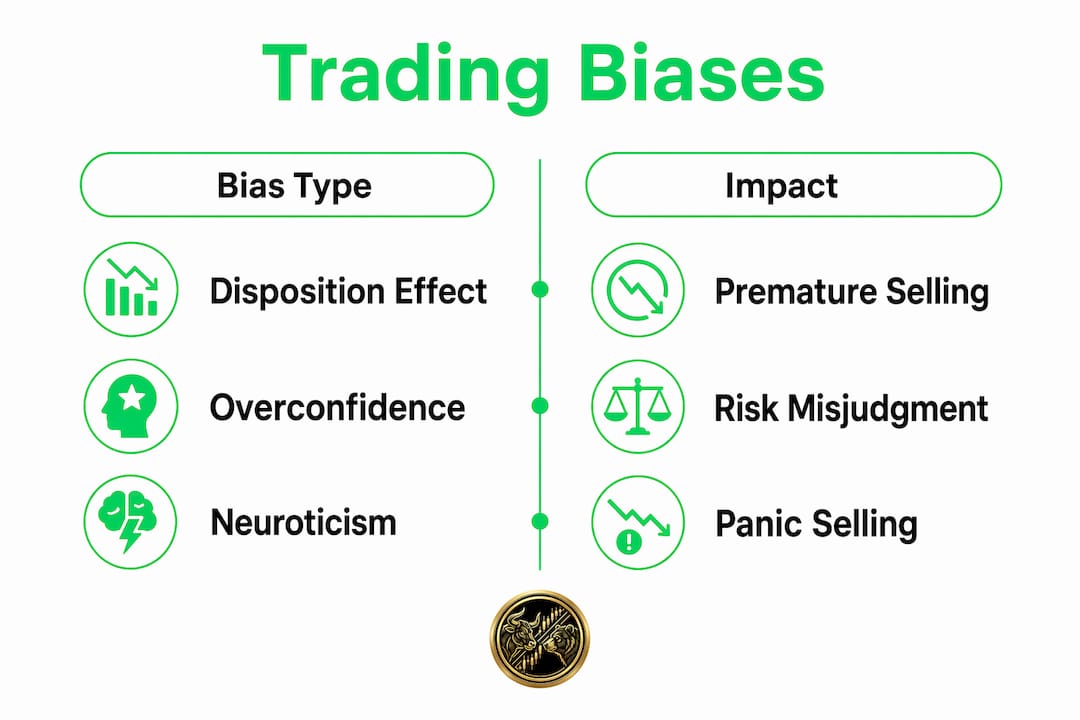
Cognitive biases are systematic errors in thinking that affect every trader regardless of experience. The disposition effect is one of the most studied and costly. Traders affected by it consistently realize gains too quickly and defer losses, which inverts the core principle of letting winners run and cutting losers short. A 2025 Frontiers in Psychology study found that increased corporate transparency significantly reduces this bias by giving traders better data and higher confidence in their positions.

Overconfidence is equally destructive. A 2026 Springer study using simulated trading found that overestimation predicts excessive risk among moderate-to-high risk traders. This means traders who overestimate their edge or their read on the market take on disproportionate position sizes, which amplifies losses when the trade goes wrong. Overconfidence is especially dangerous after a winning streak because recent success feels like evidence of skill rather than probability.
Personality traits also play a direct role. A 2024 MDPI study found that neuroticism links to panic selling during market stress, with emotionally unstable traders consistently liquidating positions at the worst possible time. This finding matters because it points toward targeted coping strategies rather than generic advice. A trader prone to anxiety needs different guardrails than one prone to overconfidence.
| Bias or trait | Effect on trading | Mitigation approach |
|---|---|---|
| Disposition effect | Sells winners early, holds losers long | Predefined exit rules and stop-losses |
| Overconfidence | Oversizes positions, ignores risk signals | Fixed position sizing limits per trade |
| Neuroticism | Panic sells during volatility | Daily loss limits and cool-off periods |
| Loss aversion | Avoids necessary losses, distorts risk | Rules-based journaling and review cycles |
Pro Tip: Identify your dominant bias by reviewing your last 20 trades. If your average winner is smaller than your average loser, the disposition effect is costing you money right now.
What practical strategies and routines improve trading psychology?
Operationalizing psychology through measurable routines and pre-commitments outperforms willpower alone. Willpower is a finite resource that degrades under stress, volatility, and fatigue. Rules and routines do not. The goal is to make as many decisions as possible before the market opens, so that in-the-moment emotional pressure has fewer degrees of freedom to exploit.
A structured pre-trade routine is the most direct way to apply this principle. The Topstep daily trading checklist recommends a consistent sequence of steps before each session: reviewing the economic calendar, confirming your bias, setting your max loss for the day, and identifying your two or three best setups in advance. This process cuts guesswork and forces you to define what a good trade looks like before emotions are involved.
Here is a practical trading psychology checklist you can use before every session:
- Review your journal from the previous session and note any emotional patterns
- Set a hard daily loss limit and commit to stopping if it is hit
- Identify your top two or three setups based on your system, not on gut feel
- Confirm your position sizing rule and do not deviate from it during the session
- Define your exit criteria for both winners and losers before entering any trade
- After the session, tag each trade by emotional state: neutral, impulsive, FOMO, or revenge
Behavioral constraints are the structural equivalent of psychological rules. Pairing fixed risk limits with routines reduces the number of discretionary choices available during a session, which directly limits the damage that overconfidence or loss aversion can cause. A fixed 1% risk per trade, combined with a 3% daily drawdown limit, removes the two most common escalation points for emotional trading.
Pro Tip: Build your trading workflow around constraints first, then add strategy. A mediocre strategy with strong constraints beats a great strategy with no guardrails every time.
How can traders measure and analyze their psychology over time?
Measuring your psychology is not a philosophical exercise. It is a data problem. Tagging trades by emotional state and comparing outcomes across those tags transforms vague self-awareness into a performance metric you can actually act on. TradeJournal Pro, a psychology-integrated journaling tool, uses this approach to help retail traders identify which emotional states correlate with their worst decisions.
The process works like this. After every trade, you assign a tag: neutral, impulsive, FOMO, or revenge. Over 30 to 50 trades, patterns emerge. You might find that your FOMO trades have a win rate of 28% while your neutral trades hit 54%. That data point is more motivating than any mindset advice because it quantifies the cost of a specific emotional state in dollars and percentage terms.
Key metrics to track in your trading journal include:
- Win rate by emotional tag: Reveals which states produce your best and worst decisions
- Average risk-reward by session type: Shows whether emotional sessions distort your sizing
- Drawdown triggers: Identifies the conditions, time of day, asset, or loss sequence that precede your worst runs
- Recovery time after losses: Measures how long it takes you to return to neutral decision-making after a losing trade
This data-driven approach to understanding trading emotions replaces vague aspirations like "trade with discipline" with specific, testable hypotheses. Instead of telling yourself to be less emotional, you identify the exact trigger, quantify its cost, and build a rule that interrupts the pattern before it starts.
Journaling does not need to be elaborate. Three sentences per trade, a tag, and the outcome is enough to build a meaningful dataset within a month. The discipline of writing forces reflection, and reflection is where psychological improvement actually happens.
Key takeaways
Trading psychology is the single most consistent predictor of long-term trading performance, and it improves only through structured routines, behavioral constraints, and data-driven self-analysis.
| Point | Details |
|---|---|
| Psychology drives most losses | Behavioral biases like the disposition effect and overconfidence cause more errors than strategy failures. |
| Personality shapes your risk profile | Neuroticism links to panic selling; knowing your trait helps you build targeted guardrails. |
| Routines beat willpower | Pre-trade checklists and daily loss limits remove emotional decisions before they happen. |
| Tag trades by emotional state | Comparing outcomes across emotional tags turns psychology into a measurable, improvable metric. |
| Constraints reduce bias damage | Fixed risk per trade and drawdown limits cut the degrees of freedom that harmful biases exploit. |
Why most traders fix the wrong thing first
Most traders I have worked with and observed over the years spend their first year optimizing their entry signals. They backtest endlessly, refine indicators, and hunt for the perfect setup. Then they take that system live and blow up anyway. The plan was fine. The psychology was not.
The moment a plan stops being the decision-maker, usually right after a loss or during a fast-moving market, is exactly when predefined behavioral responses become the only thing standing between you and a blown account. I have seen traders with 60% win rates lose money over a quarter because two revenge trading sessions wiped out three weeks of gains. The math was never the problem.
What I recommend, and what I have seen work consistently, is treating psychology as an operational discipline rather than a mindset goal. You would not tell a pilot to "just be more focused." You build checklists, procedures, and hard stops. Trading deserves the same rigor. Start with your crypto trading checklist and build outward from there. The traders who improve fastest are not the ones who meditate more. They are the ones who track more, constrain more, and review more.
— James
How Apextradellc supports disciplined, psychology-aware trading
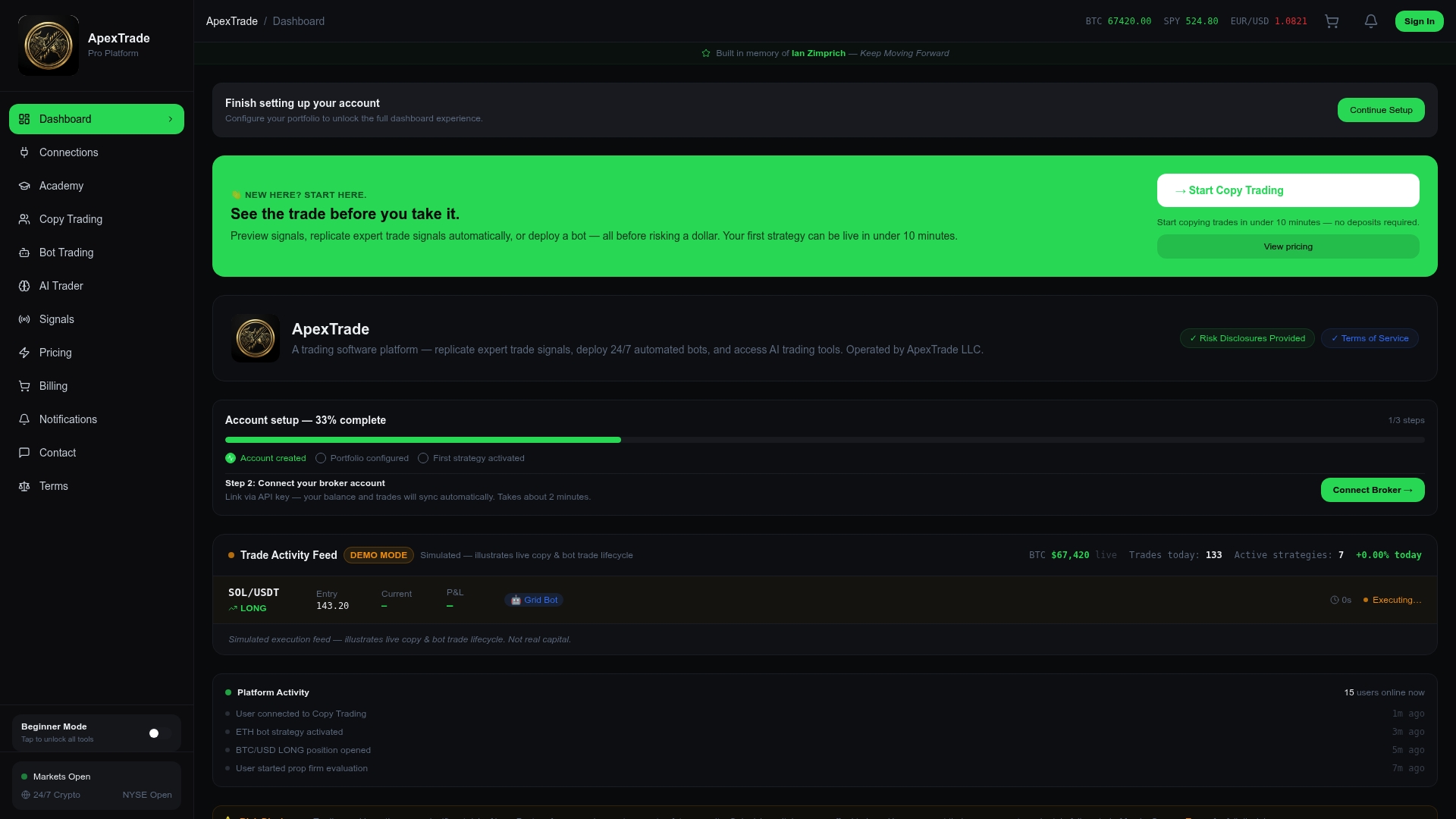
Apextradellc is built around the principle that structure reduces emotional error. The platform's bot trading tools execute your predefined strategy around the clock without hesitation, fear, or greed. Bots do not revenge trade. They do not panic sell. They follow the rules you set, which is exactly what trading psychology research says humans struggle to do under pressure. For traders still building their psychological framework, copy trading on Apextradellc lets you follow disciplined, rules-based traders while you develop your own emotional resilience. Automation does not replace psychology. It enforces it.
FAQ
What is trading psychology in simple terms?
Trading psychology is the study of how emotions and mental biases affect trading decisions. It covers fear, greed, overconfidence, and behavioral patterns that cause traders to deviate from their plan.
What are the most common psychological biases in trading?
The disposition effect, overconfidence, and loss aversion are the three most documented biases. Each one distorts risk perception and causes traders to hold losers too long, oversize positions, or exit winners too early.
How do I start improving my trading psychology?
Start by tagging every trade with an emotional state label and reviewing outcomes by tag after 30 trades. This creates a data model of your psychological patterns that is far more useful than generic discipline advice.
Can automation help with trading psychology?
Automated trading tools like bots remove emotional decision-making from execution entirely. Research supports pairing behavioral constraints with structured routines to reduce bias-driven errors, and automation enforces those constraints mechanically.
What is a trading psychology checklist?
A trading psychology checklist is a pre-session routine that includes reviewing your journal, setting a daily loss limit, identifying setups in advance, and confirming position sizing rules before the market opens. Topstep's daily routine framework is one widely cited example.