
Most new crypto day traders fail within their first few months, not because the markets are impossibly hard, but because they treat trading like a guessing game. They pick coins, click buy, watch prices, and hope. That approach explains why 80 to 90% of crypto day traders lose money over meaningful timeframes. What separates the minority who actually profit is a repeatable, step-by-step workflow built around preparation, precise execution, and constant review. This guide covers exactly that process, from setting up the right tools to managing risk and scaling your practice safely.
Table of Contents
- What you need before your first crypto day trade
- A step-by-step workflow for day trading crypto
- Manage risk, slippage, and avoid common mistakes
- From demo to real trades: Practicing and scaling safely
- Our perspective: What most guides miss about day trading discipline
- Take your crypto day trading to the next level with ApexTrade
- Frequently asked questions
Key Takeaways
| Point | Details |
|---|---|
| Have a plan | A structured workflow with defined steps gives you a critical edge over impulsive trading. |
| Risk management first | Set stop-losses based on trade logic to protect your capital and maintain discipline. |
| Practice before real money | Use demo trading and track results for at least 30 days to build skill and confidence. |
| Control slippage | Choose high-liquidity platforms and set limits to avoid unexpected losses when executing trades. |
| Review and adapt | Consistently reviewing your trades and routines is the real key to long-term profitability. |
What you need before your first crypto day trade
Now that you know why most traders struggle, let's start with the tools and preparation you'll need to set up for success. Skipping the setup phase is one of the most common reasons traders blow up their accounts in the first week.
Before placing a single live trade, you need to complete a clear crypto trading checklist that covers platforms, hardware, software, and capital rules. A step-by-step workflow starts with choosing a reliable platform and defining your goals and timeframe before anything else. That order matters. Trying to learn strategy before you have stable tools is like practicing free throws on a broken court.
Essential prerequisites for crypto day trading
Technical requirements:
- A reliable computer with at least 8GB RAM and a stable internet connection (use a wired connection if possible)
- Two monitors help enormously for tracking charts and order books simultaneously
- A hardware wallet for any funds not actively in use on an exchange
- A dedicated trading spreadsheet or journaling app to log every trade
Platform and account requirements:
- An exchange account on a regulated, high-liquidity platform
- API access if you plan to use automated bots or external charting tools
- Two-factor authentication enabled on all accounts without exception
- A demo or paper trading account set up alongside your live account
| Requirement | Why it matters | Beginner priority |
|---|---|---|
| Reliable exchange | Execution speed and order depth | Critical |
| Demo account | Risk-free practice environment | Critical |
| Trade journal | Tracks patterns and mistakes | High |
| Stop-loss tools | Prevents catastrophic single losses | Critical |
| Charting software | Supports technical analysis | High |
| Position sizing calculator | Controls capital per trade | High |
When it comes to capital, the guiding rule is never to risk more than 1 to 2% of your total trading account on any single trade. If you have $2,000 in your account, that means a maximum loss per trade of $20 to $40. This rule sounds restrictive, but it is exactly what keeps you in the game long enough to improve.
Pro Tip: When choosing a trading platform, prioritize platforms with deep liquidity and fast order execution over platforms that simply offer the most coins. Slippage and order delays will cost you more than a limited coin selection ever will.
A step-by-step workflow for day trading crypto
With preparation complete, you're ready to execute a step-by-step method proven by both research and experience. The biggest difference between traders who succeed and those who don't is not intelligence. It is process.

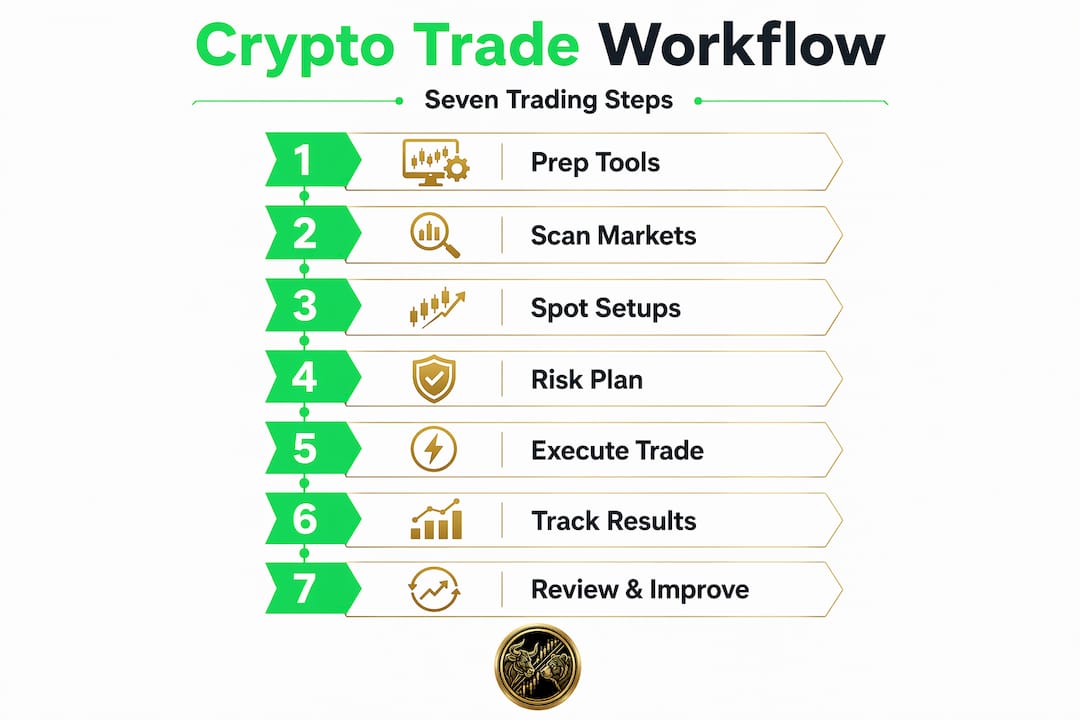
A practical trading workflow guide confirms that repeatable edge in trading comes less from magic indicators and more from a structured routine: narrow your tradable universe, map context to key price levels, define the trade with entry, stop, and targets, then execute and review outcomes consistently.
Workflow vs. ad-hoc trading: a direct comparison
| Factor | Workflow-based trading | Ad-hoc trading |
|---|---|---|
| Entry signals | Pre-defined, rule-based | Based on gut feel or noise |
| Risk per trade | Fixed percentage of capital | Random or emotional |
| Stop-loss placement | Based on invalidation point | Often skipped or arbitrary |
| Review process | After every trade | Rarely happens |
| Consistency | Measurable over time | Unpredictable |
| Emotional control | Enforced by rules | Fully dependent on mood |
The 7-step crypto day trading workflow
Following a documented workflow is what turns sporadic wins into a repeatable edge. Here is the full sequence we recommend:
-
Scan your watchlist. Each morning, review no more than 5 to 10 assets. Cutting your universe down forces you to focus on quality setups. Filter by volume, volatility, and recent news.
-
Map key levels. Identify support and resistance zones on your chart, including recent highs, lows, and volume-weighted price areas. These are the price zones where trades will be taken or avoided.
-
Define your trade thesis. Before touching the buy button, write one sentence explaining why you're entering this trade. If you can't explain it simply, you don't have a real setup.
-
Set entry, stop-loss, and take-profit levels. According to a complete crypto trading strategies framework, every trade must have a predefined stop-loss and take-profit in place before execution. No exceptions.
-
Calculate your position size. Use your stop distance and your 1 to 2% risk rule to determine how many units to buy. This step is often skipped by beginners and it is the reason small mistakes become account-destroying losses.
-
Execute and monitor. Place your order, set your stops and targets, then step back. Watching every tick after you enter a position often leads to emotional decisions that override your original analysis.
-
Log and review the trade. After the trade closes, win or lose, log the setup, your entry and exit, what worked, and what didn't. This review step is where most of the real learning happens.
"Repeatable edge in day trading typically comes less from magic indicators and more from a routine: narrow the tradable universe, map context to levels, define the trade (entry/stop/targets), execute, and review outcomes." — DEXTools 2026 guide
Pro Tip: Set your stop-loss based on where your trade idea is proven wrong, not on an arbitrary percentage. If a breakout trade fails when price falls back below the breakout level, that is your stop point. Size your position from the stop distance so the dollar risk stays within your 1 to 2% rule.
Manage risk, slippage, and avoid common mistakes
Executing trades is just the start. Now, let's focus on protecting your capital and longevity as a day trader. The most technically skilled trader in the world can blow up their account if they skip risk management.
Common mistakes new traders make
- Entering trades without a defined stop-loss
- Risking 10, 20, or even 50% of capital on a single position
- Chasing assets that have already moved sharply
- Revenge trading after a loss to "win it back"
- Ignoring trading fees and their cumulative drag on returns
- Overtrading by taking every small signal as a valid entry
These mistakes are not random. They follow predictable emotional patterns. Understanding them in advance gives you a real advantage over traders who only learn these lessons the hard way.
Slippage: the hidden cost in crypto trading
Slippage is the gap between the price you expected to pay and the price your order actually gets filled at. In crypto markets, slippage is driven by two forces: high volatility and low liquidity. When prices move fast or when order books are thin, your market order can land at a significantly different price than you intended.
For example, you see Bitcoin at $63,400 and click buy. But by the time your order reaches the exchange, it fills at $63,580. That $180 gap is slippage. On a large position, this adds up fast. On leveraged positions, it can trigger a stop-loss prematurely or reduce your profit margin on winning trades.
How to reduce slippage:
- Trade high-liquidity assets with deep order books
- Use limit orders instead of market orders when timing allows
- Set explicit slippage tolerance on decentralized exchanges (DEXs)
- Avoid entering large positions during extreme volatility spikes
The broader reality is harsh but necessary to understand: 80 to 90% of active day traders lose money over time. The traders who survive long enough to become profitable are, almost universally, the ones who treat risk management as the priority, not an afterthought.
"Slippage tolerance and liquidity selection are practical controls that directly affect your realized trade price in volatile crypto markets." — SoFi
You can find a complete breakdown of trading tips and automation strategies that help you control execution quality while managing risk systematically.
Pro Tip: Review your trading costs weekly. Add up exchange fees, slippage losses, and any spread costs. Traders often discover that a "winning" strategy is actually unprofitable after accounting for execution costs. This analysis alone changes your behavior dramatically.
From demo to real trades: Practicing and scaling safely
Having explored risk and execution, let's see how to actually practice without blowing up, and build up to real money day trading efficiently. The single biggest mistake impatient traders make is skipping straight to live capital before they have proven anything.
A structured practice path involves paper trading for an extended period and only scaling into small real capital once you have a documented track record of consistency. Paper trading means using a simulated account with fake money that mirrors real market conditions. You learn without financial consequences.
The stepwise path from demo to live trading
-
Open a demo account and trade for at least 30 days. Take it seriously. Follow your workflow exactly as you would with real money. Log every single trade.
-
Evaluate your results honestly. After 30 days, review your win rate, average win size, average loss size, and your emotional patterns. Did you follow your rules? Where did you deviate?
-
Identify two or three setups you execute well. Do not try to master everything at once. Pick the setups that consistently work for you and double down on those.
-
Move to small real capital. Start with an amount you are genuinely comfortable losing entirely. Many experienced traders suggest starting with 5 to 10% of your intended trading capital. The psychological shift from demo to live is real and significant.
-
Scale slowly and only after consistent results. A common rule is to only increase position sizes after 20 consecutive trades where you followed your rules and maintained profitability. Not 5 trades. Not 10. Twenty.
"Before risking live capital, a structured practice path is to demo and paper trade setups for an extended period and only then scale into small real capital, while tracking every trade." — Plisio's guide
Your trading journal is not optional at this stage. Every entry should include the asset, the setup type, entry price, stop price, target price, outcome, and a brief note on your emotional state during the trade. Over time, patterns in your journal will reveal your real edge, and your real weaknesses.
Another powerful tool for building confidence and learning from proven traders is copy trading, where you mirror the positions of experienced, verified traders while you're still developing your own skills. This lets you stay active in the market and study real decision-making in real time.
Pro Tip: Don't graduate from demo trading based on time alone. Graduate based on results. If you are not consistently profitable in the simulation, adding real money will not fix the underlying problems. It will just make them more expensive.
Our perspective: What most guides miss about day trading discipline
Most step-by-step guides give you a framework and leave you to it. Here is what we have seen, working with traders across experience levels, that rarely gets said clearly.
The framework matters. But the limiting factor is almost never the strategy. It is discipline under pressure. When a trade goes against you in real time, following your predefined rules feels nearly impossible. Your brain generates dozens of reasons to hold just a little longer, or to skip the stop, or to add to a losing position. That pressure is not a character flaw. It is a predictable human response to financial loss. The traders who overcome it are not emotionally stronger. They have systems that remove decisions from the equation.
This is why the efficient trading workflow is not just a productivity tool. It is a discipline enforcer. When your entry criteria, stop placement, and position size are all decided before you enter the trade, there is nothing to decide under pressure. You either follow the plan or you don't.
We also see too many traders fall into indicator obsession. They add RSI, MACD, Bollinger Bands, Fibonacci, and three custom oscillators to their chart, then wonder why they still can't make decisions. More indicators create more conflicting signals, not more clarity. The real insight from the DEXTools 2026 guide is worth repeating: define stop based on invalidation, not on an arbitrary percentage, and size the position from that distance. That single principle, applied consistently, is more powerful than any indicator combination.
Continuous review and adaptation are also non-negotiable. Crypto markets change character. A strategy that works in a trending bull market may fail completely in a choppy sideways market. Traders who review their journal monthly and adjust their approach accordingly stay relevant. Traders who ignore review keep wondering why a strategy "stopped working."
Take your crypto day trading to the next level with ApexTrade
You now have a complete framework: the setup, the workflow, risk control, and a path from demo to live trading. The next challenge is execution at scale. Manually tracking every signal, monitoring positions around the clock, and maintaining consistency across dozens of trades per week is where most traders hit a ceiling.
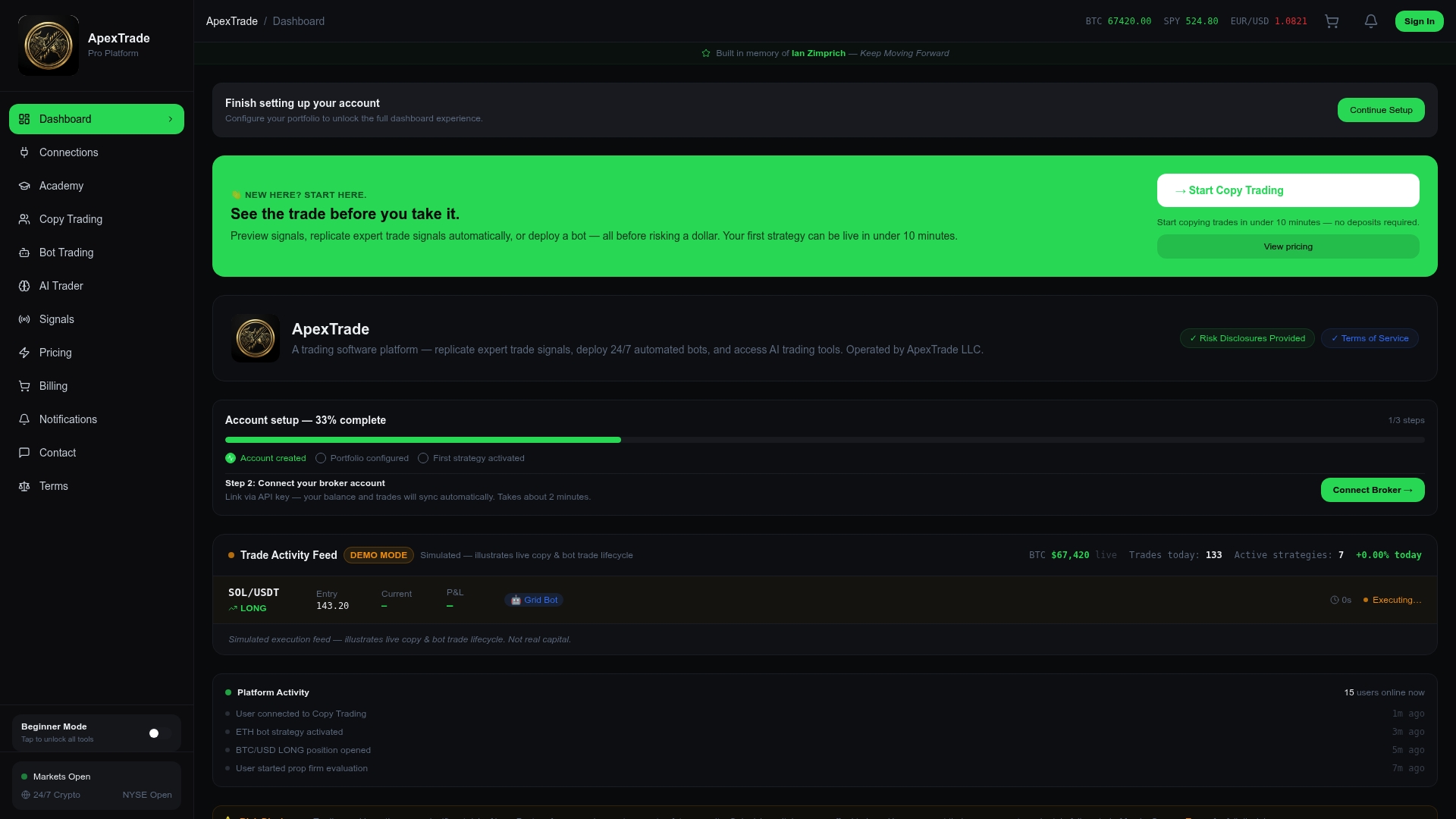
Apex Trade LLC is built specifically for traders who are ready to move beyond manual execution. With automated bot trading, you can deploy rule-based strategies that run 24/7 without you watching every candle. The copy trading solutions on the platform let you replicate verified traders while you continue building your own skills. And the built-in tools to track your trades give you the performance data and portfolio visibility you need to review, adapt, and improve continuously. Start with the tools that match where you are today, and scale from there.
Frequently asked questions
What is the first step for new crypto day traders?
Start by choosing a reliable platform and practicing with a demo account before risking real money. Getting familiar with order types and execution speed in a simulated environment prevents costly beginner mistakes.
How much money do most crypto day traders lose?
Research shows 80 to 90% of active day traders lose money over meaningful timeframes. The minority who remain consistently profitable almost always share a structured, rules-based approach to every trade.
What is slippage in crypto trading and how can I manage it?
Slippage is the difference between your expected and executed trade price, caused by volatility and low liquidity. Using limit orders and trading high-volume assets on liquid platforms are the most reliable ways to reduce it.
Should I use a stop-loss on every crypto trade?
Yes, always set a predefined stop-loss before entering any position. Trading without a stop-loss turns a manageable losing trade into a potentially account-ending event.
How long should I paper trade before trading with real money?
Most experts suggest paper trading for at least 30 days while tracking every result. The real benchmark is not time, it is whether you can demonstrate consistent, rule-following execution before putting real capital at risk.