
Most people assume algorithmic trading is reserved for hedge funds and Wall Street firms with rooms full of servers. That assumption is outdated. What is algorithmic trading, exactly? It's the use of computer programs that follow predefined rules to automatically generate and execute buy or sell orders in financial markets, without requiring a human to click a button for each trade. Today, individual traders access these same systems through accessible platforms, affordable technology, and copy trading tools that lower the barrier to entry significantly. This guide breaks down how it works, what strategies exist, and what realistic expectations look like.
Table of Contents
- Key Takeaways
- What algorithmic trading is and how it actually works
- Common types of algorithmic trading strategies
- Benefits and real limitations of trading algorithms
- How to start with algorithmic trading the right way
- My honest take on what most new traders get wrong
- Explore Apextradellc's trading automation tools
- FAQ
Key Takeaways
| Point | Details |
|---|---|
| Automated rule-based execution | Algorithms follow predefined instructions to place trades at speeds no human can match. |
| Multiple strategy types exist | From trend-following to arbitrage, different algorithmic approaches suit different market goals. |
| Emotion-free discipline | Removing human judgment from each trade reduces costly errors driven by fear or greed. |
| Backtesting is non-negotiable | Testing your strategy on historical data before going live is the single most overlooked step. |
| Ongoing monitoring required | Algorithms need regular review because market conditions shift and strategies can degrade over time. |
What algorithmic trading is and how it actually works
At its core, algorithmic trading uses computer programs executing pre-set instructions to place orders based on factors like price, timing, volume, or mathematical models. These programs, often referred to as automated trading systems (ATS), scan market data, identify conditions that match their rules, and submit orders without waiting for a human decision on each trade.
The process generally follows four steps:
- Signal generation: The algorithm scans incoming market data and detects a condition that matches its strategy rules, such as a moving average crossover or a price breaking above resistance.
- Order creation: Once a signal fires, the algorithm calculates the order details, including size, direction, and order type.
- Risk checks: Before submission, the system runs pre-trade controls to verify the order fits within defined risk parameters, such as position limits or daily loss caps.
- Order submission: The order goes to the exchange or broker in milliseconds, often far faster than any human could act.
The speed advantage is real. Algorithmic orders execute instantly at precise moments that human traders cannot replicate by hand, which matters most in volatile markets where prices move in fractions of a second. For individual traders, this means your strategy fires exactly when conditions are met, not a few seconds later when you finally notice the setup.
Pro Tip: Before you write a single line of code or configure any bot, map out your strategy rules on paper first. If you cannot explain your entry, exit, and risk rules clearly in plain language, the algorithm will not execute them cleanly either.
Common types of algorithmic trading strategies
Not all trading algorithms behave the same way. Understanding the categories helps you decide which approach fits your goals and risk tolerance.
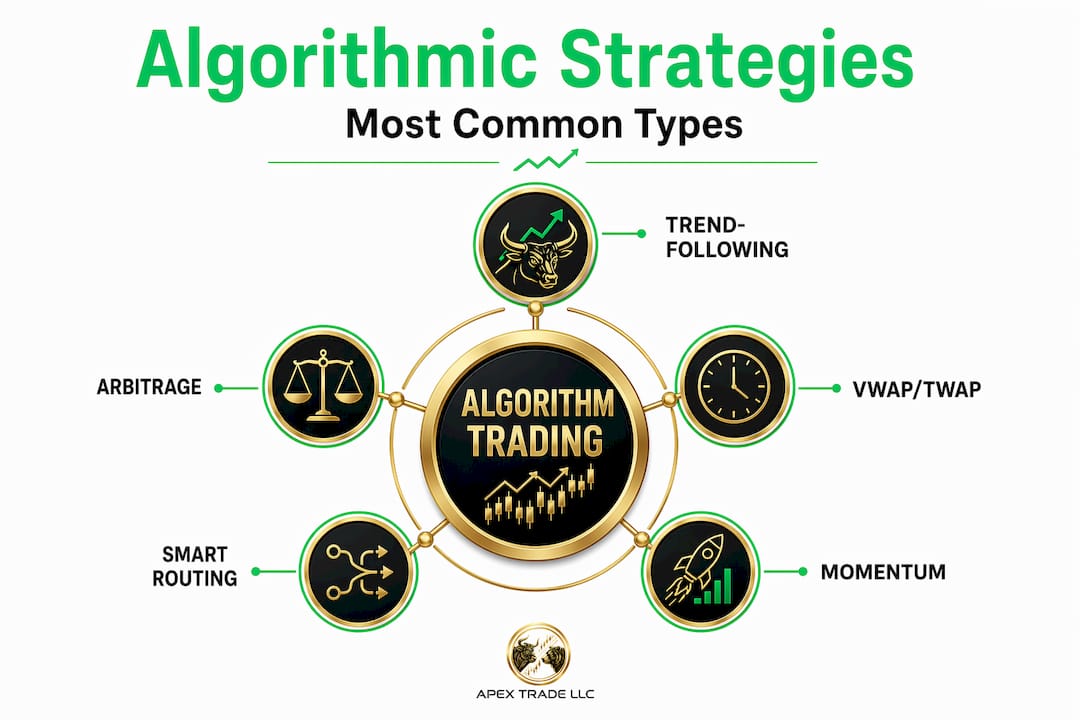
| Strategy Type | How it works | Best suited for |
|---|---|---|
| Trend-following | Buys when price trends up, sells when it trends down, using indicators like moving averages | Traders who want simplicity and clear rules |
| Arbitrage | Exploits price differences for the same asset across exchanges or related instruments | Fast execution environments with low latency |
| VWAP/TWAP execution | Breaks large orders into smaller pieces spread across time to reduce market impact | Reducing slippage on larger position entries |
| Smart order routing | Finds the best available price across multiple venues for each order | Active traders who trade across multiple exchanges |
| Momentum strategies | Enters trades in the direction of short-term price acceleration | Markets with strong directional moves |
Trend-following is the most accessible starting point for individual traders. The rules are clear, the logic is testable, and automated trading indicators are well-documented. Arbitrage strategies, on the other hand, require extremely fast execution infrastructure and are harder for individual traders to compete in without institutional-grade technology.
Execution algorithms like VWAP (Volume Weighted Average Price) and TWAP (Time Weighted Average Price) are particularly worth understanding. Large orders automatically segmented over time obtain better average prices than a single large market order would, which reduces costs meaningfully on every trade.
Benefits and real limitations of trading algorithms
The benefits of algorithmic trading are concrete, but so are the pitfalls. Here is an honest breakdown of both sides.

What the benefits actually look like in practice
Algorithmic trading enforces discipline by removing emotional decision-making from execution. When your strategy says to exit a losing trade, the algorithm exits it. You do not hesitate, second-guess, or hope it recovers.
Beyond discipline, the benefits of trading algorithms include:
- Execution speed: Orders fire in milliseconds, capturing prices that a manual trader would miss.
- Precision: Algorithms do not fat-finger order sizes or enter the wrong ticker symbol under pressure.
- Market stability contribution: Studies show algorithmic trading reduces price volatility by splitting large orders and limiting sentiment-driven swings.
- Around-the-clock operation: Bots can monitor and trade crypto markets at 3 a.m. when you are asleep.
- Access to complex strategies: Approaches like statistical arbitrage or VWAP execution would be nearly impossible to run manually.
Limitations you need to take seriously
The role of algorithmic trading sounds compelling, but the risks are not hypothetical. Regulators have implemented circuit breakers and trading curbs specifically because poorly controlled algorithms have triggered market disruptions. That context matters for individual traders too.
The most common limitations include a need for programming skills or access to a platform that handles the code for you, the risk of a flawed strategy running at machine speed and multiplying losses quickly, and the reality that market conditions change. A strategy that worked in a trending market may bleed in a choppy one if no one is watching it.
Pro Tip: Learning to automate trading effectively starts with defining what failure looks like. Set a maximum drawdown threshold your bot cannot exceed before it pauses automatically. This single control prevents the worst-case scenarios.
How to start with algorithmic trading the right way
Starting well matters more than starting fast. These steps give you a foundation that holds up under real market conditions.
-
Build your market knowledge first. Understand how the asset class you want to trade behaves, including how liquidity, volatility, and market hours affect execution. Algorithms built on shaky market understanding fail even when the code is perfect.
-
Define your strategy before touching any platform. Write your entry conditions, exit conditions, and position sizing rules in plain language. Then translate them into code or configure them on your chosen platform.
-
Backtest on historical data. This step is skipped more often than any other, and it costs traders dearly. Backtesting trading bots before going live reveals whether your logic holds up across different market environments, not just the recent conditions that inspired the strategy.
-
Run a paper trading simulation. After backtesting, run the strategy in a live market simulation without real capital. This catches execution issues, data feed problems, and logic errors that backtests miss.
-
Apply pre-trade risk controls. Set hard limits on position size, daily loss, and maximum drawdown. Strong pre-trade controls are not optional extras. They are the difference between a controlled loss and an account-destroying runaway trade.
-
Start small and monitor actively. Deploy with a fraction of your intended capital first. Watch how the algorithm behaves across different sessions and market conditions before scaling up.
-
Review and adapt regularly. Algorithmic trading complexity demands governance that keeps pace with market structure changes. A quarterly review of your strategy's performance metrics is a minimum.
Consider exploring forex trading tips if forex is your target market, as currency-specific mechanics like session overlaps and central bank events require strategy adjustments that generic guides miss.
My honest take on what most new traders get wrong
I have watched a lot of traders approach algorithmic trading as though the hard work ends once the bot is running. It does not. If anything, the work shifts rather than stops.
The biggest misconception I see consistently is treating an algorithm like a vending machine. You put in a strategy, press start, and expect profit to come out. Real algorithmic trading outcomes depend heavily on market microstructure interaction and the surrounding control framework, not just the signal logic. Two traders running identical strategy signals can get meaningfully different results based entirely on how their execution and order routing are configured.
What I have found actually works is treating the algorithm as a living system. You define it, test it, deploy it at small scale, and then study its behavior in live markets as carefully as you studied the backtest. When it underperforms, you ask whether market conditions changed, whether your data feed had an issue, or whether your execution logic is creating unnecessary slippage.
The traders who succeed with this approach are not necessarily the best coders. They are the ones who stay disciplined about execution quality and governance, review their logs consistently, and resist the urge to over-optimize based on recent performance alone. Algorithmic trading is not easy money. It is disciplined, systematic trading made faster and more consistent by automation.
— James
Explore Apextradellc's trading automation tools
If you are ready to move from understanding algorithmic trading to actually applying it, Apextradellc gives you the infrastructure to do that without building everything from scratch.
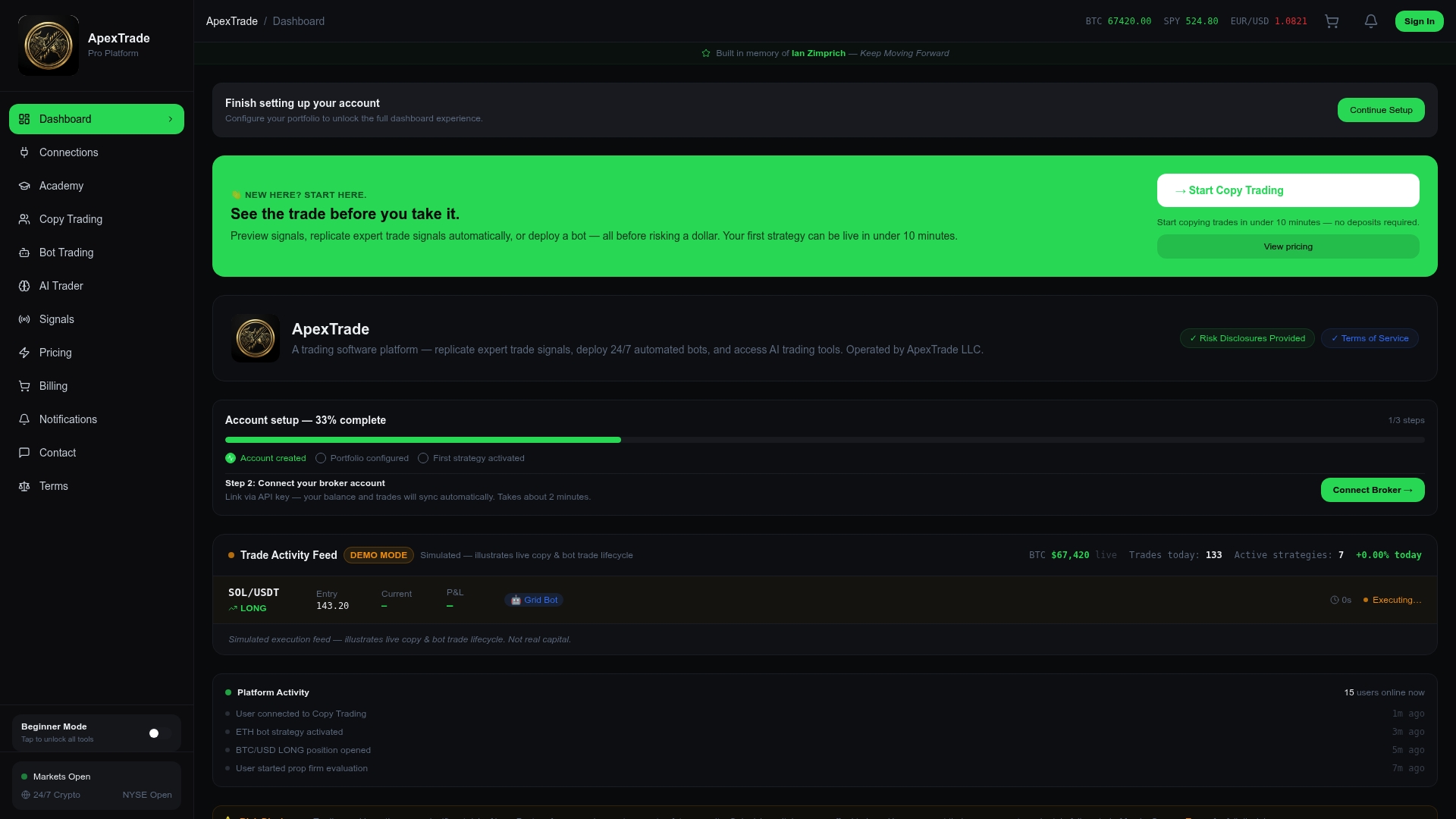
The bot trading platform at Apextradellc lets you deploy strategy bots across crypto, forex, and stock markets 24/7, with built-in risk controls and portfolio tracking that handle the operational complexity. If you are not ready to code your own strategies, the copy trading feature lets you replicate verified traders' approaches automatically, which mirrors how copy trading has grown since the early 2010s as an accessible entry point for individuals. Both options sit inside a single platform with trade history, bot performance analytics, and account management tools designed to support your growth from beginner to advanced trader.
FAQ
What is algorithmic trading in simple terms?
Algorithmic trading uses computer programs that follow predefined rules to automatically place buy or sell orders in financial markets, removing the need for a human to manually execute each trade.
Is algorithmic trading profitable for individual traders?
Profitability depends on the strategy, market conditions, and how well the algorithm is tested and monitored. Algorithmic trading is not guaranteed profit. Success requires ongoing review, risk controls, and adaptation to changing markets.
What types of algorithmic trading strategies exist?
Common types include trend-following, arbitrage, VWAP/TWAP execution, smart order routing, and momentum strategies. Trend-following is generally the most accessible starting point for individual traders.
Do I need coding skills to use algorithmic trading?
Not necessarily. Platforms like Apextradellc offer pre-built trading bots and copy trading tools that allow individuals to access algorithmic strategies without writing any code themselves.
What are the biggest risks of algorithmic trading?
The primary risks include running a flawed strategy at machine speed, inadequate pre-trade risk controls, and failing to monitor the algorithm as market conditions shift. Regulators require circuit breakers and controls for exactly these reasons.