

Understanding the forex vs crypto trading types available to you is the single most important step before committing real capital to either market. These two markets share surface-level similarities but diverge sharply in structure, risk, and opportunity. The forex daily volume sits at roughly $9.6 trillion, dwarfing crypto's $100 to $200 billion. That gap tells you something meaningful about liquidity, execution, and what kind of trader thrives where. This guide breaks down each trading type across both markets and gives you a framework for choosing.
Table of Contents
- Key takeaways
- 1. Understanding the forex vs crypto trading types landscape
- 2. Types of forex trading
- 3. Types of crypto trading
- 4. Forex vs crypto trading types: side-by-side comparison
- 5. Situational recommendations for choosing your trading type
- My honest take on choosing between these markets
- Take your forex and crypto trading further with Apextradellc
- FAQ
Key takeaways
| Point | Details |
|---|---|
| Liquidity shapes execution quality | Forex's massive daily volume means tighter spreads and more reliable fills than crypto. |
| Volatility defines position sizing | Bitcoin swings 3 to 10% daily vs. 0.3 to 1% for major forex pairs, requiring very different leverage rules. |
| Ownership works differently | Crypto lets you hold the actual asset; most forex exposure comes through derivative contracts. |
| Market hours favor different lifestyles | Forex runs 24/5 while crypto trades 24/7/365, changing how you manage open positions and alerts. |
| No single market wins for everyone | Your risk tolerance, schedule, and goals determine which trading types actually suit you. |
1. Understanding the forex vs crypto trading types landscape
Before picking a strategy, you need to understand the objective differences between these two markets. Eight criteria separate them in ways that directly affect your bottom line.
Market hours. Forex trades 24/5 with defined sessions in Sydney, Tokyo, London, and New York. Crypto runs every hour of every day with no close. That means no gap risk on Sunday open in crypto, but it also means you can get squeezed at 3 a.m. with no liquidity floor.
Liquidity and volume. Forex liquidity is deep and relatively stable, though it tightens during stress events. Crypto liquidity is fragmented and more volatile, spread across dozens of centralized and decentralized exchanges. Slippage on a $500,000 crypto order can be brutal compared to the same size in EUR/USD.
Volatility. Bitcoin daily volatility ranges from 3 to 10% while major forex pairs typically move 0.3 to 1% daily. That difference is not cosmetic. It changes your stop placement, position size, and emotional exposure entirely.
Regulation. Forex is regulated by mature bodies such as the CFTC, FCA, and ASIC. Crypto regulation is still evolving and varies by jurisdiction, which creates both risk and opportunity depending on your location.
Leverage. Forex leverage reaches 50:1 in the US and up to 500:1 offshore. Crypto platforms offer 2x to 100x, but the underlying volatility makes high crypto leverage far more dangerous than the same ratio in forex.
Market infrastructure. Most crypto trading happens on centralized exchanges with visible order books, while forex operates through an OTC interbank network with no central exchange.
Technical analysis reliability. Technical patterns are more consistent in forex due to its depth and maturity. In crypto, sentiment and news can invalidate a textbook setup within minutes.
Pro Tip: Before choosing a trading type, write down your available hours per week, your maximum tolerable drawdown, and whether you want to own the underlying asset. Those three answers will eliminate most of the wrong choices immediately.
2. Types of forex trading
Forex offers a more structured menu of trading types than most beginners realize. Here are the core approaches.
Spot trading is the most straightforward. You agree to buy or sell a currency pair at the current market price, with settlement typically in two business days. Most retail traders never actually take delivery. They roll positions or close before settlement.
Day trading and scalping involve opening and closing multiple positions within a single session. Scalpers target 5 to 20 pip moves and rely on tight spreads and fast execution. EUR/USD and GBP/USD are the preferred pairs because of low transaction costs. The psychological demand is high. You need to be comfortable making rapid decisions with incomplete information.
Swing trading captures moves over several days to weeks. A trader watching the USD/JPY might enter after a clean break of a key level following a Federal Reserve rate decision and hold for 150 to 300 pips. Macro fundamentals drive most of the thesis here.
Position trading works on a timeline of months. These trades are macro bets. A trader going long AUD/USD in anticipation of a commodity cycle shift, for example, might hold through multiple smaller counter-moves.
Carry trades are unique to forex. You borrow in a low-interest-rate currency and invest in a high-yield one, collecting the interest rate differential daily. These trades can unwind violently during risk-off events, as anyone holding AUD/JPY in late 2008 discovered.
Pro Tip: In forex, the economic calendar is your edge. Set alerts for NFP, CPI, and central bank decisions before every trading week. Positions held through these releases without a plan are not trades. They are bets.
3. Types of crypto trading
Crypto trading methods cover a wider and stranger range than forex. Some overlap with forex approaches; others have no equivalent. Understanding crypto trading strategies in full context helps you avoid treating crypto like a faster version of forex.
Spot trading with ownership is the baseline. You buy Bitcoin or Ethereum and hold the actual asset in a wallet or exchange account. This is fundamentally different from most forex trading, where you trade contracts rather than own currencies. Spot crypto gives you custody risk but also upside from asset appreciation.
Day trading and scalping in crypto mirrors the forex approach in format but differs dramatically in execution. Crypto order books are thinner, spreads widen during off-peak hours, and a single large wallet can move a mid-cap coin 10% in a candle. On-chain analytics and exchange flow data matter here in ways they simply do not in forex.
Swing trading works well in crypto for traders who identify regime cycles. A clean accumulation base on a BTC weekly chart, followed by a momentum breakout with increasing volume, is a textbook swing setup. The discipline of defined entry, exit, and sizing is the difference between a swing trade and holding a losing position hoping for recovery.
Margin trading and futures introduce leverage with all its amplifying effects. A 10x long on a coin that drops 10% means a total wipe of the position. Many traders who move from forex to crypto underestimate this. Applying high-leverage forex strategies directly to crypto is dangerous without significantly reducing position size first.
Range trading suits crypto markets during consolidation phases. When Bitcoin trades sideways for weeks between two well-defined levels, buying near support and selling near resistance is a statistically valid approach. The risk is a breakout that traps both sides.
Staking and DeFi yield farming are non-trading options that still generate returns. They are not trading in the classical sense but are frequently included in a crypto portfolio approach as income layers alongside active positions. Stablecoins can serve as volatility buffers and tactical hedges within this structure.
Pro Tip: In crypto day trading, check funding rates on perpetual futures before entering. When funding is extremely positive, the market is overcrowded long. When it is deeply negative, longs are being paid. These conditions often precede sharp reversals.
4. Forex vs crypto trading types: side-by-side comparison
Here is how the two markets compare across the dimensions that matter most for selecting a trading type.
| Criteria | Forex | Crypto |
|---|---|---|
| Market hours | 24/5 with defined sessions | 24/7/365 with no close |
| Daily volume | ~$9.6 trillion | ~$100 to $200 billion |
| Typical daily volatility | 0.3 to 1% (major pairs) | 3 to 10% (Bitcoin) |
| Leverage available | Up to 50:1 (US) or 500:1 offshore | 2x to 100x |
| Regulation | Mature (CFTC, FCA, ASIC) | Evolving, jurisdiction-dependent |
| Asset ownership | Derivative contracts (mostly) | Actual digital asset ownership possible |
| Technical analysis | More consistent and reliable | Frequently overridden by sentiment |
| Transaction costs | Tight spreads, swap rates on overnight | Exchange fees, gas costs, funding rates |
| Entry learning curve | Moderate, structured resources | Steeper due to fragmentation and new instruments |
| Infrastructure | OTC interbank network | Centralized and decentralized exchanges |
The table shows clearly that forex suits traders who want structure, deep liquidity, and a macro-driven framework. Crypto suits traders who want flexibility, direct asset ownership, and are comfortable with wider price swings. Neither is objectively better. The right answer depends entirely on how you match against these criteria.
Pro Tip: Run a 30-day paper trading test in both markets before allocating real capital. Log every trade with your reasoning and review at the end. Your actual behavior under simulated conditions will tell you more than any analytical comparison.
5. Situational recommendations for choosing your trading type
The forex vs crypto comparison stops being theoretical the moment you apply it to your actual situation. Here are scenarios that map directly to real trader types.
-
You are new to trading with limited time. Start with forex spot trading or swing trading on major pairs. The structured hours, deeper liquidity, and more consistent technical patterns give you a more forgiving environment to build process. Forex suits beginners who favor lower volatility and macro-driven setups.
-
You work a full-time job and trade part-time. Crypto's 24/7 schedule is an advantage here. You can trade Asian session Bitcoin moves at midnight or set alerts for key breakout levels and manage positions outside business hours without the session-specific constraints of forex.
-
You are a professional trader managing larger capital. Both markets belong in your toolkit. Many professional traders hold crypto long-term while generating short-term income through forex. This combination reduces correlation risk and creates multiple income streams.
-
You have high risk tolerance and strong technical skills. Crypto futures and margin trading can offer outsized returns, but you need a regime-based approach. Switching between trend-following and range strategies as market conditions shift gives better long-term results than applying a single method through every cycle.
-
You want income with lower drawdown risk. Forex carry trades, combined with staking stable assets in crypto, can generate yield without requiring constant active management. This suits traders who want exposure without screen time.
-
You keep blowing up on leverage. Step back entirely. Forex at 2:1 or crypto spot-only are your training grounds. Choosing between these markets depends heavily on risk tolerance. A trader who cannot survive drawdowns in spot will not survive them in leveraged products either.
My honest take on choosing between these markets
I've watched traders burn capital because they assumed that success in forex translated automatically to crypto, and vice versa. It does not. The mechanics overlap, but the behavior of these markets is fundamentally different in ways that only become obvious after you have held positions through both a forex central bank surprise and a crypto flash crash.
What I've learned is that the traders who do best long-term are not the ones who pick the "better" market. They are the ones who develop a disciplined process and apply it consistently within a single market before adding complexity. Starting with both simultaneously almost always ends badly.
My take on volatility management is simple: the market you should trade is the one where you can place a stop-loss, walk away, and not obsess. If a 5% overnight crypto move keeps you from sleeping, trade forex. If the grind of small pip accumulation in EUR/USD bores you into bad decisions, you need the crypto environment to stay engaged.
I've also seen the real edge in treating these markets as a portfolio rather than a competition. Holding a long-term Bitcoin position while actively swing-trading GBP/USD is not contradiction. It is diversification with intent.
— James
Take your forex and crypto trading further with Apextradellc
Knowing the differences between trading types is half the work. Executing them with discipline is the other half.
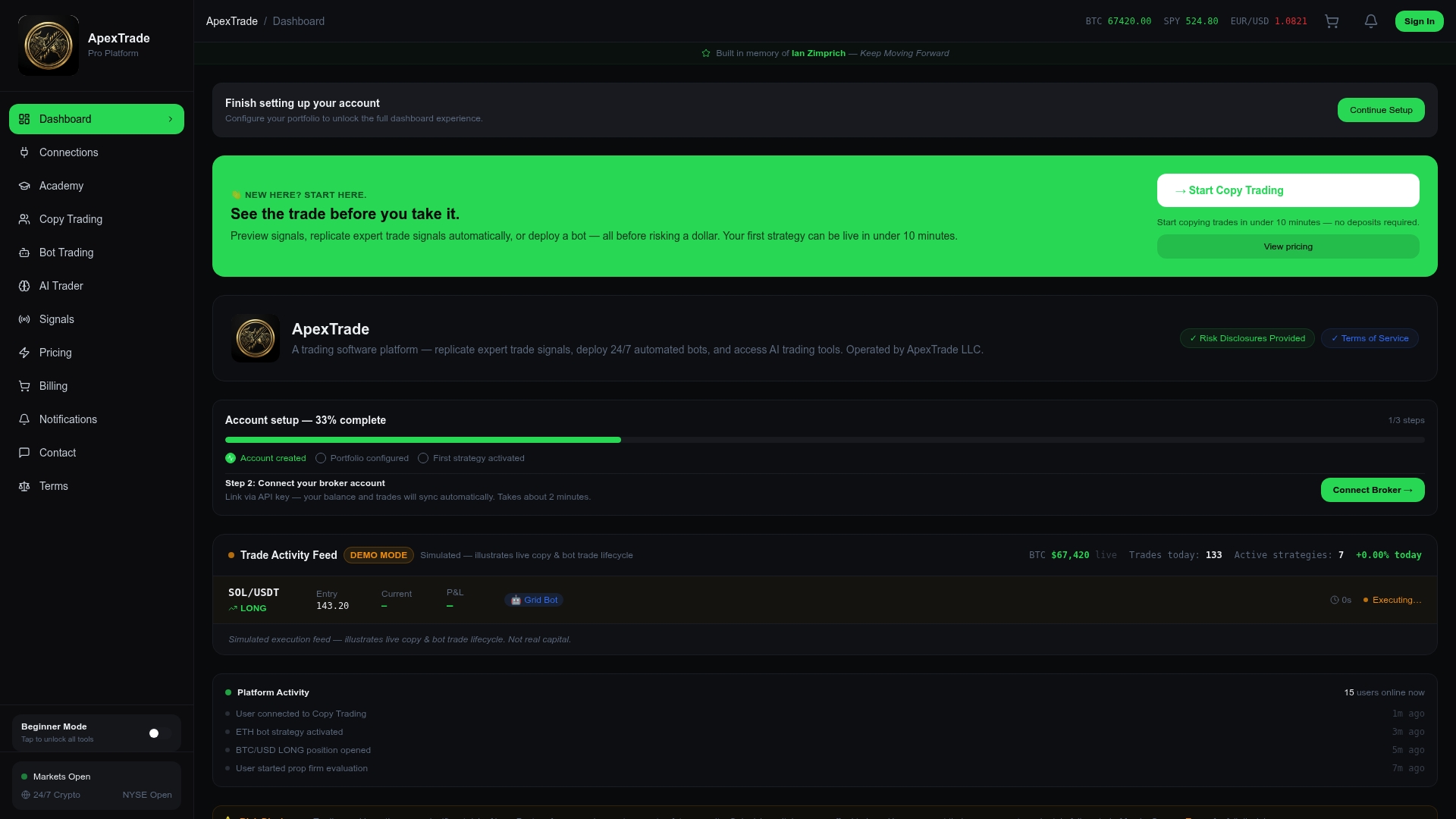
Apextradellc is built for traders who want to act on analysis without letting emotion or missed signals get in the way. The platform's automated trading bots run your strategy around the clock across both forex and crypto markets, executing entries and exits according to your defined rules whether you are at your desk or not. For traders who want to learn from proven performers, Apextradellc's copy trading feature lets you mirror experienced traders across both asset classes, which is particularly useful when you are building confidence in a new market. Setup is straightforward, and the platform supports multiple account integrations so your existing positions stay visible in one place.
FAQ
Which market is safer, forex or crypto?
Forex is generally considered more structured and lower-volatility, with mature regulation from bodies like the CFTC and FCA. Crypto carries higher price swings and evolving regulatory frameworks, making it higher-risk for most trader types.
Can you use the same strategy in both markets?
Core concepts like trend-following and range trading apply in both markets, but position sizing and leverage must be adjusted significantly. Bitcoin's 3 to 10% daily volatility demands much smaller positions than the same strategy would use on EUR/USD.
What is the best trading type for beginners?
Forex spot or swing trading on major pairs is the most forgiving starting point due to deeper liquidity, tighter spreads, and more reliable technical patterns. Crypto spot trading is a reasonable second choice for those who want direct asset ownership.
How does leverage differ between forex and crypto?
Forex leverage reaches 50:1 in the US and up to 500:1 on offshore platforms. Crypto platforms typically offer 2x to 100x, but the higher underlying volatility makes even moderate crypto leverage more dangerous than high forex leverage on stable major pairs.
Do professional traders use both forex and crypto?
Yes. Many professional traders combine long-term crypto holdings with active short-term forex trading to diversify income streams and reduce correlation risk between positions.