
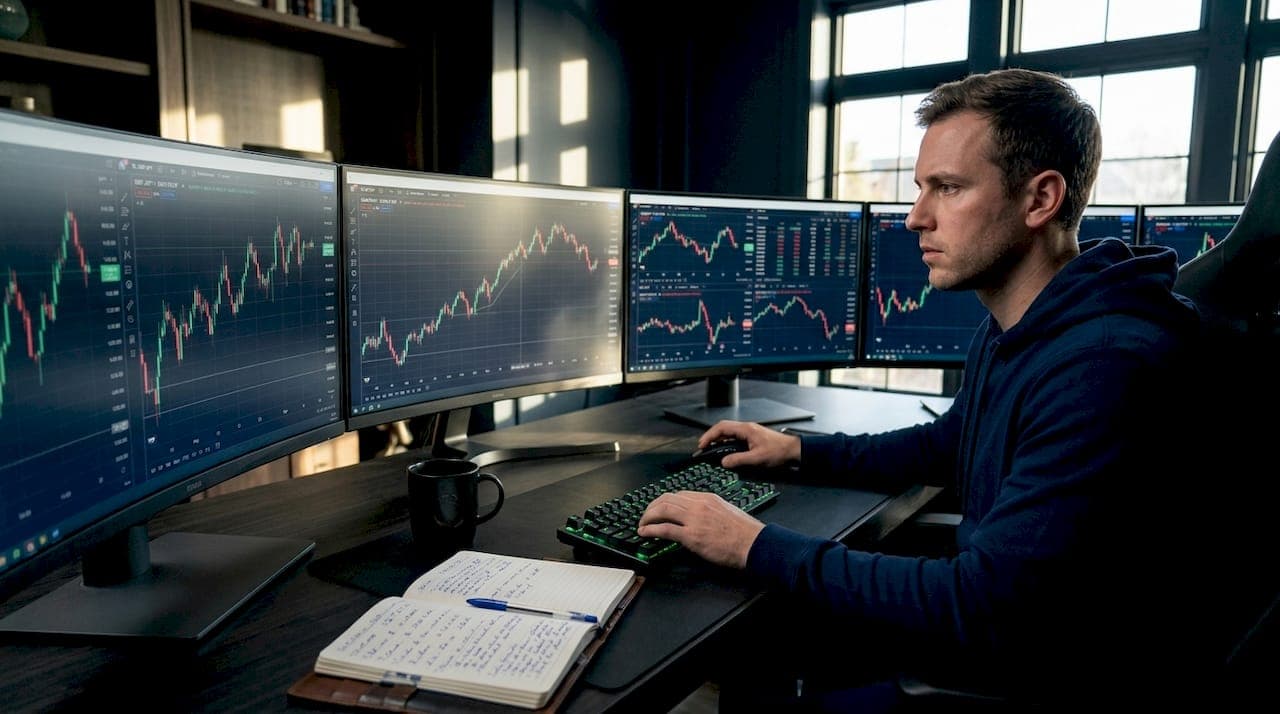
Forex trading step by step is a systematic process of selecting currency pairs, placing buy or sell orders, managing risk with protective stops, and reviewing results to improve over time. The foreign exchange market, commonly called FX or forex, is the largest financial market in the world, where currencies like EUR/USD and GBP/USD are traded simultaneously in pairs. Beginners who follow a structured approach using platforms like MetaTrader 5, apply position sizing formulas, and practice on demo accounts before going live give themselves a real edge. This guide covers every stage: setting up your tools, executing your first trade, managing risk, reading charts, and building a learning routine that compounds over months.
What are the essential tools and accounts needed to start forex trading?
Every beginner needs three things before placing a single trade: a regulated broker, a trading platform, and a funded account. Skipping any one of these creates unnecessary risk before you even enter the market.
Choosing a regulated broker is the first decision. Regulation by bodies like the NFA (National Futures Association) in the US, the FCA in the UK, or CySEC in Europe means your funds are held in segregated accounts and the broker operates under defined conduct rules. Avoid brokers that cannot clearly state their regulatory status.
Platform and account setup comes next. Most brokers offer MetaTrader 5 as their primary platform. MetaTrader 5 provides real-time price feeds, one-click order entry, charting tools, and a built-in economic calendar. Once installed, you will see a Market Watch panel on the left listing currency pairs, and a chart window in the center where price action displays in real time.
Here is what to set up before your first trade:
- Open a demo account first. Demo accounts simulate real market conditions and let you develop instincts and discipline without risking capital. Treat every demo trade as if real money is on the line.
- Build a watchlist of 3 to 5 major pairs: EUR/USD, GBP/USD, USD/JPY, and AUD/USD. Major pairs have the tightest spreads and the most available analysis.
- Familiarize yourself with the order window. In MetaTrader 5, right-clicking a chart opens the order dialog where you set volume, stop loss, take profit, and order type.
- Understand the difference between a demo and live account. Demo accounts use virtual money. Live accounts use real capital and carry real psychological pressure, which is why demo practice matters.
Pro Tip: Set your demo account balance to match what you plan to deposit in your live account. Practicing with $10,000 virtual dollars when you plan to trade with $500 real dollars creates false confidence in position sizing.
How to place your first forex trade step by step
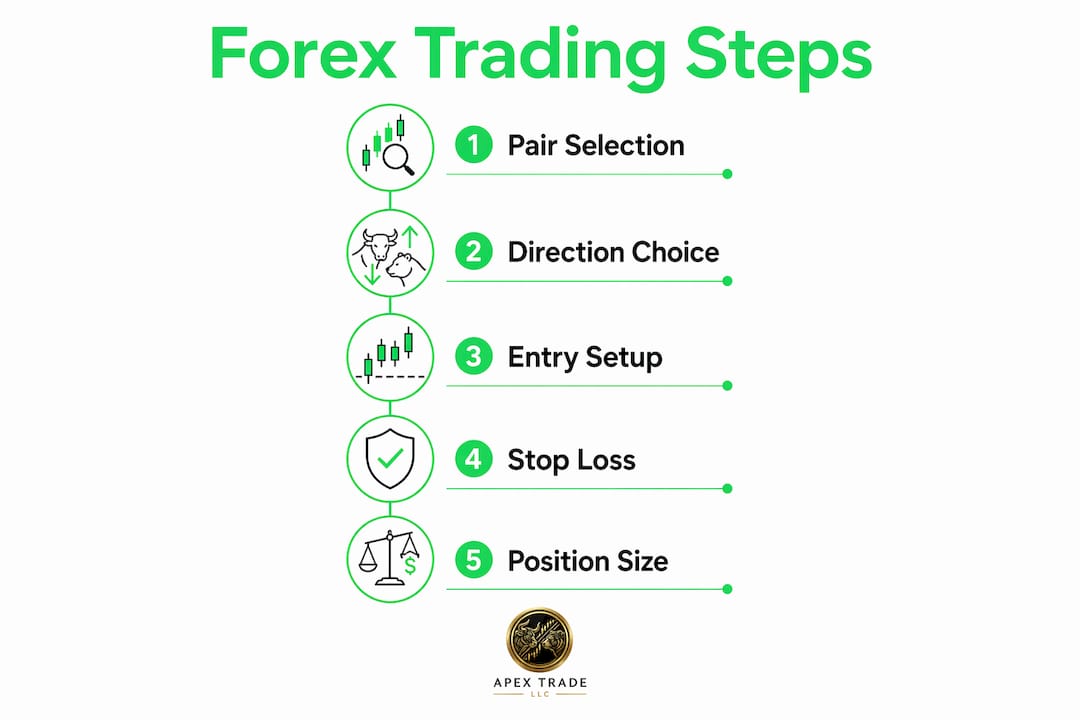
The standard trade flow follows seven steps: choose a currency pair, decide buy or sell, set lot size, place a market order, set stop loss and take profit, manage the open trade, then close and review. Each step has a specific purpose, and skipping one creates gaps that cost money.
- Choose your currency pair. Start with EUR/USD. It has the highest daily volume, the tightest spreads, and the most educational resources. EUR/USD means you are buying euros and selling US dollars (or vice versa) in a single transaction.
- Decide buy or sell. If you believe the euro will strengthen against the dollar, you buy (go long). If you believe the dollar will strengthen, you sell (go short). Your analysis drives this decision, not a guess.
- Set your lot size. A standard lot is 100,000 units of the base currency. A mini lot is 10,000 units, and a micro lot is 1,000 units. Beginners should start with micro lots to keep pip values small.
- Place a market order. In MetaTrader 5, select "Market Execution" in the order window. This fills your trade at the current market price immediately.
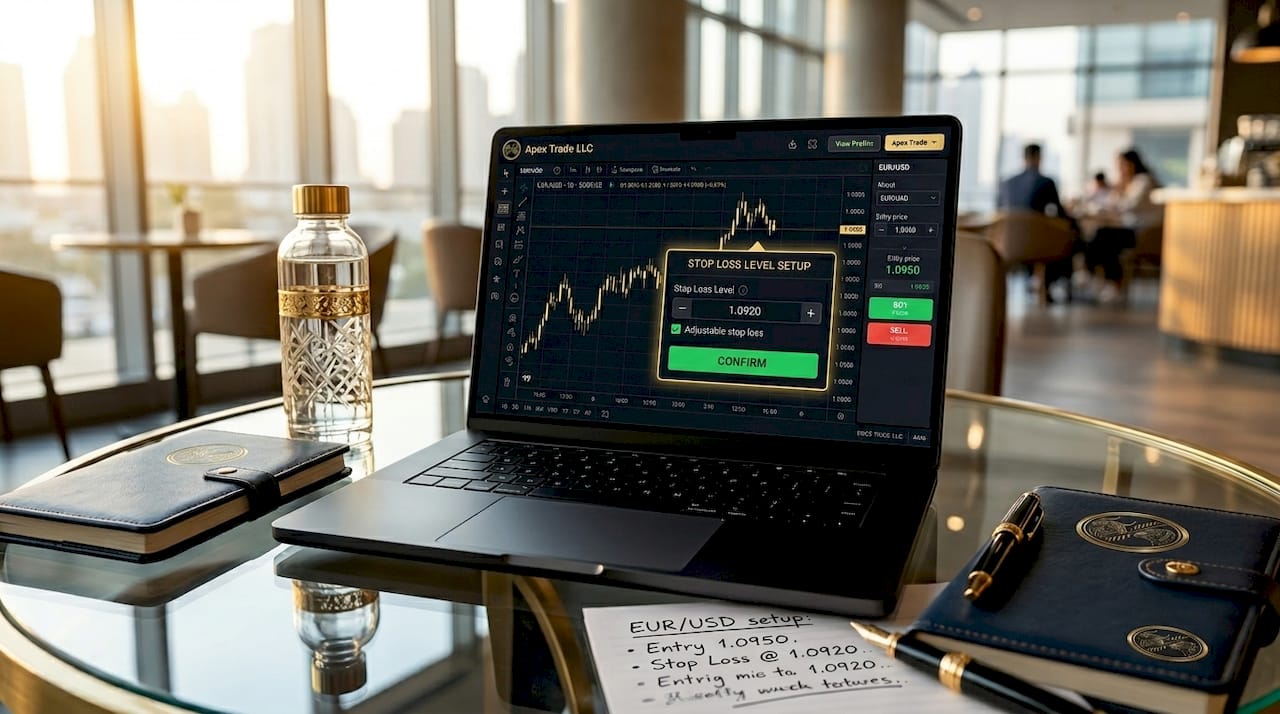
- Set stop loss and take profit. Stop-loss orders automatically close trades to limit losses; take-profit orders lock in gains automatically. A common beginner setup on EUR/USD is a stop loss 20 to 30 pips below entry and a take profit at least 40 pips above entry, giving a 1:2 risk-to-reward ratio.
- Manage the open trade. Watch for price reaching your levels. Avoid moving your stop loss further away from entry if the trade moves against you.
- Close and review. After the trade closes, record the entry price, exit price, reason for entry, and what happened. This review habit is what separates improving traders from stagnant ones.
| Trade step | Key action |
|---|---|
| Pair selection | Choose EUR/USD or GBP/USD for tightest spreads |
| Direction | Buy if base currency strengthens, sell if it weakens |
| Lot size | Start with micro lots (1,000 units) to limit pip exposure |
| Order type | Use market execution for immediate fills |
| Protective levels | Set stop loss 20 to 30 pips from entry; take profit at 1:2 ratio |
Pro Tip: Never leave a trade open without a stop loss. If you forgot to set one at entry, add it immediately after the trade is placed. Trades without stops have led to account-wiping losses for beginners who assumed the market would "come back."
What are the key risk management techniques every beginner should apply?
Position sizing is the key factor to market survival. Every trade's outcome is secondary to controlling how much you risk on each position. This is not optional advice. It is the foundation of staying in the game long enough to get good.
The core formula is straightforward: Position Size = Risk Amount / (Stop Loss in Pips × Pip Value per Lot). Here is how that works with a real example. You have a $1,000 account and you risk 1%, which is $10. Your stop loss is 20 pips. On EUR/USD with a standard lot, each pip is worth $10. So: $10 / (20 × $10) = 0.05 lots, or 5 micro lots. That is the correct position size to stay within your risk limit.
Pip values vary with currency pairs and lot sizes, so you must calculate pip value specific to the pair you are trading. USD-quoted pairs like EUR/USD have a pip value of $10 per standard lot. USD-base pairs like USD/JPY require a conversion using the current exchange rate.
| Account size | Risk per trade (1%) | Stop loss (pips) | Correct lot size |
|---|---|---|---|
| $500 | $5 | 20 | 0.025 lots |
| $1,000 | $10 | 20 | 0.05 lots |
| $5,000 | $50 | 25 | 0.20 lots |
Common risk management mistakes beginners make:
- Risking more than 2% per trade. The Kelly Criterion offers a theoretical sizing formula, but it is too aggressive for retail traders. Fixed fractional risk of 1 to 2% of equity per trade is the proven approach.
- Moving stop losses away from entry. This turns a controlled loss into an uncontrolled one. Set your stop and leave it.
- Ignoring correlation. Trading EUR/USD and GBP/USD long simultaneously is essentially doubling your position, since both pairs often move together.
Pro Tip: After a losing trade, reduce your next position size by 25% until you string together two winning trades. This prevents the emotional spiral of revenge trading after a loss.
Which basic analysis methods support your forex trading approach?
Analysis is how you decide whether to buy or sell before you place the trade. Two main types exist: fundamental analysis and technical analysis. Most beginners benefit from learning technical analysis first, since it applies directly to chart-based trade entries.
Fundamental analysis examines economic data that affects currency values. Interest rate decisions from the Federal Reserve or the European Central Bank move EUR/USD significantly. Non-Farm Payrolls (NFP) from the US Bureau of Labor Statistics, released the first Friday of each month, regularly causes 50 to 100 pip moves in USD pairs. Beginners should check an economic calendar (available inside MetaTrader 5) before entering trades to avoid being caught in high-impact news events.
Technical analysis reads price charts to identify patterns and probable future direction. Key concepts include:
- Candlestick charts. Each candle shows the open, high, low, and close for a time period. A green (bullish) candle means price closed higher than it opened. A red (bearish) candle means the opposite.
- Support and resistance. Support is a price level where buying has historically exceeded selling. Resistance is the opposite. Buying near support and selling near resistance is one of the simplest and most durable strategies in forex.
- Trend identification. A series of higher highs and higher lows defines an uptrend. A series of lower highs and lower lows defines a downtrend. Trading in the direction of the trend reduces the number of decisions you need to make correctly.
- Simple moving averages (SMA). The 50-period and 200-period SMAs on a daily chart show the medium and long-term trend direction. When price is above the 200 SMA, the long-term trend is up.
For a deeper look at how algorithmic tools apply these analysis methods at scale, the approach translates directly from manual chart reading to automated signal generation.
How to learn and improve your forex trading over time
A structured learning roadmap suggests 3 to 6 months from fundamentals through demo practice with journaling, then small live account trading for consistent results. That timeline is realistic, not pessimistic. Rushing it is the single most common reason beginners blow their first live accounts.
Follow this staged progression:
- Weeks 1 to 2: Learn the basics. Study currency pairs, how the forex market operates, what pips and lots mean, and how to read a basic candlestick chart. Use free resources from brokers like OANDA or educational sites like Babypips.
- Weeks 3 to 8: Build your methodology. Choose one strategy, whether support and resistance trading, moving average crossovers, or price action patterns, and study it deeply. Avoid switching strategies every week.
- Weeks 9 to 16: Demo trade with a journal. Complete 100 demo trades tracked in a journal before moving to a live account. Record entry reason, exit reason, result, and what you would do differently.
- Month 4 onward: Small live account. Start with the minimum deposit your broker allows. The goal is not profit yet. The goal is executing your plan under real emotional conditions.
- Ongoing: Review and refine. Weekly review of your trade journal is more valuable than any indicator or signal service. Patterns in your mistakes become visible only when you track them consistently.
A structured trading workflow that defines your pre-trade checklist, entry criteria, and post-trade review process removes the guesswork that causes most beginner losses.
Key takeaways
Forex trading step by step requires a regulated broker, a position sizing formula, protective stop orders, and at least 100 demo trades before committing real capital.
| Point | Details |
|---|---|
| Start with a demo account | Practice with virtual funds on MetaTrader 5 before risking real capital. |
| Use position sizing formulas | Risk only 1 to 2% of account equity per trade using the pip-based formula. |
| Always set a stop loss | Place a stop loss at entry; never leave a trade unprotected in the market. |
| Learn one strategy deeply | Master support and resistance or moving averages before adding complexity. |
| Journal every trade | Track 100 demo trades with entry reasons and outcomes before going live. |
Why most beginners get forex backwards
I have watched hundreds of new traders make the same mistake: they spend 90% of their energy finding the "perfect" entry signal and almost none on what happens if the trade goes wrong. That is backwards. After years of working with trading systems and watching beginner accounts, the pattern is clear. The traders who survive long enough to get good are not the ones with the best entries. They are the ones who never let a single loss get large enough to matter.
The uncomfortable truth about beginner forex trading is that your first 50 trades are not about making money. They are about learning how you behave under pressure, whether you move stops, whether you exit early, whether you overtrade after a loss. A demo account gives you that data for free. Most people skip this phase because it feels slow. It is not slow. It is the fastest path to a live account that does not blow up in the first month.
My honest advice: treat your first three months as tuition, not trading. Set a fixed risk per trade, follow your plan, and journal obsessively. The market will still be there when you are ready.
— James
Start your forex journey with Apextradellc
Apextradellc gives beginners and experienced traders the tools to execute their forex strategies without building everything from scratch.
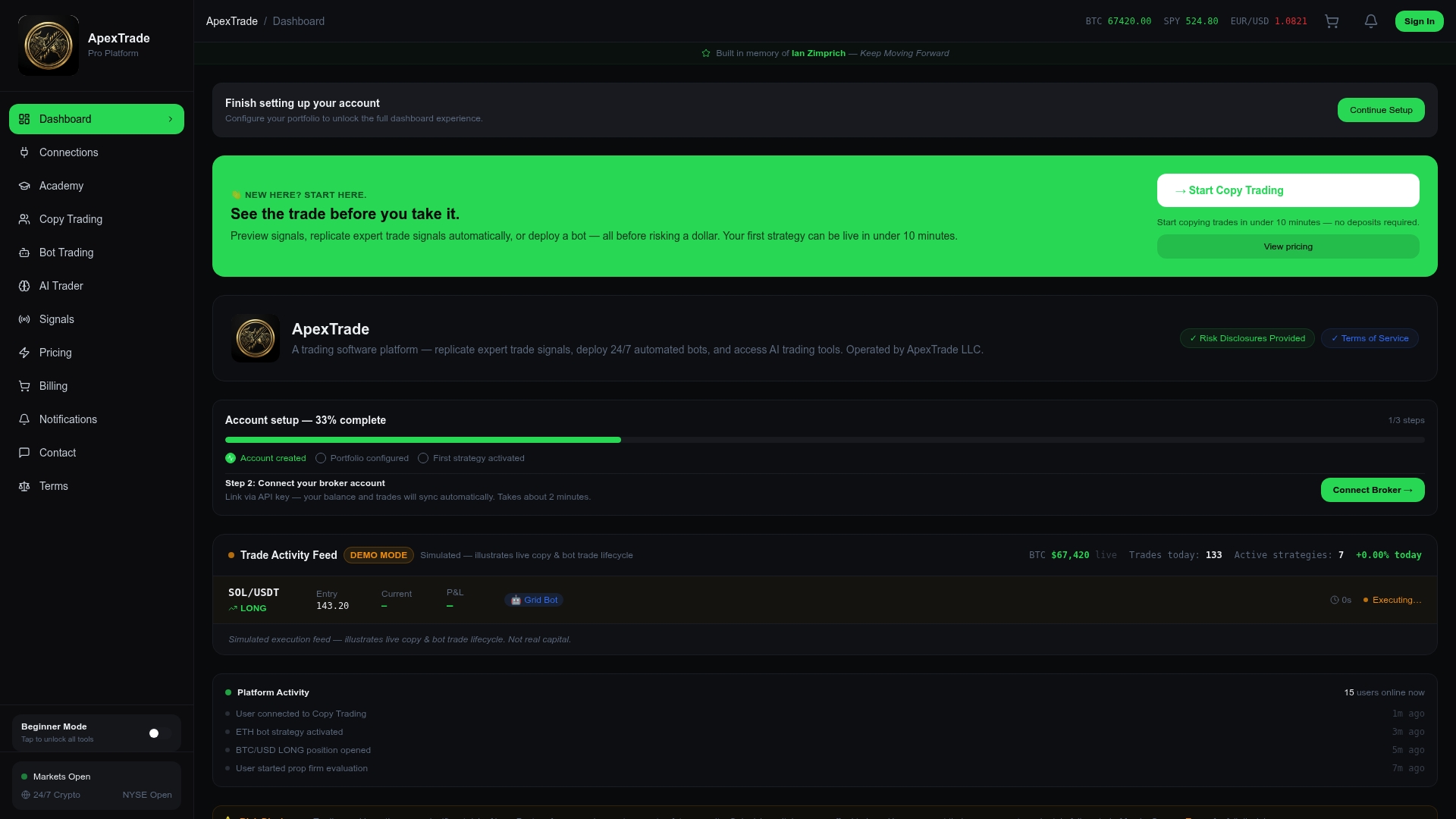
The Apextradellc trading platform provides a user-friendly interface for placing forex orders, monitoring open positions, and reviewing trade history in one place. For traders who want to automate their strategies, Apextradellc bot trading deploys rule-based systems that execute 24/7 without manual intervention. Beginners who are still developing their own approach can use copy trading to replicate the positions of experienced traders while they learn. Visit Apextradellc to explore which tools fit your current stage.
FAQ
What is forex trading step by step for beginners?
Forex trading step by step is the process of choosing a currency pair, deciding buy or sell based on analysis, setting lot size, placing a market order, and protecting the trade with a stop loss and take profit. Beginners should complete this process on a demo account at least 100 times before trading real money.
How much money do I need to start forex trading?
Many regulated brokers allow accounts starting at $100 to $500, though $500 to $1,000 gives you enough capital to practice proper position sizing at 1 to 2% risk per trade. Starting with less makes it difficult to size positions correctly without risking too large a percentage per trade.
What is a stop loss and why does it matter?
A stop loss is an order that automatically closes your trade at a predefined price to cap your loss. Trades without stop losses have caused account-wiping losses for beginners, making stop loss placement a non-negotiable part of every trade entry.
How long does it take to learn forex trading?
A realistic learning roadmap runs 3 to 6 months: two weeks on basics, four to eight weeks building a methodology, and four to eight weeks of demo trading with journaling before transitioning to a small live account.
What currency pair should beginners trade first?
EUR/USD is the best starting pair for beginners because it has the highest daily trading volume, the tightest spreads, and the most available educational content and analysis. Starting with major pairs reduces costs and simplifies learning.