

Most people assume cryptocurrency trading is just gambling with a tech coat. It is not. What is cryptocurrency trading, stripped of the noise? It is the active buying and selling of digital assets on exchanges to profit from price movements over short to medium time horizons. That is a fundamentally different activity from investing in cryptocurrency for years and forgetting about it. Traders study mechanics, use specific order types, and manage risk deliberately. If you want to understand how it actually works before you put money in, this guide is where you start.
Table of Contents
- Key Takeaways
- What is cryptocurrency trading and how it works
- Order books, order types, and price formation
- Common trading strategies and risk considerations
- Getting started on crypto trading platforms
- My honest take after watching traders get this wrong
- Take your trading further with Apextradellc
- FAQ
Key Takeaways
| Point | Details |
|---|---|
| Trading differs from investing | Traders target short to medium price moves; investors hold assets for long-term growth. |
| Spot trading is the safest start | Buying and immediately owning the asset removes liquidation risk that derivatives carry. |
| Order types control your price | Limit orders protect against slippage; market orders prioritize speed over price. |
| Leverage amplifies both wins and losses | Derivatives with leverage can wipe a position quickly if the market moves against you. |
| Platform choice carries its own risk | Crypto exchanges operate with less regulatory oversight than traditional brokers. |
What is cryptocurrency trading and how it works
Cryptocurrency trading is the practice of buying, selling, or exchanging digital assets on platforms to capitalize on price movements. The key word is active. A trader might hold Bitcoin for three days and sell it for a 6% gain. A long-term investor might hold that same Bitcoin for three years without flinching at a 40% drawdown. Same asset, completely different mindset and time horizon.
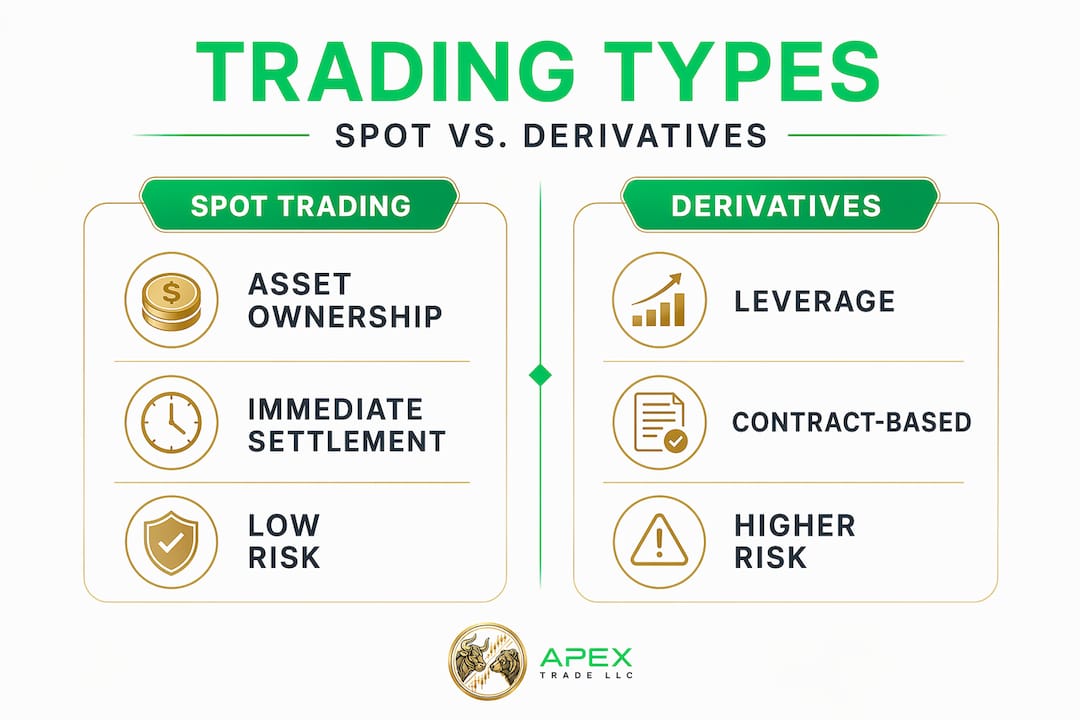
Spot trading
Spot trading means you exchange assets immediately at the current market price and take ownership right away. Buy BTC on a spot market and you receive actual BTC in your account. No contracts, no expiry dates. This simplicity makes it the right starting point for anyone new to the space.

Derivatives trading
Derivatives are a different animal. Rather than owning the underlying asset, you trade contracts tied to its price. Futures, options, and perpetual swaps all fall here. The appeal is leverage: you can control a large position with a smaller amount of capital. The danger is identical. Leverage can magnify losses, and beginners often underestimate how fast a leveraged position can hit liquidation.
A few other mechanics worth knowing before you place your first trade:
- 24/7 markets. Unlike the stock market, crypto never closes. Price-moving news can hit at 3 a.m. on a Sunday, and positions can move sharply while you sleep.
- Centralized exchanges (CEXs). Platforms like Coinbase or Kraken hold your funds and match orders through their own order books. They offer speed and familiar interfaces.
- Decentralized exchanges (DEXs). These run on blockchain smart contracts with no central authority. You keep custody of your assets, but the user experience is more complex.
- Spot market exposure offers 24/7 access and real asset ownership, which most beginners find easier to manage than derivatives or exchange-traded products.
Pro Tip: If you are deciding between a CEX and a DEX as your first platform, start with a regulated centralized exchange. Lower fees, clearer interfaces, and customer support make the learning curve significantly shorter.
Order books, order types, and price formation
This is where most beginner guides skip ahead too fast. Understanding the order book is not optional. It is the foundation of how every trade actually executes.
How the order book works
An order book is a live list of buy and sell orders sitting in a market at different price levels. Bids are the prices buyers are willing to pay. Asks are the prices sellers are willing to accept. The gap between the highest bid and the lowest ask is the spread. Tight spreads indicate high liquidity. Wide spreads indicate the opposite.
Order book depth affects both liquidity and slippage, because market orders execute immediately by consuming existing bids or asks in sequence from best price downward.
| Order type | How it works | Best use case |
|---|---|---|
| Market order | Executes immediately at the best available price | Speed matters more than exact price |
| Limit order | Sits in the book until price reaches your set level | Price control and slippage reduction |
| Stop-loss order | Triggers a market or limit order when a threshold is hit | Protecting an open position from large losses |
Why slippage matters more than most beginners expect
Large market orders can move through multiple order book levels, resulting in a worse average execution price than the last traded price you saw. This is called slippage. On a liquid pair like BTC/USD, slippage on a modest order is negligible. On a smaller altcoin with thin order books, a $5,000 market order could execute at prices 2 to 4% worse than expected.
Limit orders give you price control but come with fill risk. If the market never reaches your limit price, the order simply does not fill. Professional traders treat that as a feature, not a flaw. Missing a trade because you refused to chase the price is often the better outcome.
Pro Tip: For any new position, use a limit order placed just inside the current spread. You will often get filled within seconds on liquid pairs while avoiding unnecessary slippage.
Common trading strategies and risk considerations
There is no single right strategy. The right one depends on how much time you can commit and how comfortable you are watching a position move against you before it recovers.
Here are the four strategies most traders encounter early on:
- Spot trading. Buy an asset, hold it for days to weeks, sell when the target is hit. No leverage. No liquidation risk. The cleanest way to learn how markets move.
- Day trading. Open and close all positions within the same day. Requires focused attention during market hours and solid technical analysis skills. Learn more about the mechanics in this step-by-step day trading guide.
- Swing trading. Hold positions for days to weeks, targeting medium-sized price moves. Requires less screen time than day trading but still demands active management.
- Scalping. Take many small trades throughout the day, targeting tiny price increments. High frequency, high transaction costs, and high mental load. Not beginner-friendly.
Beginners are strongly advised to start with spot trading before engaging derivatives. The mechanics of margin, funding rates, and liquidation thresholds take time to internalize, and the cost of learning those lessons with leverage is steep.
Risk management is the part most people skip until they experience a painful loss. Three rules that actually matter:
First, never risk more than 1 to 2% of your total capital on a single trade. Second, always set a stop-loss before entering a position, not after the trade goes against you. Third, understand that crypto intermediaries carry counterparty and liquidity risks since many operate without the full prudential safeguards that traditional brokers hold. Platform risk is real and separate from market risk.
Getting started on crypto trading platforms
Choosing a platform is your first practical decision, and it shapes everything that follows.
- Select a regulated centralized exchange. Look for platforms with strong security records, clear fee schedules, and responsive support. Trading platforms typically offer order type explanations and fee calculators that help new traders build foundational knowledge before live trading.
- Complete your account setup and KYC. Most reputable exchanges require identity verification before you can deposit fiat currency. This is standard practice and a sign the platform takes compliance seriously.
- Fund your account. You can deposit via bank transfer, debit card, or transfer crypto from another wallet. Bank transfers are typically slower but carry lower fees.
- Understand your trading pairs. A pair like ETH/BTC means you are trading Ether against Bitcoin. BTC/USD means you are trading Bitcoin against US dollars. Pairs involving stablecoins like USDT are often the best starting point because one side of the trade does not move.
- Set up your basic tools. Learn to read a candlestick chart before you trade. Practice placing limit orders and stop-losses in a paper trading environment if the platform offers one.
- Explore automation tools. Once you understand the basics, trading bots and copy trading can help automate strategies and reduce emotional decision-making.
Fees deserve more attention than most beginners give them. A maker fee of 0.1% and a taker fee of 0.2% sounds trivial per trade. Across dozens of trades per month, fee drag becomes a meaningful variable in your overall performance.
My honest take after watching traders get this wrong
I've seen hundreds of traders walk into crypto convinced that the hard part is picking the right coin. It is not. The hard part is understanding what you are actually doing when you place a trade.
What I've found is that most early losses come from two places. The first is skipping spot trading and going straight to leveraged futures because the profit potential sounds better. It does sound better. But when a 10x leveraged position gets liquidated on a 10% adverse move, the entire account can be gone before the trader has even had time to learn what went wrong.
The second mistake I see consistently is underestimating platform risk. People scrutinize the chart for hours and spend zero time reading about the exchange's withdrawal policies, security record, or reserve transparency. The BIS has documented that many crypto firms act like financial middlemen without traditional regulations, adding counterparty exposure beyond simple price volatility.
My honest advice is this: spend your first month on spot trading with a small amount you are genuinely comfortable losing. Not an amount that hurts, but an amount that teaches. Use limit orders. Watch how your orders fill. Track every trade and review what you did right and wrong. The traders I've watched succeed long-term treated the early period as paid education, not the start of a money-making machine.
Emotional control is the skill nobody talks about in beginner guides. Losing three trades in a row and maintaining the same disciplined process is harder than any technical analysis concept. It is also what separates traders who last from traders who quit.
— James
Take your trading further with Apextradellc
You now understand the fundamentals. The natural next question is how to trade more efficiently without watching screens around the clock.
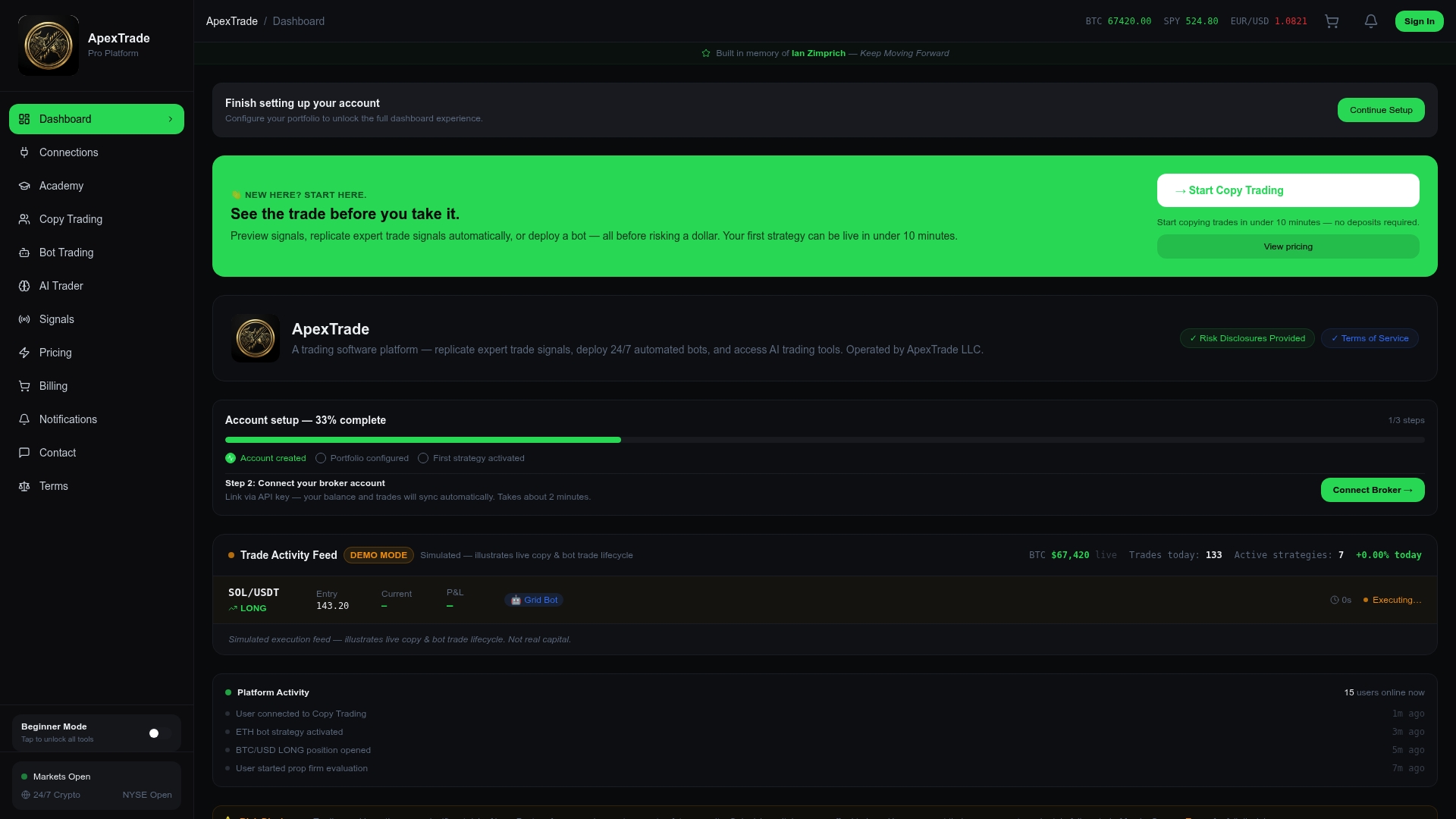
Apextradellc is built exactly for this stage. The platform's automated trading bots execute your defined strategy 24/7, so open positions are managed even when you are away from your screen. For traders who want to learn while they earn, the copy trading feature lets you mirror the moves of experienced traders directly, turning real market activity into a live education. Apextradellc integrates portfolio tracking, trade history, and strategy management in one place, making it a practical environment for beginners ready to move from theory to execution.
FAQ
What is the difference between trading and investing in crypto?
Trading targets short to medium-term price movements with active buying and selling. Investing in cryptocurrency typically means holding assets over a longer time horizon, often months or years, regardless of short-term price swings.
Is spot trading safer than derivatives for beginners?
Yes. Spot trading means you own the asset outright with no liquidation risk. Derivatives use leverage, which can amplify losses and wipe a position on a relatively small price move.
How do crypto trading platforms make money?
Most platforms charge maker and taker fees on each transaction, typically ranging from 0.05% to 0.5% per trade. Some also charge withdrawal fees, spread markups, or subscription fees for premium tools.
What is slippage in cryptocurrency trading?
Slippage is the difference between the price you expected when placing a market order and the price at which the order actually filled. It occurs because large orders consume multiple levels of the order book, worsening the average execution price.
Do I need a lot of money to start trading crypto?
No. Many exchanges allow you to start with as little as $10 to $50. Starting small while you learn the mechanics is the practical approach most experienced traders recommend.