

Most people assume stock trading is either gambling or something reserved for Wall Street professionals in expensive suits. Neither is true. What is stock trading, really? At its core, it's the practice of buying and selling shares in publicly listed companies with the goal of profiting from price changes, usually over shorter timeframes than traditional investing. This guide breaks down how the stock market works, the terminology you need to know, the strategies traders actually use, and the practical steps to get started without making the costly beginner mistakes most people make.
Table of Contents
- Key takeaways
- What is stock trading and how it differs from investing
- How the stock market actually works
- Essential trading terms and order types
- Common stock trading strategies
- How to start stock trading as a beginner
- My honest take on what actually matters
- Ready to trade smarter with Apextradellc?
- FAQ
Key takeaways
| Point | Details |
|---|---|
| Trading vs. investing | Trading targets short-term price moves, while investing focuses on long-term growth over years. |
| Order types matter | Choosing between market, limit, and stop-loss orders directly affects your risk and execution price. |
| A plan is non-negotiable | Every trade needs a defined entry, exit, and risk limit before you click buy. |
| Practice before real money | Paper trading lets you test strategies in real market conditions without losing a cent. |
| Tools can multiply your edge | Automation and copy trading features help you act faster and learn from experienced traders. |
What is stock trading and how it differs from investing
Stock trading is the act of buying and selling shares of public companies with the goal of making a profit, focusing on short-term price movement rather than long-term ownership. That distinction matters more than most beginners realize.
A long-term investor buys shares in a company and holds them for years, betting on the company's overall growth. A trader, by contrast, watches price charts, news events, and market signals, looking for opportunities to profit within days, hours, or even minutes. The same stock can be someone's retirement holding and a day trader's quick flip at the same time.
The key practical difference between investing and trading is activity level defined by time horizon, with trading involving more frequent action and higher risk tolerance. That higher frequency means more decisions, more transaction costs, and more emotional pressure.
There are three common trading frequencies you'll hear about:
- Day trading: Positions are opened and closed within the same trading day. No overnight exposure to price gaps.
- Swing trading: Positions are held for several days to a few weeks, aiming to capture a single price "swing" in either direction.
- Position trading: Traders hold for weeks to months, somewhere between active trading and traditional investing.
Pro Tip: If you're just starting out, swing trading tends to be more forgiving than day trading. You have more time to analyze your decisions and less pressure to react in seconds.
Each style demands different skills, time commitments, and risk tolerances. Knowing which fits your life before you open a position will save you a lot of pain.
How the stock market actually works
The stock market is not one physical place. It's a network of exchanges, the most well-known being the New York Stock Exchange (NYSE) and Nasdaq, where buyers and sellers meet to trade shares. Think of each exchange as a highly regulated marketplace with transparent pricing.

When you place a trade, you're not calling a broker on the phone. You open a brokerage account, enter your order through an online platform, and the broker routes that order to the exchange or a market maker who matches it with a seller (or buyer). The whole process can happen in milliseconds.
| Trading detail | What you need to know |
|---|---|
| Market hours | U.S. stock markets run from 9:30 a.m. to 4:00 p.m. Eastern Time on business days |
| Settlement | Most stock trades settle within one business day (T+1) after execution |
| Brokerage account | A brokerage account is required to buy and sell stocks and can be opened online quickly |
| Pre and after-hours | Extended trading sessions exist but carry lower liquidity and wider price spreads |
One thing many beginners miss: the price you see quoted on a stock is not always the price you'll pay. The actual transaction depends on the type of order you place and how liquid the market is at that moment. That's why understanding order types is one of the most important parts of stock trading basics.
Essential trading terms and order types
Before you place a single trade, you need to speak the language. Here's what you'll encounter immediately.
The bid is the highest price a buyer is willing to pay for a stock. The ask is the lowest price a seller will accept. The difference between those two numbers is the spread. In liquid markets with heavy trading volume, spreads are tiny. In thinly traded stocks, the spread can cost you real money before the market even moves.
Market orders execute immediately at the best available price, while limit orders execute only at a specified price or better. That sounds simple, but the implications run deep. Market orders prioritize speed. Limit orders prioritize price control.
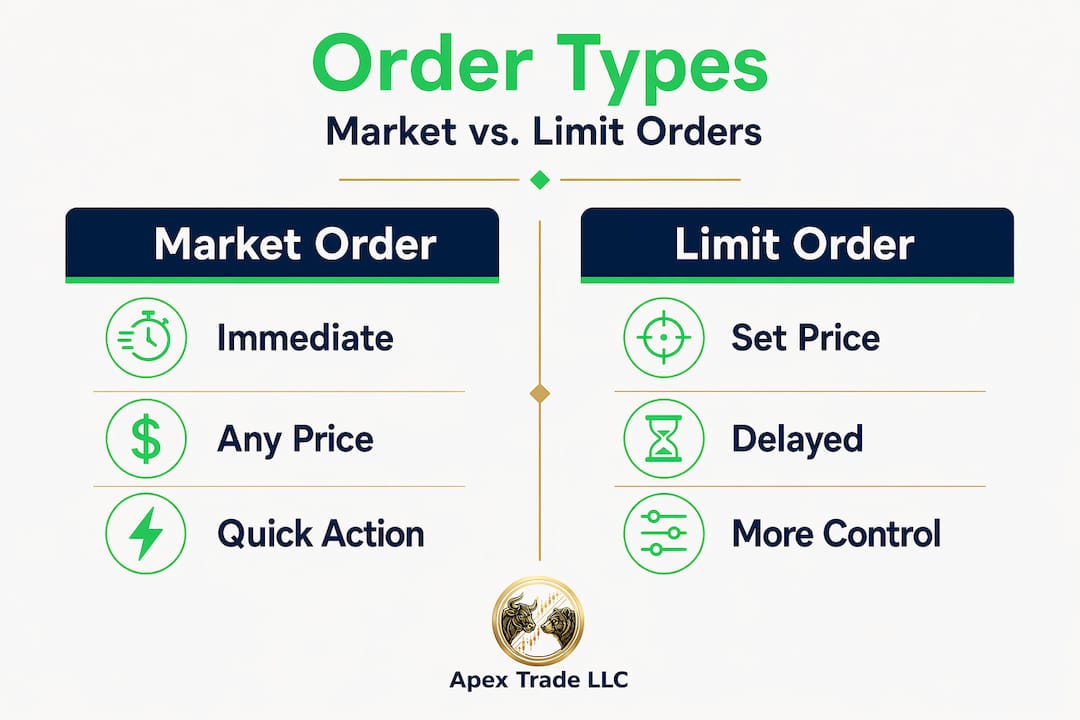
Here's how they compare directly:
| Order type | Execution speed | Price certainty | Best used when |
|---|---|---|---|
| Market order | Immediate | None | You need fast execution in a calm market |
| Limit order | Conditional | Guaranteed (or better) | You want control over your entry or exit price |
| Stop-loss order | Triggered at set price | Approximate | You want automatic protection against large losses |
Stop-loss orders help limit losses by triggering an automatic sale once a specified price is reached. For any trader managing risk seriously, stop-losses are not optional. They're the mechanism that keeps one bad trade from wiping out several good ones.
The classic beginner mistake is using a market order during a fast-moving event, like an earnings release or a Fed announcement. Market orders during volatile markets can execute at prices dramatically different from what you expected. A limit order prevents that, though it might not fill at all if the price moves past your target.
Pro Tip: When you're learning, default to limit orders. You'll pay a bit more attention, think more carefully about your target price, and avoid the nasty surprises that market orders deliver during fast moves.
Common stock trading strategies
Understanding what a strategy actually is will save you from chasing every new "hot tip" you come across. A trading strategy is a defined set of rules for when to enter a trade, when to exit, and how much to risk. Without one, you're not trading. You're gambling.
Here are the approaches most active traders work with:
- Technical analysis: Traders study price charts, volume patterns, and indicators like moving averages and RSI to predict future price moves based on historical behavior.
- Momentum trading: Buying stocks that are already moving strongly in one direction, betting the trend continues for a period.
- News-based trading: Capitalizing on price reactions to earnings reports, economic data releases, or major corporate announcements.
- Contrarian trading: Taking positions against the current trend, usually at extreme overbought or oversold levels.
Trading is riskier than long-term investing due to time sensitivity and market timing challenges. This isn't meant to discourage you. It's meant to frame your expectations correctly. Every strategy has losing periods. The traders who survive are the ones who manage losses well, not the ones who are always right.
Before committing real money, there's one practice that separates confident traders from reckless ones. Paper trading. Experienced traders test strategies extensively using paper trading and predefine exit conditions before committing real money. A paper trading account mirrors real market conditions but uses simulated funds. You get the experience without the financial consequences.
Pro Tip: Run any new strategy through at least 20 to 30 paper trades before going live. A small sample size will tell you nothing meaningful about whether the strategy actually works.
How to start stock trading as a beginner
Getting started is more straightforward than most people think. Here's the honest sequence:
-
Choose a broker that fits your goals. Look at commission structures, the quality of their trading platform, available research tools, and whether they offer paper trading. For active traders, platform speed and charting tools matter more than for casual investors.
-
Open and fund your brokerage account. Most accounts can be opened in under 15 minutes online. You don't need a large amount to begin. Many brokers allow fractional shares, so you can buy pieces of expensive stocks for as little as a few dollars.
-
Practice with a paper trading account. Almost every serious trading platform offers a simulated trading environment. Use it until you understand how orders work and how your chosen strategy performs in real market conditions.
-
Build a trading plan before your first live trade. Your plan should define which stocks you'll trade, what signals trigger an entry, where you'll set your stop-loss, and what profit target would make you exit. Trading requires a plan and exit strategy rather than just buying and hoping for a price rise.
-
Start small with real money. Risk only what you can afford to lose entirely. Professional traders typically risk no more than 1 to 2 percent of their total account on any single trade.
-
Review your trades systematically. Keep a trading journal. After every trade, record why you entered, what happened, and what you'd do differently. This is how real skill develops.
Pro Tip: Your first goal as a new trader is not to make money. It's to not lose money while you're learning. Protecting capital in the early stage keeps you in the game long enough to actually get good.
My honest take on what actually matters
I've watched too many beginners blow up their first accounts chasing the same myths. They hear about someone doubling their money in a week and assume that's the norm. It isn't. The people sharing those wins rarely mention the five trades before that wiped out their gains.
What I've found consistently true is this: the traders who last are obsessively focused on managing losing trades, not on picking winners. You can have a strategy that's right only 40 percent of the time and still be profitable if your winners are twice as large as your losers. That math runs completely counter to how most beginners think.
The other thing I'd push back on is the idea that more tools equals better results. Technology is genuinely useful. Automated platforms and bots can remove emotion from execution. But the beginner who jumps straight into algorithmic tools without understanding the underlying strategy is just automating their confusion faster. Start with the fundamentals. Build a plan. Then let the tools work for you.
Discipline is the actual edge. Not the secret indicator, not the hot sector, not the broker with the lowest fees. Discipline over weeks and months is what separates accounts that grow from accounts that get closed.
— James
Ready to trade smarter with Apextradellc?
Understanding stock trading basics is step one. Putting those concepts into practice with the right platform is step two. Apextradellc is built for exactly that transition.
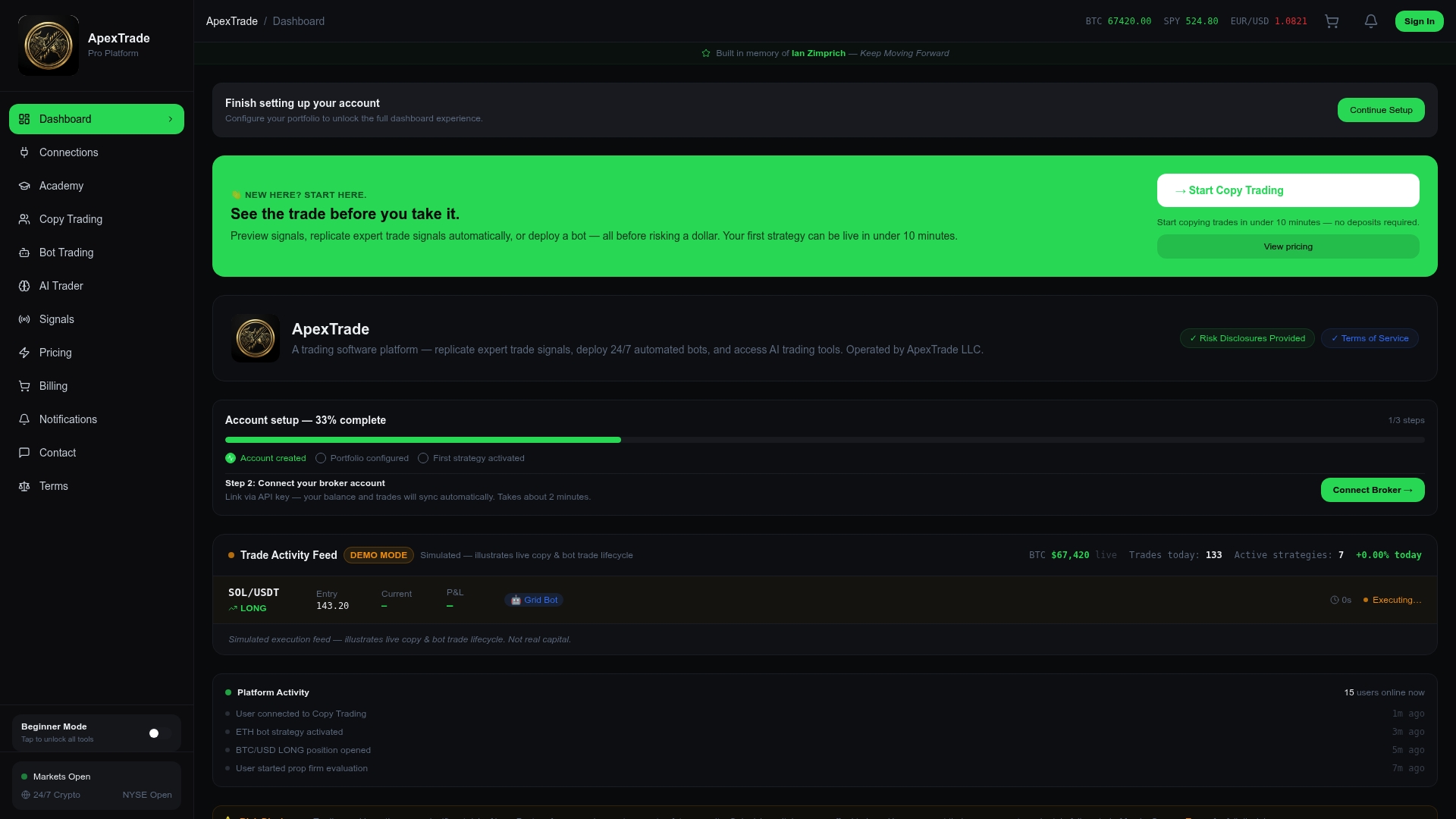
Whether you're just getting comfortable with order types or ready to explore automated bot trading that executes your strategy around the clock, Apextradellc has the tools for both. For those who prefer to learn by watching what works, the platform's copy trading feature lets you mirror the positions of experienced traders directly. You can also explore the full suite of trading tools available on the platform to find what fits your approach. Stop waiting until you feel "ready enough." Start with the right tools at your side.
FAQ
What is stock trading in simple terms?
Stock trading is the buying and selling of shares in publicly listed companies with the goal of making a profit from short-term price changes. Unlike long-term investing, trading focuses on timing and frequent market activity.
What is the difference between a market order and a limit order?
A market order executes immediately at the current best available price, while a limit order only executes at the price you specify or better. Limit orders give you price control; market orders give you speed.
How much money do you need to start stock trading?
Many online brokers allow you to open an account with no minimum deposit, and fractional shares let you invest with just a few dollars. Starting small is actually recommended while you're still building experience.
What is a stop-loss order and why does it matter?
A stop-loss order automatically sells your stock when it drops to a price you set in advance, capping your potential loss on any single trade. It's one of the most practical risk management tools for beginner and experienced traders alike.
Is stock trading risky for beginners?
Yes, stock trading carries more risk than long-term investing because it depends on timing and short-term market movements. Using paper trading to practice, keeping position sizes small, and following a defined plan significantly reduces the risk while you're learning.