
Not every platform that calls itself "secure" actually is. That gap between marketing language and operational reality is where traders lose money, get locked out of accounts during volatile markets, or discover their data was never protected in the first place. Understanding what is a secure trading platform means looking beyond the SSL badge on a login page. It means asking harder questions about regulatory standing, cybersecurity programs, execution integrity, and disaster recovery. This guide gives you the framework to ask those questions and recognize the real answers.
Table of Contents
- Key takeaways
- What a secure trading platform actually means
- Beyond the login screen: execution and operational security
- How different platform types compare on security
- How to choose a secure trading platform
- My take on what traders consistently get wrong
- Trade smarter with Apextradellc's security-first platform
- FAQ
Key takeaways
| Point | Details |
|---|---|
| Regulation is foundational | A truly secure platform operates through registered brokerages with FINRA and SEC oversight, not just marketing claims. |
| Cybersecurity goes beyond MFA | Broker-dealers must maintain programs covering phishing, ransomware, and account takeovers per FINRA and SEC rules. |
| Operational security matters equally | Order routing accuracy, audit trails, and confirmations define whether a platform is trustworthy at the workflow level. |
| Platform types carry different standards | Traditional brokers, crypto exchanges, and institutional platforms each meet different security benchmarks worth verifying independently. |
| Verification is your responsibility | Always check licenses, certifications, and third-party audits before committing capital to any platform. |
What a secure trading platform actually means
The term gets thrown around loosely. A banner reading "secure trading" on a website homepage tells you almost nothing. The real definition has two distinct pillars: regulatory compliance and cybersecurity infrastructure, and you need both.
On the regulatory side, a genuinely secure platform for stocks, ETFs, or bonds operates through registered broker-dealers subject to FINRA and SEC oversight. That registration is not cosmetic. It means the firm must follow rules on capital requirements, record-keeping, order handling, and customer protection. When you place a trade, FINRA expects you to receive a detailed order confirmation covering execution price, date, commission, and any relevant fees. That paper trail is part of what makes a platform secure at the transactional level.
On the cybersecurity side, broker-dealers face explicit obligations to maintain programs that address phishing, ransomware, account takeovers, and vendor breaches. The specific rules include FINRA 3110, 3120, 4370, and 4530, alongside SEC Regulations S-P and S-ID. These are not optional best practices. Regulators treat gaps in these programs as compliance failures.
The core technical controls you should expect on any secure trading site include:
- End-to-end encryption on all data in transit and at rest
- Multi-factor authentication (MFA) for account login and sensitive account changes
- Session timeout policies to prevent unauthorized access during inactive periods
- Role-based access controls limiting what each user or system component can access
- Real-time anomaly detection to flag unusual login patterns or transaction behavior
Pro Tip: Verify MFA is required, not just offered as optional. Platforms that make MFA optional are leaving the most common attack vector wide open.
Beyond the login screen: execution and operational security
Most traders stop evaluating security at the login page. That is a mistake. The integrity of your trade from the moment you click "buy" to the moment it settles is just as much a security concern as your password strength.
Order execution reliability is a core component that often gets separated from security discussions. Market orders carry no execution guarantee at a specific price, particularly during high volatility or unusual volume. A platform's security in this sense means its ability to accurately route your order, process it correctly, and confirm the result with a clean audit trail that matches what you agreed to. Mismatches between what you ordered and what was confirmed are a security failure, not just a UX problem.
True operational security for any platform involves several layers working together:
- Pre-trade risk controls: Position limits, margin checks, and order size validation run before your order reaches the market. These protect both you and the platform from cascading errors.
- Post-trade reconciliation: Every confirmed trade should match the original order parameters. Discrepancies trigger exception reports and investigations.
- Audit trail integrity: Order processing requires a clean record matching customer agreements to what was executed and confirmed. Without this, disputes become nearly impossible to resolve.
- Disaster recovery and failover planning: Platform outages during volatility can destroy trust even when all cybersecurity controls are functioning perfectly. Recovery time objectives should be defined, tested, and documented.
- Institutional authentication models: For platforms serving institutional clients, service-to-service authentication using client certificates, signed instructions, and explicit trust architectures secures the connections between order management and execution systems.
"Security without operational reliability is an incomplete promise. A platform that never gets breached but goes dark during a market crash has still failed its users at the moment that mattered most."
Managing pre- and post-trade risk is not just about compliance. It is about whether the platform behaves predictably when conditions are hardest to handle.
How different platform types compare on security
Security standards are not uniform across platform categories. Understanding what each type typically offers helps you set accurate expectations before you deposit.
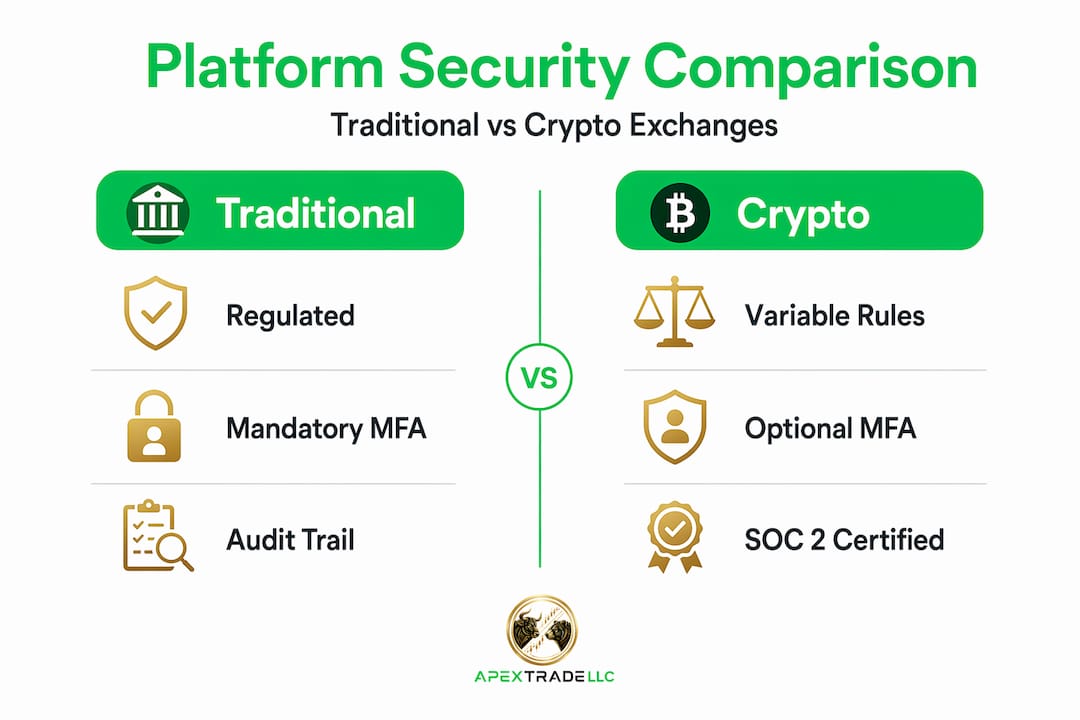
| Platform Type | Regulatory Framework | Key Security Features | Third-Party Validation |
|---|---|---|---|
| Regulated broker-dealer | SEC, FINRA registration | MFA, encryption, SIPC protection, order confirmations | FINRA examinations, SEC audits |
| Crypto exchange | Varies by jurisdiction | Cold storage, SOC 2 audits, insurance funds | SOC 2 Type II certification |
| Institutional multi-asset | SEC/FINRA plus CFTC in some cases | Automated regulatory reporting, pre/post trade controls | Internal audits, third-party penetration testing |
| Automated trading platforms | Varies widely | API security, bot-level access controls, encrypted signals | SOC 2, ISO 27001 in stronger cases |
The crypto exchange category deserves a closer look because it is where the widest quality gap exists. SOC 2 Type II certification has become a meaningful benchmark in this space, covering availability, confidentiality, and privacy controls over an extended audit period. An exchange that completed this audit has demonstrated sustained security practices, not just a point-in-time snapshot.
Institutional platforms go further with automated regulatory reporting and real-time risk management, though users still need to independently verify vendor claims rather than accept product marketing at face value.
Pro Tip: For crypto specifically, check whether the exchange maintains a separate insurance fund for user assets. Platforms with a dedicated reserve fund have at least one more layer of protection between you and a loss event.
How to choose a secure trading platform
Knowing what security means in theory is useful. Knowing how to verify it before you commit real capital is what actually protects you. Here is the checklist that should drive your evaluation process.
Verify regulatory status first. Look up any broker or exchange on FINRA BrokerCheck or the SEC's Investment Adviser Public Disclosure database before anything else. For crypto platforms, check whether they hold a money transmitter license in your state or a BitLicense in New York if relevant.
Audit the cybersecurity disclosures. Legitimate platforms publish information about their security controls, including whether they use encrypted connections, how MFA is implemented, and what happens when a breach is detected. Vague language like "we take security seriously" without specifics is a yellow flag.
Test the customer protection structures. Does the platform have SIPC membership for brokerage accounts? Does the crypto exchange carry insurance? Are client funds held separately from operating capital? These details are often buried in terms of service but are non-negotiable for institutional money.
- Check whether the platform provides a transparent fee schedule and order routing disclosure. Hidden markups on execution are both a financial and governance concern.
- Look for published incident response procedures. How does the platform communicate when something goes wrong?
- Read third-party reviews from traders who have used the platform under real market stress, not just during normal conditions.
- Confirm the platform conducts regular penetration testing and publishes (or at minimum acknowledges) the results.
Assess transparency on order execution. Safe trading options require platforms to be upfront about how and where orders are routed. Payment for order flow arrangements, for example, affect execution quality and should be disclosed.
For automated trading specifically, evaluate how bot strategies are permissioned and what controls prevent unauthorized access to your trading account through API keys or connected third-party tools. API key scope management is an underrated security feature that most retail traders ignore until it is too late.
My take on what traders consistently get wrong
I have watched traders obsess over two-factor authentication while completely ignoring the operational integrity of the platform processing their trades. In my experience, that is exactly backwards from where the real risk sits.
Cybersecurity is table stakes. If a platform cannot clear that bar in 2026, you should not be using it at all. But once you have confirmed the baseline controls are in place, the more interesting question is whether the platform has genuine audit trail integrity at the workflow level. Have they had regulatory enforcement actions? Do they have a history of execution anomalies their customers could not dispute?
What I have learned from reviewing regulatory enforcement cases is that most platform security failures that actually hurt traders are not dramatic hacks. They are quiet operational failures. Orders routed incorrectly. Confirmations that do not match executions. Systems that go down at exactly the wrong moment. The cybersecurity programs regulators require are designed to address the dramatic failures. The operational ones are on you to evaluate.
My recommendation: spend as much time reading a platform's regulatory history and execution quality disclosures as you spend reading its feature list. The feature list is written by marketing. The regulatory history is written by reality.
— James
Trade smarter with Apextradellc's security-first platform
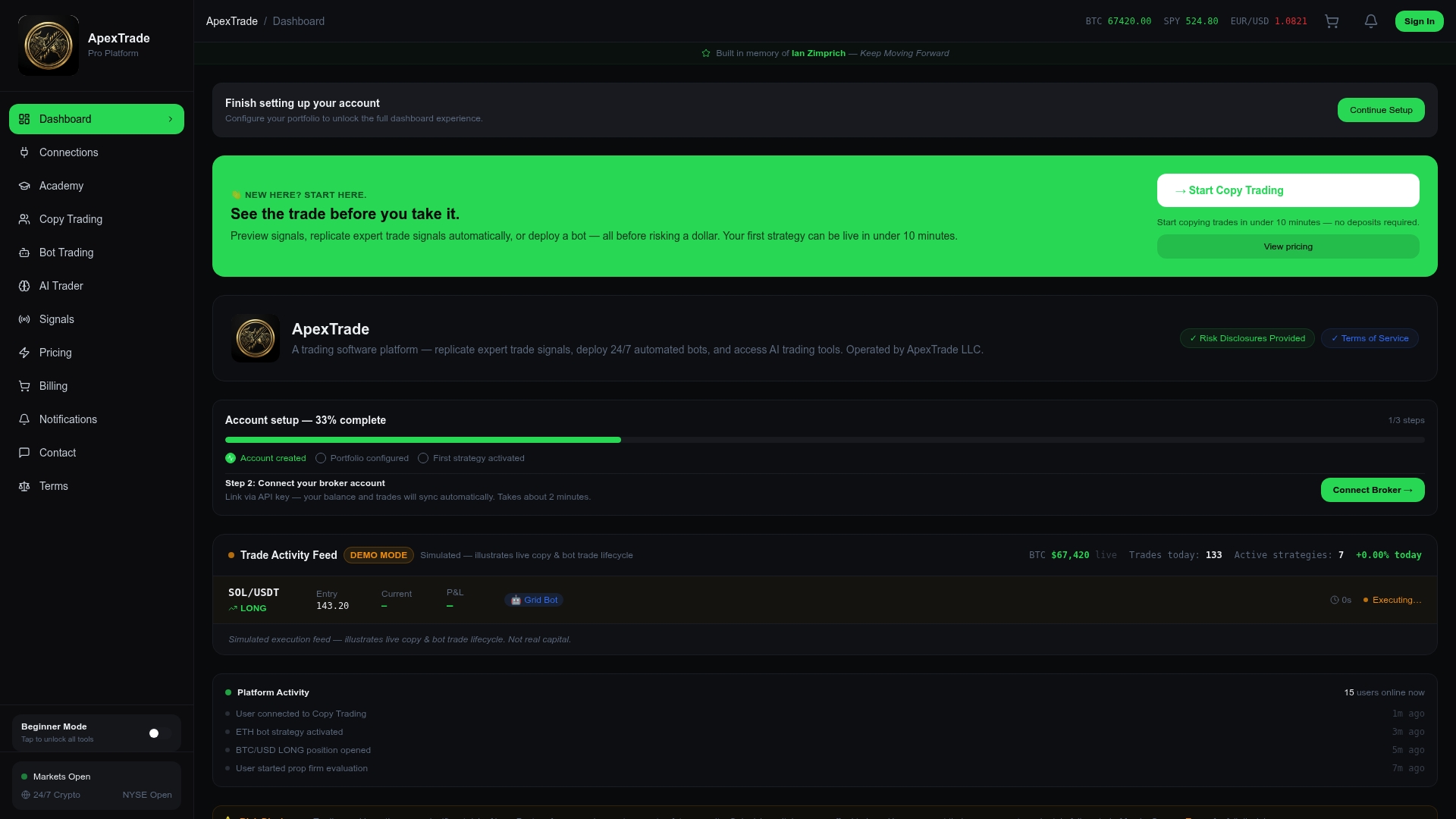
If you have just spent time understanding what genuine platform security looks like, the next logical step is finding a platform that actually delivers it. Apextradellc is built for traders who take both performance and protection seriously. The platform runs automated bot trading with encrypted signal delivery and API-level access controls, so your strategies execute without exposing your account to unnecessary risk. For traders who prefer following proven strategies, copy trading on Apextradellc replicates verified trader activity within a secured account environment. From portfolio management to trade history and connected account monitoring, Apextradellc handles the data infrastructure that institutional-grade security requires. Whether you trade crypto, stocks, or forex, the tools are there and the security posture is transparent.
FAQ
What is a secure trading platform in simple terms?
A secure trading platform is a regulated, licensed venue that combines strong cybersecurity controls like encryption and MFA with operational protections including accurate order processing, audit trails, and customer fund segregation.
How do I know if my trading platform is secure?
Check its regulatory registration on FINRA BrokerCheck or the SEC database, confirm it uses MFA and encrypted connections, and look for third-party audits like SOC 2 Type II certification or FINRA examination history.
What security features should every trading platform have?
Every legitimate platform should offer multi-factor authentication, end-to-end encryption, real-time fraud monitoring, segregated client funds, and a clear incident response policy. Institutional platforms should also include pre- and post-trade risk controls.
Are crypto exchanges as secure as traditional brokerages?
Not automatically. Traditional broker-dealers operate under mandatory SEC and FINRA rules, while crypto exchanges vary widely. The strongest exchanges pursue SOC 2 Type II audits and maintain insurance funds, but regulatory coverage is less consistent than in traditional markets.
What is the biggest security risk most traders overlook?
Operational security failures, meaning inaccurate order routing, unresolved execution discrepancies, and platform outages during volatility. These cause real financial harm far more often than headline-grabbing breaches.