

Automation in investing is defined as the deployment of AI and agentic technologies to handle research, decision-making, trade execution, and post-trade operations at a scale no human team can match. The impact of automation on investing now touches every layer of the financial markets, from how BlackRock writes its code to how a solo trader manages a crypto portfolio overnight. Firms like BCG, McKinsey, and UBS have each documented a structural shift: automation is not a feature upgrade. It is a redesign of the entire investment process, and investors who understand its mechanics will hold a measurable edge over those who do not.
How does automation impact investment research and decision-making?
Automation expands analytical capacity in ways that were structurally impossible five years ago. AI agents can monitor thousands of securities simultaneously, process earnings transcripts in seconds, and flag risk signals across correlated asset classes before a human analyst opens a spreadsheet. The result is a research cycle that runs faster and covers more ground with fewer blind spots.
The benefits for risk management are equally concrete. Dynamic risk models powered by machine learning can recalibrate portfolio exposure in real time as market conditions shift, rather than waiting for a weekly review. BCG research shows that agentic AI automates 70-80% of investment execution and operational workflows, which means analysts spend less time gathering data and more time applying judgment to the signals that matter.

This shift changes what analysts are actually paid to do. The role moves from data aggregation toward higher-order interpretation: identifying which signals are noise, which market narratives are credible, and where the model is wrong. Firms investing in scalable, continuously improving AI agents are redefining what competitive research looks like in asset management.
The Sharpe ratio implications are real. When automation removes execution drag and improves risk-adjusted timing, portfolio construction becomes more precise. Understanding the role of AI in trading is now a prerequisite for any investor building a systematic strategy.
Pro Tip: Use AI-assisted screening tools to narrow your research universe first, then apply your own judgment to the shortlist. Automation handles the volume; you handle the conviction.
- AI agents process earnings data, macro feeds, and alternative data simultaneously
- Risk models recalibrate dynamically rather than on fixed review schedules
- Analyst roles shift from data collection to interpretation and judgment
- Portfolio construction benefits from reduced execution drag and improved timing signals
What does automation do to trade execution and operations?
Trade execution is where automation delivers its most measurable financial return. Automated systems handle order routing, algorithm selection, timing optimization, and market impact management without human latency. BCG confirms that trader time shifts from routine order management to execution strategy and exception handling, which is a structural upgrade in how human capital is deployed.
Post-trade operations have seen an equally dramatic transformation. Duco's agentic operations platform illustrates what is now possible: the firm processes 20 billion transactions monthly for top banks and asset managers, and reconciliation time dropped from two days to four hours using AI agents. That is not an incremental improvement. It is a category change in operational capacity.
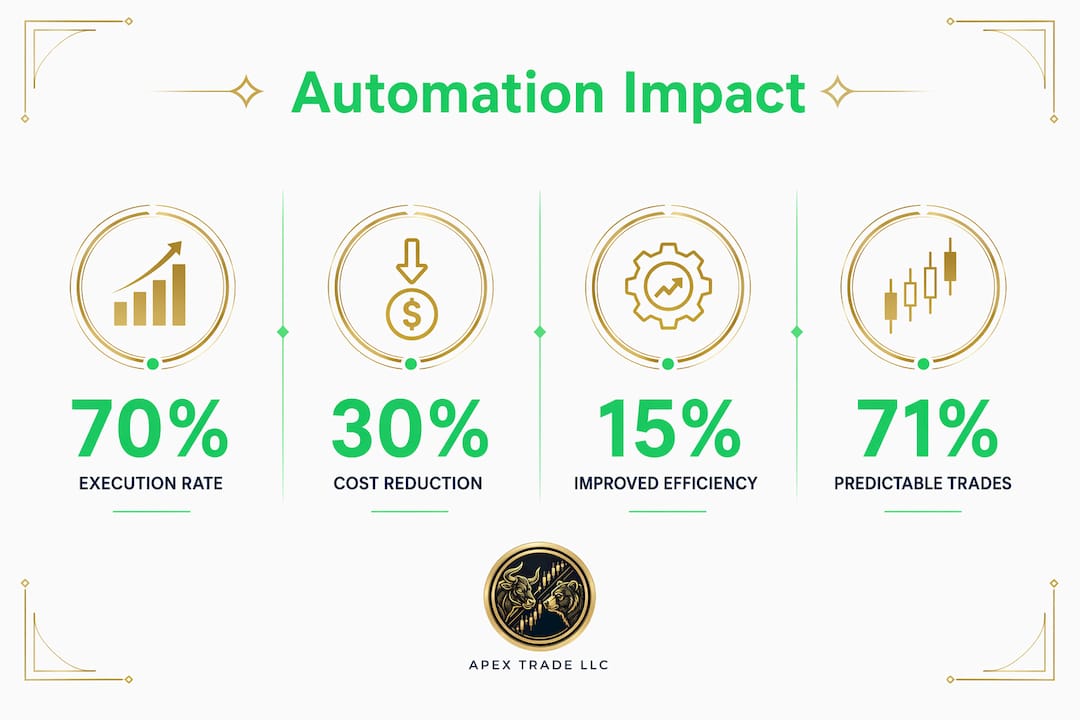
The financial case for this transformation is direct. Agentic automation delivers operational cost reductions of around 40% and increases distribution capacity by 35 to 50 percent. For asset managers running high-volume strategies, those numbers translate directly into margin and scalability.
Here is how the workflow transformation breaks down in practice:
- Order management is automated end-to-end, including routing logic and venue selection
- Real-time monitoring flags anomalies and execution deviations without human oversight
- Reconciliation runs continuously rather than in overnight batch cycles
- Exception handling is escalated to human traders only when the agent cannot resolve it
- Reporting and compliance documentation is generated automatically from execution logs
| Workflow Stage | Before Automation | After Automation |
|---|---|---|
| Reconciliation time | 2 days | 4 hours |
| Operational cost | Baseline | ~40% reduction |
| Distribution capacity | Baseline | 35-50% increase |
| Trader focus | Routine order management | Strategy and exceptions |
Pro Tip: If you are running a systematic strategy, audit your post-trade workflow first. Reconciliation delays are often where hidden costs accumulate, and they are the easiest wins for automation.
How is automation changing the role of fund managers?
The most provocative finding in recent research is this: 71% of US mutual fund managers' trade directions can be predicted by AI. That number reframes the entire debate about what active management is actually worth. If an algorithm can anticipate the majority of a manager's moves, the traditional fee model for those moves becomes very hard to defend.
The performance data sharpens the point. The most predictable managers lost 0.42% on a risk-adjusted basis, while the least predictable gained 0.4%. Novel strategies outperform predictable ones by a meaningful margin. This means human value in fund management is now concentrated in the ability to do something an AI cannot replicate, not in the ability to execute a disciplined process consistently.
"The shift is from outputs to outcomes. Automation commoditizes the output. What remains scarce is the judgment, the relationship, and the accountability that clients cannot get from a model."
The implications for hiring and compensation are already visible. Firms are reducing headcount in roles that automation handles well and paying more for the roles it cannot. Portfolio managers who specialize in genuinely novel strategies, relationship management, or complex multi-asset structures are gaining leverage. Those who built careers on disciplined execution of well-documented processes are under direct pressure.
McKinsey documents that AI automating technical planning is shifting value from outputs to trusted outcomes and human judgment across wealth management. Sell-offs in wealth management stocks erased more than $20 billion in market value as markets priced in this structural repricing. That reaction was not panic. It was the market correctly identifying which business models are durable and which are not.
- Predictable managers face direct AI competition and fee pressure
- Novel, differentiated strategies retain and grow their value premium
- Relationship management and advisory roles become the new moat
- Compensation structures are shifting toward judgment-intensive roles
What are the broader economic effects of automation in finance?
AI functions as a general-purpose enabling layer across economies, which means its effects on investing are uneven and sector-specific rather than uniform. Not every company that adopts AI benefits equally. The distinction between technological inevitability and economic inevitability is one of the most important analytical frames an investor can apply right now.
UBS research makes this point directly: AI's rapid, nonlinear improvement challenges traditional investment durability assumptions. A company can be a genuine AI adopter and still face margin compression if its competitors adopt at the same rate. The automation advantage only compounds when adoption is faster, deeper, or more proprietary than the competition.
Value traps are a real risk in this environment. Investors who buy AI adoption narratives without assessing the durability of the underlying business model are exposed to repricing when the narrative meets the income statement. The companies that benefit most from automation are those where AI reduces a structural cost, creates a proprietary data advantage, or enables a product that was previously impossible to deliver at scale.
| Sector | Automation Benefit | Key Risk |
|---|---|---|
| Asset management | Cost reduction, scalability | Fee compression, commoditization |
| Specialized software | New product capabilities | Rapid competitive catch-up |
| Infrastructure providers | Volume growth from AI demand | Valuation already pricing in growth |
| Traditional brokerages | Execution efficiency | Margin pressure on core services |
BlackRock reports that 35% of its code is now written by AI, and firms across financial services are achieving 15 to 30 percent efficiency gains in operations. Those gains are real, but they are also becoming table stakes. The firms that convert efficiency gains into durable competitive advantage are the ones worth owning. Granular, fundamentals-based analysis is the only reliable way to tell the difference.
Key takeaways
Automation in investing creates durable advantage only for firms and investors who combine AI-driven efficiency with irreplaceable human judgment and novel strategy.
| Point | Details |
|---|---|
| Automation scope is broad | AI now handles 70-80% of execution and operational workflows, cutting costs by roughly 40%. |
| Predictability is a liability | Fund managers whose trades AI can predict lose risk-adjusted returns; novel strategies outperform. |
| Operations are transformed | Reconciliation dropped from two days to four hours with agentic platforms like Duco's. |
| Economic effects are uneven | AI adoption does not guarantee economic gain; durability depends on proprietary advantage. |
| Human judgment retains value | Relationship management, novel strategy, and accountability are the roles automation cannot replace. |
Why the automation debate misses the most important question
I have watched the automation conversation in investing get framed as a binary for years: either AI replaces human investors or it does not. That framing is wrong, and it leads people to the wrong decisions.
The real question is not whether automation replaces you. It is whether you are building the kind of judgment that automation cannot commoditize. The Harvard Business School finding that 71% of fund manager trades are predictable by AI is not a death sentence for active management. It is a very precise map of where the value has already been extracted and where it still lives.
What I find most interesting is the McKinsey observation about trust and auditability becoming the new competitive moat. Firms that can prove their AI-driven decisions are compliant, auditable, and aligned with client outcomes will hold a structural advantage over firms that just run faster algorithms. Speed is easy to copy. Trust takes years to build.
For individual investors, the practical implication is straightforward. Learning how to automate trading for the mechanical parts of your strategy frees your attention for the decisions that actually require your judgment. That is not a concession to automation. It is how you use it correctly.
The investors I respect most right now are not the ones arguing about whether AI is overhyped. They are the ones quietly building workflows where automation handles the repeatable work and their own thinking is reserved for the irreplaceable calls. That combination is what durable performance looks like in 2026.
— James
Put automation to work in your own portfolio
The industry shift described in this article is not reserved for BlackRock and BCG clients. Apextradellc gives individual and professional investors direct access to the same automation capabilities reshaping institutional finance.
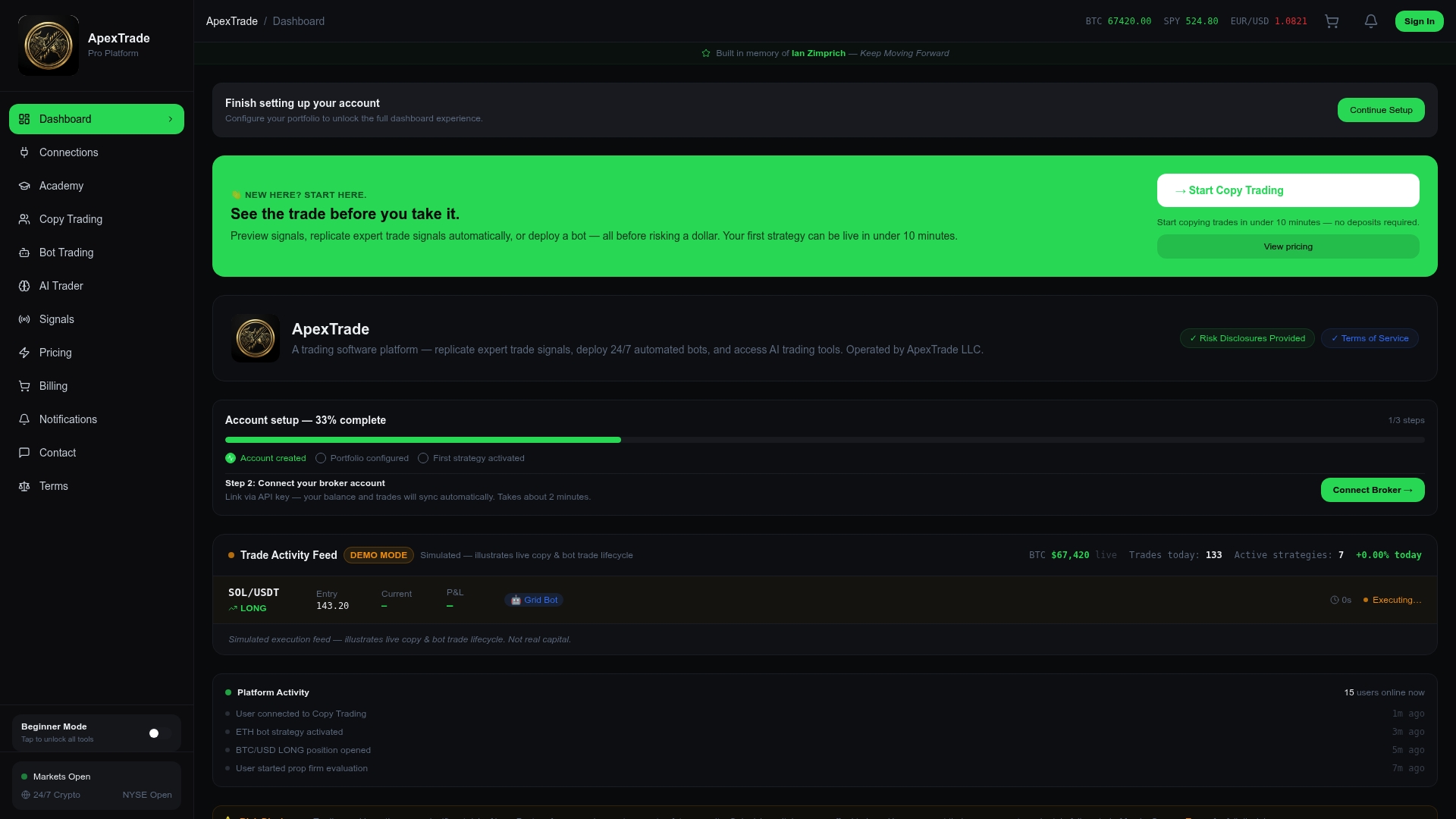
Apextradellc's bot trading platform deploys algorithmic strategies across crypto, stocks, and forex markets around the clock, handling execution, monitoring, and order management automatically. For investors who want to replicate proven strategies without building from scratch, Apextradellc's copy trading tools let you mirror the activity of successful traders in real time. Both solutions are built for the investor who understands that automation handles the volume while you retain control of the strategy.
FAQ
What is the impact of automation on investing?
Automation in investing uses AI and agentic technologies to handle research, execution, and operations at scale, reducing costs by roughly 40% and shifting human roles toward judgment and strategy rather than routine tasks.
How does automation affect fund managers?
Research shows 71% of US mutual fund managers' trade directions are predictable by AI, which compresses fees for routine strategies while rewarding managers who develop genuinely novel, differentiated approaches.
What are the benefits of automation in finance?
The core benefits include faster research cycles, dynamic risk management, reduced operational costs, and execution optimization. Duco's platform cut reconciliation time from two days to four hours as one documented example.
Does automation in investing create risks for investors?
Yes. The primary risks are value traps from AI adoption narratives without durable economic advantage, fee compression in commoditized strategies, and overreliance on predictable models that competitors can replicate quickly.
How can individual investors use automation effectively?
Individual investors can deploy trading bots and copy trading platforms to automate execution and monitoring, then focus their own judgment on strategy selection, risk parameters, and the decisions that require genuine insight.