

A crypto portfolio is defined as a structured collection of digital assets allocated across different coins, sectors, and risk tiers to balance growth potential against volatility. The best crypto portfolio tips center on three non-negotiable disciplines: structured diversification, rules-based rebalancing, and risk-aware asset allocation. Without these, even experienced investors end up chasing narratives and suffering preventable losses. Tools like DEXTools, tracking platforms like CoinTracker, and institutional frameworks from Morgan Stanley all point to the same conclusion: process beats prediction every time.
1. Core crypto portfolio tips for asset allocation
The most effective framework for crypto asset allocation is the core-satellite model, where your most stable assets anchor the portfolio and riskier positions orbit around them. Tier-based allocation places BTC and ETH at 50 to 70% of total crypto holdings, mid and large caps at 15 to 25%, small caps at 10 to 20%, speculative tokens at 0 to 10%, and stablecoins at 5 to 15%. This structure gives you growth exposure without betting the entire portfolio on a single narrative.
The stablecoin reserve is the most underrated slice of this model. It is not dead weight. It is dry powder you deploy when markets drop 30% and everyone else is panic-selling. Keeping 5 to 15% in USDC or USDT means you can buy into dislocations without liquidating your core positions at a loss.

Speculative tokens deserve strict limits. Allocating more than 10% to low-cap, high-narrative tokens is how portfolios get cut in half during sector rotations. Treat them as lottery tickets with a defined maximum loss, not as core holdings.
Pro Tip: Write your allocation percentages down before you buy a single token. Investors who commit their targets to paper before entering positions are far less likely to deviate when markets move against them.
2. How to diversify your crypto portfolio across sectors
Diversification in crypto is not just about holding many coins. It is about holding coins from different sectors that do not all collapse together. The sector bucket approach groups assets into store-of-value (Bitcoin), smart-contract platforms (Ethereum, Solana), DeFi and yield protocols, real-world asset tokenization, and speculative narrative plays. Sector-based diversification with a cap of two tokens per sector prevents correlation blowups when a single narrative unravels.
The reason this matters is that during stress events, tokens within the same sector tend to fall together and fall hard. If you hold five DeFi tokens, you do not have five positions. You have one concentrated DeFi bet split across five tickers.
Real-world asset tokenization and yield protocols are worth a dedicated allocation because they behave differently from pure speculative plays. They generate cash flows or are backed by off-chain assets, which creates a partial buffer when sentiment-driven tokens crater.
- Store-of-value: Bitcoin as the primary holding
- Smart-contract platforms: Ethereum plus one alternative layer-1
- DeFi and yield: two protocols maximum, focused on established platforms
- RWA tokenization: one to two positions in tokenized treasuries or real estate
- Speculative narratives: capped at 10% total, rotated based on cycle themes
- Stablecoins: 15 to 30% of the crypto sleeve for flexibility and rebalancing
Pro Tip: Before adding a new token, ask which sector bucket it belongs to. If that bucket is already at its cap, you must remove something before adding. This one rule eliminates most impulsive buys.
3. When and how to rebalance your portfolio
Rebalancing is the practice of selling overweight positions and buying underweight ones to return to your target allocation. Calendar and threshold rebalancing are the two dominant methods. Calendar rebalancing runs on a fixed schedule, monthly or quarterly. Threshold rebalancing triggers when any position drifts more than 5 to 10% from its target weight.
Threshold rebalancing is generally more responsive in crypto because prices move faster than any calendar schedule can track. If Bitcoin runs 40% in a month, your allocation shifts dramatically before your next scheduled review. A 5% drift trigger catches this automatically.
Tax implications are real and should shape your execution. Selling a position that has appreciated significantly creates a taxable event. One way to minimize this is to rebalance into new purchases rather than selling winners. When fresh capital enters the portfolio, direct it toward underweight positions first. This is sometimes called cash-flow rebalancing and it reduces your tax burden without requiring you to sell anything.
For large rebalancing moves, break the trade into smaller parts executed over several days. This reduces slippage in lower-liquidity tokens and prevents you from moving the market against yourself. Stablecoin reserves make this cleaner. You can manage portfolio rebalancing by deploying stablecoins into underweight positions during drawdowns rather than selling appreciated assets at the wrong time.
- Set your target allocation percentages before any market move occurs
- Choose a primary rebalancing method: calendar or threshold
- Define your threshold trigger, typically 5 to 10% drift from target
- Review tax implications before executing any sell order
- Use stablecoin reserves to rebalance without forced selling
- Break large trades into smaller tranches to reduce slippage
Pro Tip: Use CoinTracker or Zerion to set allocation alerts. When a position crosses your drift threshold, the platform notifies you automatically so you do not have to monitor prices manually.
4. Security and custody practices that protect your holdings
Self-custody is the only way to fully control your crypto assets, and hardware wallets from manufacturers like Ledger and Trezor are the standard for serious holders. Hardware wallet security requires purchasing devices only from official sources, verifying tamper-evident packaging on arrival, and generating your seed phrase entirely within the device, never on a connected computer.
The seed phrase is the master key to your funds. Write it on paper, store it in at least two geographically separate locations, and never photograph it or store it digitally. A single cloud breach can empty a wallet if the seed phrase is stored online.
Malware is a specific and underappreciated threat. Address substitution attacks occur when malware on your computer swaps out the recipient address you copied with an attacker's address. Your hardware wallet displays the actual destination address on its own screen. Always verify the address on the hardware device screen, not the software interface, before confirming any transaction.
"Security incidents often stem from poor backup strategies. Splitting seed backups into different secure locations and using multisignature wallets at higher balances reduce single points of failure." The Central Bulletin
For balances above a meaningful threshold, multisignature wallets add a second layer of protection by requiring multiple key approvals for any transaction. This eliminates the single point of failure that a standard hardware wallet still carries.
5. Trading discipline, tax strategy, and tracking tools
Position sizing is the discipline that separates sustainable crypto investing from gambling. The 1% rule states that no single position should risk more than 1% of total capital. Applied consistently, this rule means even a string of bad trades cannot destroy the portfolio. It forces you to size positions relative to your total capital rather than your conviction level.
Dollar-cost averaging (DCA) is the most practical entry strategy for most investors. Rather than timing a single entry, you buy a fixed dollar amount at regular intervals. This removes the emotional weight of trying to call bottoms and reduces the average cost basis over time. Staking rewards from proof-of-stake assets like Ethereum add a yield component that compounds over longer holding periods.
Tax documentation is not optional. All crypto dispositions are reportable on IRS Form 8949, and the IRS now issues 1099-DA forms through exchanges. Maintaining a complete transaction log from every wallet and exchange is the only way to avoid mismatches that trigger audits. CoinTracker and Zerion both automate this process by syncing with wallets and exchanges to generate tax reports.
| Tool | Primary use | Best for |
|---|---|---|
| CoinTracker | Tax reporting and portfolio tracking | Investors with multiple wallets and exchanges |
| Zerion | DeFi portfolio monitoring | Active DeFi users tracking on-chain positions |
| DEXTools | Token research and liquidity analysis | Traders evaluating new token entries |
Avoiding FOMO is a behavioral skill as much as a strategic one. The best crypto investment strategies include a written rule that prohibits buying any token that has already risen more than 30% in 24 hours without a pre-planned thesis. This single rule eliminates most of the worst trades most investors ever make.
Key takeaways
Effective crypto portfolio management requires a written allocation framework, sector-based diversification, threshold-triggered rebalancing, and hardware wallet security working together as a system.
| Point | Details |
|---|---|
| Use the core-satellite model | Allocate 50 to 70% to BTC and ETH, with smaller slices for mid-caps, small-caps, and stablecoins. |
| Diversify by sector, not just by coin count | Cap exposure at two tokens per sector to prevent correlated losses during sector-wide drawdowns. |
| Rebalance on thresholds, not just calendars | Trigger rebalancing when any position drifts 5 to 10% from its target to stay ahead of fast-moving markets. |
| Verify every address on your hardware device | Malware can swap addresses on your computer screen. The hardware wallet screen is the only trusted source. |
| Document every transaction for tax purposes | IRS Form 8949 requires reporting all dispositions. Use CoinTracker or Zerion to automate this record-keeping. |
Why most crypto portfolios fail before the bull run ends
I have watched investors build solid portfolios in the early stages of a cycle and then dismantle them through a predictable sequence of mistakes. The first mistake is abandoning the allocation plan the moment a speculative token starts trending on social media. The second is refusing to rebalance because selling a winner feels wrong. The third is holding 25 tokens and calling it diversification when it is actually just noise.
The over-diversification trap is real. Holding more than 15 coins dilutes returns without meaningfully reducing risk, because correlations spike during stress periods and everything falls together anyway. Five to fifteen coins across three to four sectors is the efficient range. Beyond that, you are adding complexity without adding protection.
What actually works is boring. Write your allocation rules before you buy anything. Set your rebalancing triggers in advance. Keep a stablecoin reserve and treat it as a strategic asset, not a failure to be fully invested. When markets drop 40%, that reserve is what lets you buy while others are selling. That asymmetry is where real portfolio returns come from.
Process and rules-based management is what separates sustainable investing from speculation. I have seen investors with modest starting capital outperform traders with far more experience simply because they followed a written plan and did not deviate. The plan does not need to be perfect. It needs to exist and be followed.
Security deserves the same discipline. A hardware wallet setup takes two hours. Losing funds to a malware attack or a lost seed phrase takes two seconds. The asymmetry there is obvious, yet most investors treat security as an afterthought until it is too late.
— James
How Apextradellc helps you execute your portfolio strategy
Building a disciplined portfolio plan is one thing. Executing it consistently, especially during volatile markets, is where most investors struggle. Apextradellc's automated bot trading tools let you deploy rules-based strategies that run 24/7 without emotional interference. You set the parameters and the bots execute, removing the behavioral drag that undermines even well-designed allocation plans.
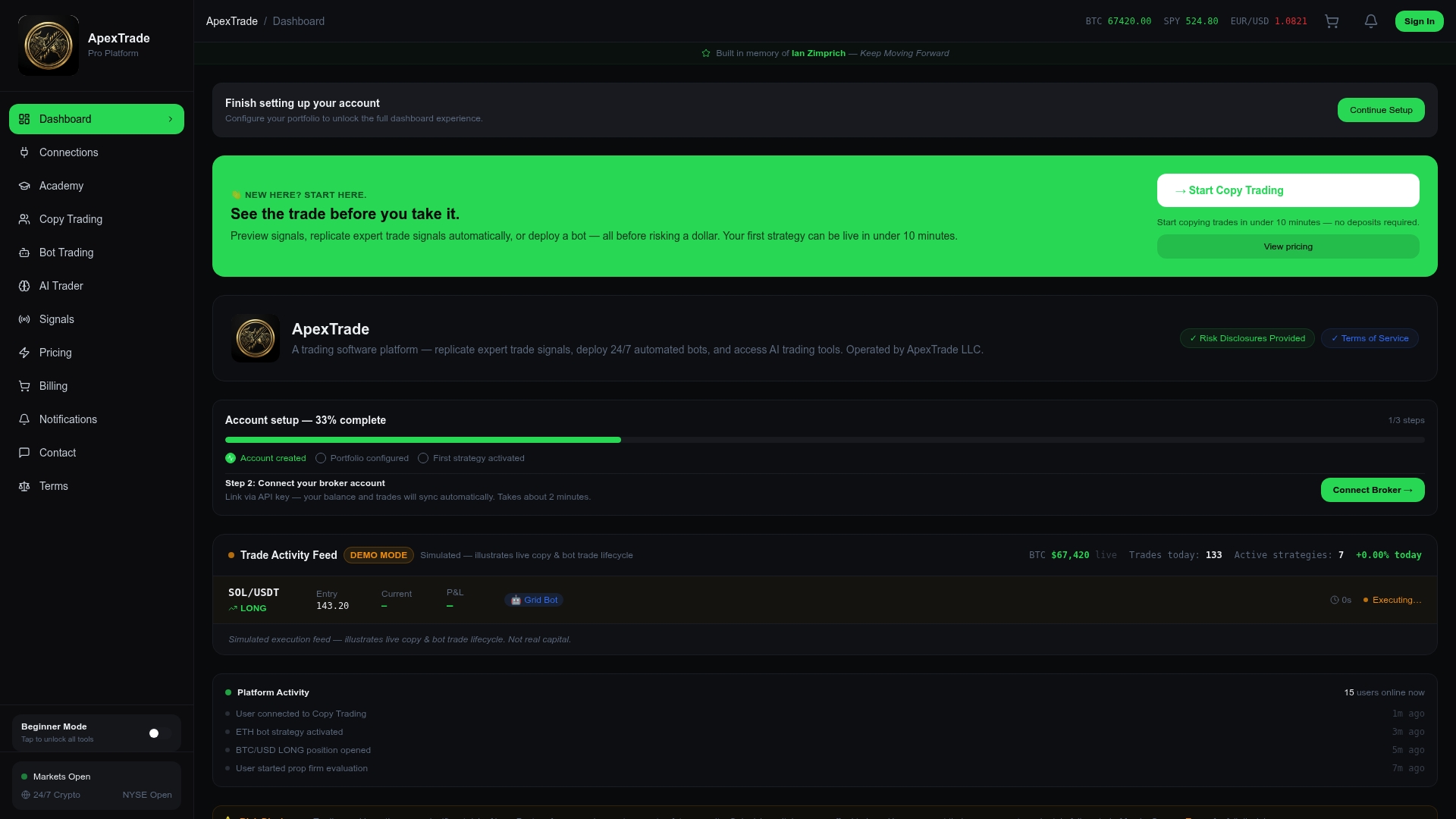
For investors who want to follow proven strategies rather than build from scratch, Apextradellc's copy trading service mirrors the positions of disciplined, experienced traders in real time. This is particularly useful for beginners who understand the theory of diversification and rebalancing but want a structured model to follow while they build their own expertise. Apextradellc also provides portfolio tracking and trade history tools that integrate directly with your tax documentation workflow.
FAQ
What is the ideal crypto portfolio allocation for beginners?
Beginner crypto investment advice points to a core-satellite model where Bitcoin and Ethereum represent 50 to 70% of holdings, with the remainder spread across mid-caps, stablecoins, and a small speculative slice. This structure limits downside while preserving meaningful upside exposure.
How often should you rebalance a crypto portfolio?
Rebalancing works best on a threshold basis, triggered when any position drifts 5 to 10% from its target weight, or on a monthly to quarterly calendar schedule. CoinTracker and similar tools can automate drift alerts so you never miss a trigger.
How many coins should a diversified crypto portfolio hold?
The efficient range is 5 to 15 coins spanning 3 to 4 sectors plus a stablecoin position. Holding more than 15 coins dilutes returns without reducing risk, because correlations increase during market stress regardless of how many tokens you hold.
Do I need a hardware wallet if I use a reputable exchange?
Hardware wallets are the standard for any meaningful holding because exchange custody introduces counterparty risk. Ledger and Trezor devices verify addresses on their own screens, protecting against malware attacks that cannot be blocked at the exchange level.
How do I handle crypto taxes when rebalancing?
Every sale of a crypto asset is a taxable disposition reportable on IRS Form 8949. Using cash-flow rebalancing, directing new capital toward underweight positions rather than selling winners, reduces taxable events. Platforms like CoinTracker generate compliant tax reports automatically from your transaction history.