

Manual trading demands hours of chart analysis, split-second decisions, and the kind of emotional discipline most people can't sustain. A well-structured copy trading workflow offers a different path. Instead of building expertise from scratch, you connect your account to proven traders and let automation handle execution. This guide breaks down every stage of that process, from platform setup through ongoing portfolio review, with real risk controls and best practices you can apply immediately.
Table of Contents
- Key takeaways
- Setting up your copy trading workflow
- The core copy trading workflow, step by step
- Risk management inside your copy trading setup
- Monitoring and optimizing your portfolio
- My take on what actually makes copy trading work
- Apextradellc's copy trading tools
- FAQ
Key takeaways
| Point | Details |
|---|---|
| Workflow has five core phases | Detection, evaluation, sizing, execution, and lifecycle mirroring define every copy trading process. |
| Risk controls protect your capital | Per-trade caps of 3 to 5% and daily loss limits prevent catastrophic drawdowns regardless of lead performance. |
| Proportional vs. fixed sizing matters | Your allocation method directly affects how much capital each copied trade actually uses. |
| Trial periods reveal real results | Running small 2-week tests exposes latency issues and calibrates risk rules before you commit full capital. |
| Tax compliance needs attention | Copy trading generates multiple taxable events per day. Tracking exports and tax software are non-negotiable. |
Setting up your copy trading workflow
Before a single trade gets copied, your foundation determines everything. Platform selection is where most beginners shortchange themselves. You want a platform with fast API execution, transparent lead trader performance data, and built-in risk enforcement at the server level. Not all copy trading platforms offer equal protection, and finding out their limitations after you've allocated capital is an expensive lesson.
Account linking and integrations
Once you choose a platform, link your trading account through API keys or connect a wallet if you're trading on-chain assets. Double-check the read/write permissions on your API. Read-only access lets the platform monitor prices but won't let it execute trades. Write access is required for execution, so confirm those settings before you fund the account.

Funding a dedicated copy-trade account or sub-wallet is worth the extra setup time. Separating copy trading funds from your personal holdings keeps performance tracking clean and limits unintended exposure.
Allocation methods: proportional vs. fixed
Proportional allocation replicates the lead trader's portfolio percentage in your account. If the lead uses 5% of their capital on a Bitcoin trade, the system uses 5% of yours. Fixed allocation copies a set dollar amount per trade regardless of what the lead commits. Each method has real trade-offs:
| Method | Best for | Key consideration |
|---|---|---|
| Proportional | Matching risk exposure relative to account size | Works well when your account size is similar to the lead's |
| Fixed | Controlling absolute dollar risk per trade | Can over-allocate if lead enters large positions |
Pro Tip: Start with proportional allocation during your trial period. It scales naturally with your account size and makes performance comparisons more meaningful.
Set initial exposure limits before you go live. Know the maximum percentage of your account you're willing to have in open copy trades at any given time.
The core copy trading workflow, step by step
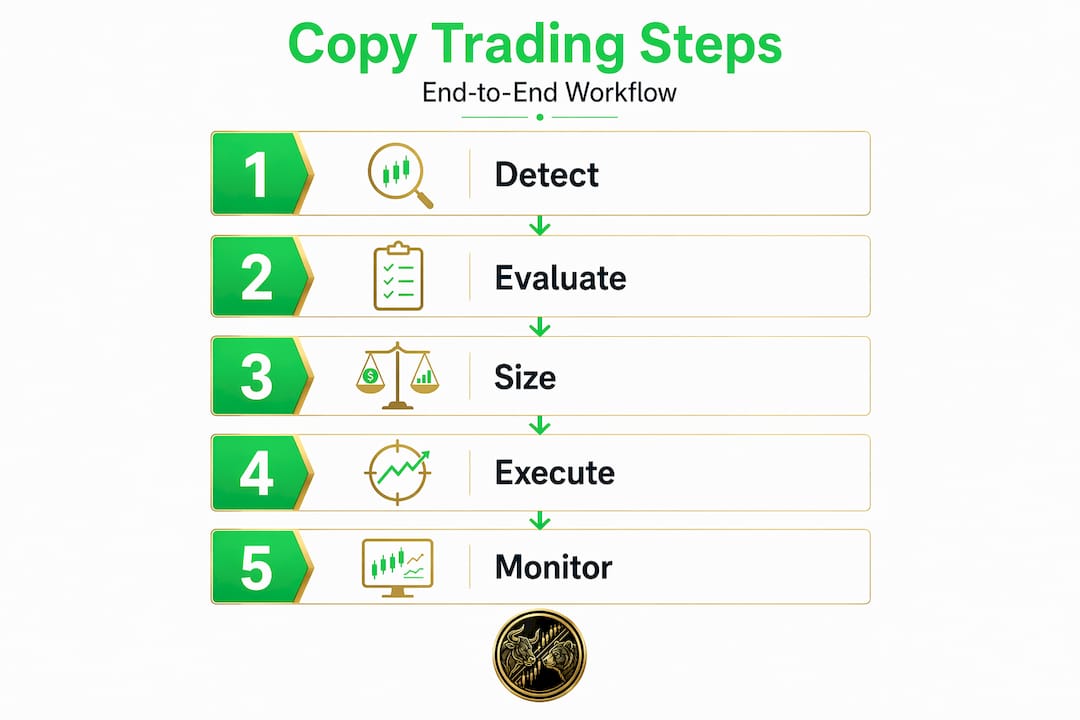
The copy trading workflow follows a defined sequence every time a lead trader places an order. Understanding each step helps you spot problems when results diverge from expectations.
-
Detection. The platform's API monitors the lead trader's account in real time. The moment the lead opens a position, the system registers the trade details including asset, direction, size, and entry price.
-
Evaluation. Your follower-side filters run instantly. If the trade doesn't meet your configured criteria (minimum confidence score, allowed asset classes, trading hours), the system skips it. This is where your personal risk guardrails matter most.
-
Position sizing. The platform calculates your position size using your chosen allocation method. Proportional or fixed sizing gets applied against your available balance, and the result is validated against your per-trade caps before anything executes.
-
Execution. The order fires in your account automatically. Slippage is possible here, especially in volatile markets or when multiple followers trigger orders at the same moment. Fast execution engines reduce this gap but don't eliminate it entirely.
-
Lifecycle mirroring. This step separates solid platforms from weak ones. Robust systems replicate every subsequent action the lead takes on that position. If they tighten a stop-loss, adjust a take-profit, or close the trade early, your account mirrors those changes. Platforms that only copy entries leave you managing exits manually, which defeats the purpose.
Pro Tip: Test your workflow on a small position before scaling up. A $50 test trade will confirm that lifecycle events like stop-loss updates are actually replicating before you commit serious capital.
Some sophisticated automated trading processes use low-latency Rust-based engines with multi-layer risk guards and wallet rotation to minimize execution delays. At that level, the architecture is purpose-built to handle the speed and simultaneity that copy trading demands.
Risk management inside your copy trading setup
Risk management is the difference between copy trading that compounds your account and copy trading that wipes it out. The lead trader's performance record doesn't protect you from your own configuration mistakes.
The most cited best practice parameters include:
- Per-trade position size cap: Keep each copied trade to 3 to 5% of your total account. This limits the damage any single bad trade can do.
- Total exposure limit: Set a ceiling on how much capital can be in open copy positions simultaneously. A common setting is 20 to 30% of the account.
- Drawdown pause rule: Configure the platform to pause copying if your account drops a set percentage within a defined window. This prevents a losing streak from compounding.
- Daily loss cap: Server-enforced daily limits such as a 10% maximum loss per 24 hours are a critical backstop, especially during high-volatility events.
- Stop-loss and take-profit enforcement: These must be set at the platform level, not left to the lead trader's discretion.
Copying windows also matter. Some platforms automatically stop copying after a defined period, such as 30 days, closing any open positions at market price if the lead has been inactive. Understand exactly how your platform handles this so you aren't caught off-guard by an automatic position closure.
Pro Tip: Review your risk parameters every two weeks during the first three months. Your account size changes, markets shift, and what felt conservative at setup may become aggressive or too timid over time.
Revisit your settings after any period of unusual performance, positive or negative. Risk rules should reflect your current account state, not the one you had at setup.
Monitoring and optimizing your portfolio
Setting up a copy trading workflow isn't a one-time task. Active monitoring is what separates traders who sustain results from those who give back gains without realizing it.
The core metrics to track include:
- Realized P&L vs. lead trader P&L: Your returns should track the lead's reasonably closely. A large gap signals slippage, latency, or a sizing miscalibration that needs investigation.
- Execution latency: Consistent lag between the lead's entry and yours erodes edge. If your average execution delay is growing, it's worth checking your API connection and platform infrastructure.
- Drawdown periods: Log every drawdown event, what triggered it, and whether your rules handled it as intended. This builds the audit trail you need to make confident adjustments.
Testing copy trading setups with small allocations over a dedicated trial period helps you detect latency issues and confirm that follower risk parameters are functioning before full deployment. The two-week small-capital trial is genuinely useful. It's not just about performance. It tells you whether execution is tight and whether lifecycle mirroring is working correctly.
Use the performance data your platform provides to prune lead traders who are underperforming relative to their historical stats. A lead with a six-month track record who posts three consecutive losing months deserves scrutiny, not blind faith.
| Dashboard metric | What it tells you | Action threshold |
|---|---|---|
| Follower vs. lead P&L gap | Slippage and latency magnitude | Greater than 5% gap warrants investigation |
| Open exposure percentage | Portfolio concentration risk | Pause new copies above 30% open exposure |
| Drawdown frequency | Risk rule effectiveness | Three drawdown events in a week triggers parameter review |
Tax compliance is where many copy traders get surprised. Copy trading generates multiple taxable events every single day. Using CSV trade history exports combined with specialized tax software is the practical solution. Build this habit from day one rather than trying to reconstruct a year of automated trades at filing time.
My take on what actually makes copy trading work
I've spent a good amount of time watching traders approach copy trading the same way they approach a passive index fund. They set it up, choose the highest-returning lead on the leaderboard, and walk away. Then they come back a month later surprised that their account is down 18%.
The uncomfortable truth I've learned is that copy trading's real benefit is outsourcing decisions to experts while you apply your own risk controls. It's not removing risk. It's restructuring who makes which decisions. The lead decides what to trade. You decide how much to risk doing it.
Most beginners get the second part wrong entirely. They copy at maximum allocation because the lead's monthly return looks impressive. They skip the trial period because it feels overly cautious. And they don't monitor results because the whole point was supposed to be hands-off. That combination destroys accounts.
What I've found actually works is treating copy trading as a managed sub-portfolio inside your broader strategy. Run it alongside a portion of manual trades. This keeps you engaged with the market, which sharpens your judgment about when to cut a lead trader and when to stay patient. Centralized platforms with consolidated analytics reduce the friction here considerably. When your charts, alerts, and execution controls live in one place, you actually review them. When they're scattered across three tabs and two apps, you don't.
The traders I've seen do well long-term are the ones who treat risk configuration as the primary skill. The lead does the trading. Your job is managing the exposure.
— James
Apextradellc's copy trading tools
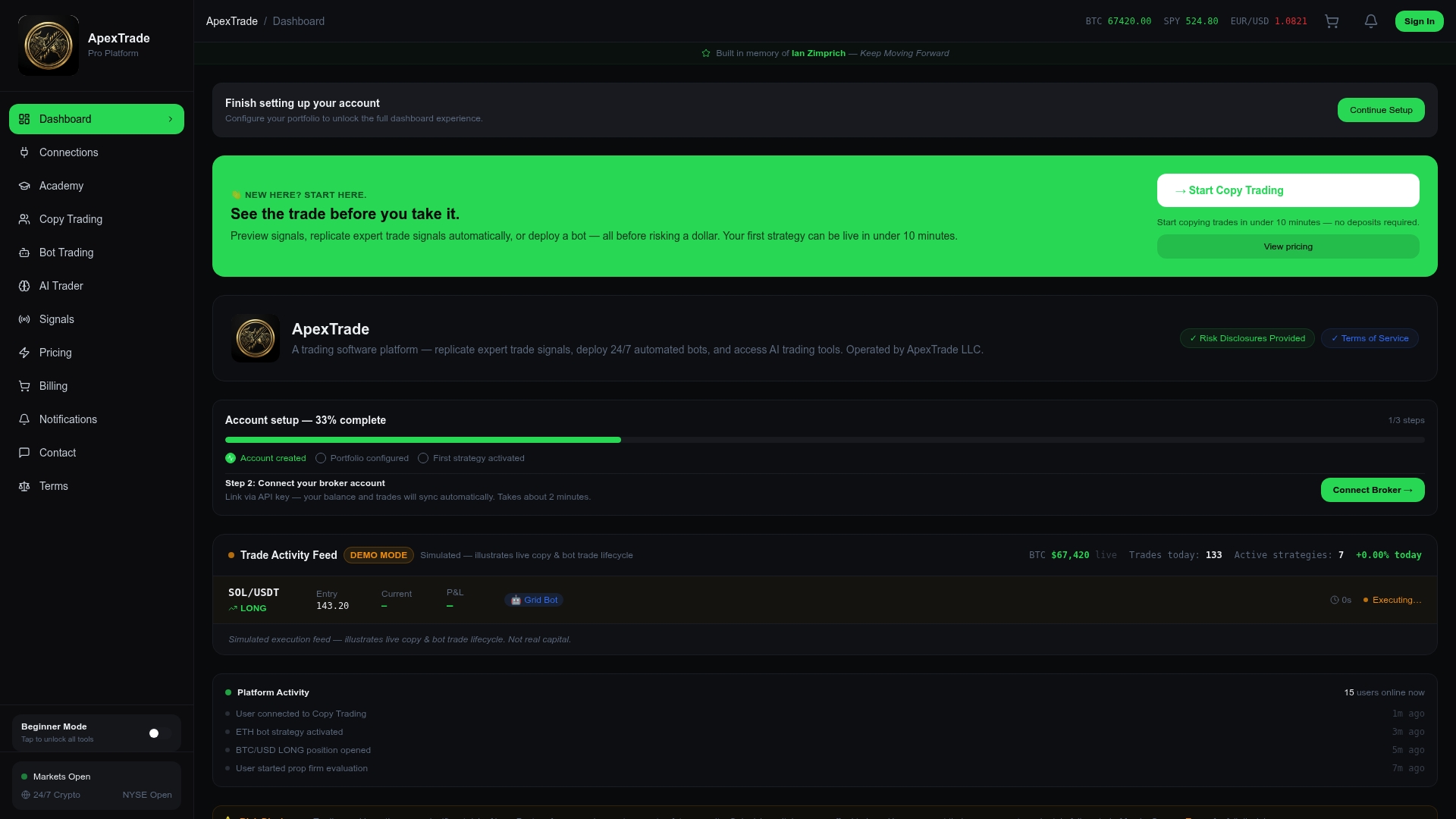
Apextradellc was built specifically for traders who want the precision of automated execution without sacrificing control over risk. The platform's copy trading features support both proportional and fixed allocation modes, with server-level enforcement of stop-loss, take-profit, and daily loss caps across every copied position. Lifecycle mirroring runs on a centralized execution pipeline, so your account tracks the lead's position changes in real time without manual intervention.
For traders who want to layer automation on top of copy trading, Apextradellc's bot trading tools run 24/7 across crypto, stocks, and forex, making them a natural complement to a copy trading workflow that needs to operate beyond your active hours.
FAQ
What is a copy trading workflow?
A copy trading workflow is the end-to-end process of detecting a lead trader's actions, evaluating them against follower filters, calculating position size, executing the trade automatically, and mirroring any subsequent changes like stop-loss adjustments or position closures.
How should I set position sizes in copy trading?
Keep each copied trade to 3 to 5% of your account balance and set a total exposure cap of no more than 20 to 30% across all open copied positions to limit concentrated risk.
What is the difference between proportional and fixed allocation?
Proportional allocation mirrors the lead trader's portfolio percentage in your account, while fixed allocation copies a set dollar amount per trade regardless of the lead's position size.
How often should I review my copy trading setup?
Review your risk parameters and lead trader performance every two weeks during the first three months, then monthly once your configuration is stable and producing consistent results.
Do I need to report copy trades for tax purposes?
Yes. Copy trading generates multiple taxable events daily. Export your trade history regularly and use dedicated tax software to track realized gains and losses accurately.