

Automated trading, known formally as algorithmic trading, is the practice of using software to execute buy and sell orders based on predefined rules without manual intervention. The automated trading mistakes to avoid are not always obvious, especially when a strategy looks perfect on paper. Risk management failures, system architecture gaps, and overfitted backtests account for the majority of real-money losses in live automated environments. Understanding how algorithmic trading works before deploying capital is the difference between a bot that compounds gains and one that drains an account overnight.
1. Automated trading mistakes to avoid: risking too much per trade
Risking more than 1 to 2% per trade is one of the most damaging trading automation beginner mistakes, because backtests routinely underestimate live volatility and leverage effects. A bot that sizes positions correctly in a calm backtest period can blow through 20% of an account in a single volatile session when those same parameters run live.
The fix is not complicated, but it requires discipline baked into the system itself:
- Set a hard position size cap of 1 to 2% of total account equity per trade
- Configure intraday loss limits that pause the bot automatically after a defined drawdown threshold
- Never allow the bot to compound position sizes without a corresponding equity check
Pro Tip: Set your intraday loss limit at 5% of account equity. If the bot hits that threshold, it stops trading for the rest of the session. This single rule prevents one bad hour from becoming a catastrophic day.
2. Ignoring stop-loss orders in automated systems

Stop-loss orders are not optional in automated trading. They are the last line of defense when a signal fires incorrectly or market conditions shift faster than the strategy anticipates. Many traders configure a bot to enter trades but leave the exit logic vague, assuming the strategy will self-correct.
Always setting stop-loss orders is a non-negotiable best practice for trading automation at any level. A bot without a stop-loss is not a trading system. It is an open-ended liability. Pair every entry signal with a defined exit, and test that the exit fires correctly in your paper trading environment before going live.
3. Missing a global kill switch
A missing kill switch is the most catastrophic system architecture failure in automated trading. One documented case showed $440 million in losses in 45 minutes because a software fault triggered repeated order submissions with no automated halt in place. That figure represents a real firm, not a hypothetical scenario.
MiFID II mandates a system-wide kill switch that cancels all open orders and halts new submissions automatically when intraday loss limits are breached. The kill switch must cover all venues, trigger automatically, and be tested quarterly with full audit trails. Even traders operating outside MiFID II jurisdiction should treat this standard as the baseline for any production bot.
"The kill switch regulation is about operational resilience. It enforces automatic halts on loss breaches to prevent runaway losses from software faults." — Kill switch requirements
4. Poor order state handling and duplicate alerts
Bots that do not handle order states like pending, partial fills, rejected, or cancelled orders risk duplicating positions or breaching risk limits without any visible warning. This is one of the most common trading system failures in production environments, and it almost never appears in backtests because backtests assume clean fills.
TradingView alert duplication is a real-world example of this problem. A webhook fires twice due to a network retry, the bot processes both signals, and the position doubles in size. Without a deduplication layer, the bot has no way to recognize it already acted on that signal. Building idempotency into your alert processing pipeline, meaning the system ignores duplicate signals for the same event, is a production-grade requirement, not an optional upgrade.
The trading signals workflow must account for every order state transition. A bot that only handles "filled" and ignores "partial" or "rejected" will eventually create unintended exposure at the worst possible moment.
5. Failing to maintain persistent state across restarts
A bot that loses its memory when it crashes or reboots is a bot that will re-enter positions it already holds, skip exits it should have taken, or lose track of its risk exposure entirely. Production-grade trading bots require persistent state management so that a restart does not reset the system's understanding of what it owns and what it owes.
This mistake is especially common among traders who build their first bot over a weekend. The script works in testing, but the first time a server reboots mid-session, the bot re-enters a position it never exited. Storing order state in a database rather than in memory is the standard solution. The bot reads its last known state on startup and reconciles against the exchange before placing any new orders.
6. Overfitting strategies to historical data
Overfitting is the process of tuning a strategy so precisely to past price data that it performs brilliantly in backtests and fails immediately in live trading. Quant trading tools warn explicitly against overfitting and recommend testing strategies against multiple market regimes and drawdown scenarios before any live deployment.
The table below shows the key differences between a well-validated strategy and an overfitted one:
| Factor | Overfitted strategy | Well-validated strategy |
|---|---|---|
| Backtest performance | Extremely high win rate | Realistic win rate with drawdowns |
| Market regimes tested | Single trending period | Bull, bear, and sideways markets |
| Slippage modeled | Zero or minimal | Realistic execution costs |
| Forward test completed | No | 2 to 4 weeks of paper trading |
| Live performance | Degrades immediately | Consistent with backtest range |
Backtest overfitting is the primary cause of live strategy degradation. The solution is to test across regimes, model realistic slippage, and always run a paper trading period before committing real capital. Apextradellc's guide on why you should backtest trading bots covers this validation process in detail.
7. Ignoring slippage and execution costs
Small slippage changes, such as moving from 0.05% to 0.15%, can flip a strategy from profitable to break-even or worse. This is not a theoretical risk. It is a live execution reality that affects every high-frequency or scalping strategy running in real markets.
Real-time monitoring of realized slippage versus backtest assumptions is the correct response. Set threshold alerts that notify you when actual execution costs deviate from your model. If slippage consistently runs higher than your backtest assumed, the strategy's expected edge may no longer exist. Catching this early prevents weeks of slow account erosion.
8. Overlooking hidden fees and transaction costs
Hidden fees including exchange commissions, bid-ask spreads, and withdrawal fees compound over hundreds or thousands of trades and can turn a profitable strategy into a losing one. This is one of the most overlooked common trading errors among traders who focus on signal accuracy but ignore execution economics.
A strategy with a 55% win rate and a 1:1 reward-to-risk ratio looks solid in isolation. Add 0.1% per side in fees across 500 trades per month, and the math changes significantly. Every strategy assumption must include a full cost model: entry fee, exit fee, spread, and any financing costs for overnight positions. If the strategy does not show a positive expectancy after all costs, it does not belong in live trading.
9. Skipping paper trading before going live
Paper trading for 2 to 4 weeks before live trading is the single most skipped step in trading automation, and it is the step that would prevent the majority of first-month losses. Backtesting creates false confidence because it cannot replicate live volatility, execution delays, or the psychological pressure of watching real money move.
Paper trading exposes order handling bugs, slippage surprises, and configuration errors before they cost real capital. Treat the paper trading period as a mandatory quality check, not an optional warm-up. If the live paper results diverge significantly from the backtest, investigate the cause before funding the account.
10. Failing to monitor bots after deployment
Automated trading is not risk-free, and the most dangerous mindset in algorithmic trading is "set and forget." Common mistakes include ignoring strategy parameters after deployment, investing too much capital too soon, and failing to review bot performance on a regular schedule. Automation handles execution. It does not handle judgment.
Markets change. A strategy that performed well during a low-volatility trending period will behave differently during a news-driven spike or a liquidity crisis. Build a weekly review into your workflow: check realized slippage, win rate, drawdown, and any anomalies in order logs. The smart crypto trading checklist from Apextradellc provides a practical framework for ongoing monitoring.
Pro Tip: Set up automated alerts for three conditions: daily loss exceeding your threshold, slippage deviating more than 50% from your backtest model, and any order that stays in "pending" status for longer than your expected fill time. These three alerts catch 80% of live execution problems before they compound.
11. Using incorrect indicators or timeframe mismatches
Configuration mistakes are silent killers in automated trading. A bot using a 14-period RSI on a 1-minute chart behaves completely differently than the same RSI on a 4-hour chart, even if the entry logic looks identical. Many traders copy indicator settings from a strategy guide without verifying that the timeframe and parameter combination matches their intended trading style.
Verify every indicator setting against the market and timeframe you are trading. A momentum indicator calibrated for daily swing trading will generate noise on a 5-minute scalping chart. Apextradellc's indicators for automated trading guide covers correct configuration for common setups across asset classes.
Key takeaways
Avoiding automated trading pitfalls requires combining disciplined risk controls, production-grade system architecture, and continuous post-deployment monitoring rather than relying on backtest results alone.
| Point | Details |
|---|---|
| Cap risk per trade | Never risk more than 1 to 2% of account equity per trade to prevent rapid drawdown. |
| Build a kill switch | Implement a system-level kill switch that halts all orders automatically on loss-limit breaches. |
| Validate before going live | Paper trade for 2 to 4 weeks and test across multiple market regimes before funding the account. |
| Model all costs | Include commissions, spreads, slippage, and financing costs in every strategy assumption. |
| Monitor continuously | Review bot performance weekly and set threshold alerts for slippage, drawdown, and order anomalies. |
Why most traders get automation backwards
I have reviewed dozens of automated trading setups over the years, and the pattern is almost always the same. The trader spends 90% of their time on the signal, the indicator combination, the entry logic. Then they spend the remaining 10% on everything else: the kill switch, the state management, the cost model, the monitoring plan. That ratio is exactly backwards.
The signal is the easy part. A strategy that wins 55% of the time with a reasonable reward-to-risk ratio is not hard to find. What kills accounts is the infrastructure around that signal. A duplicate alert doubles the position. A missing stop-loss turns a 2% loss into a 15% loss. A bot that loses state on a server restart re-enters a position it already holds. None of these failures show up in a backtest.
My honest advice is to treat your bot like a piece of financial infrastructure, not a trading idea. Before you go live, ask yourself: what happens if the server crashes mid-trade? What happens if the exchange rejects an order? What happens if slippage runs three times higher than expected? If you cannot answer those questions with a specific system response, the bot is not ready. Automation amplifies whatever is underneath it. A solid strategy with weak infrastructure loses money. A modest strategy with solid infrastructure survives long enough to improve.
— James
Trade smarter with Apextradellc's bot trading tools
Avoiding the mistakes covered in this article is significantly easier when your platform has the right controls built in from the start.
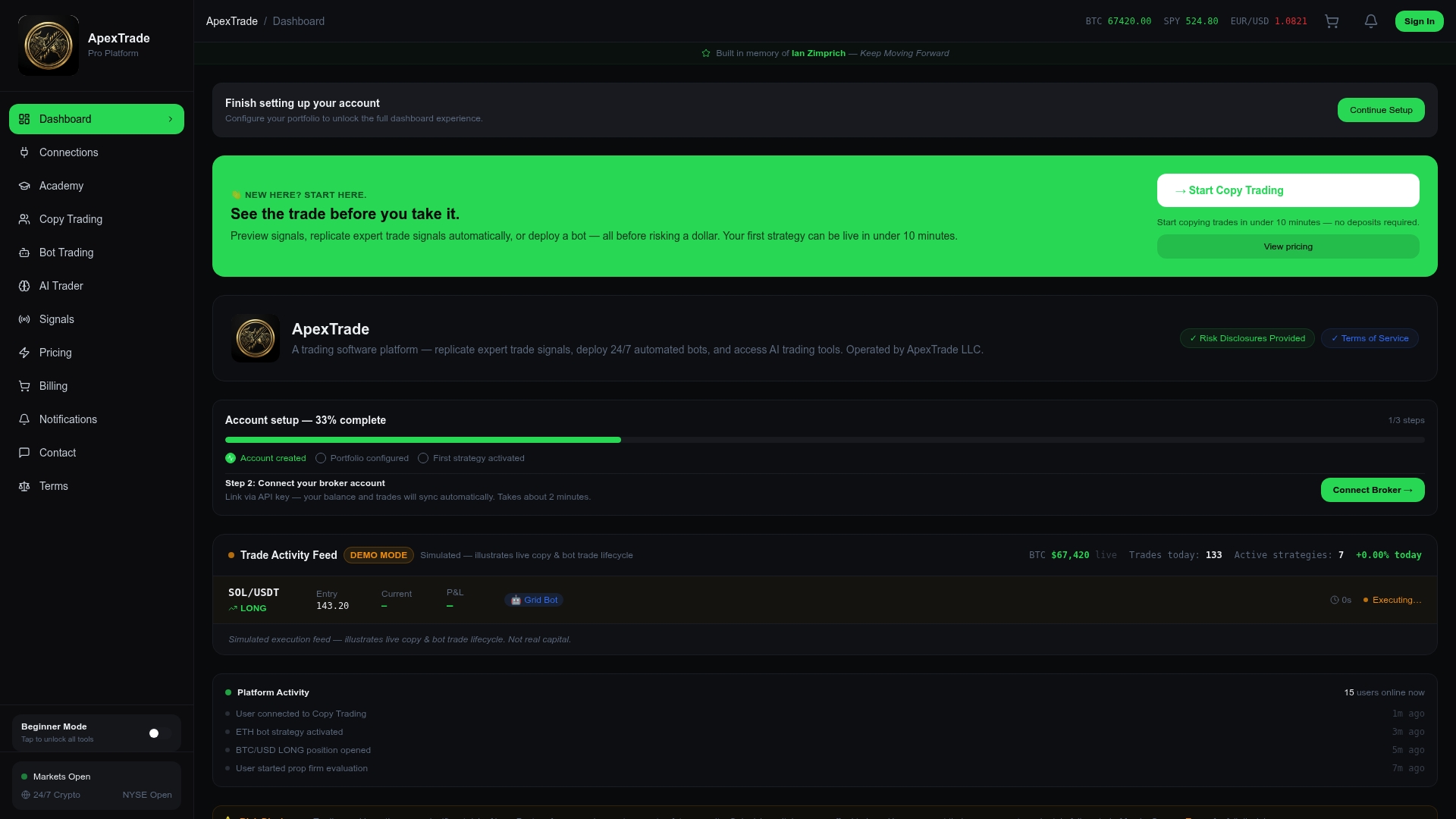
Apextradellc's bot trading platform includes built-in stop-loss configuration, position sizing controls, and performance monitoring tools designed to prevent the most common automated trading pitfalls. The platform supports demo account deployment so you can paper trade your strategy before committing real capital. Whether you are running crypto bots, forex automation, or stock strategies, Apextradellc provides the infrastructure controls that production-grade trading requires. Start with a demo, validate your setup, and scale with confidence.
FAQ
What is the most common automated trading mistake?
Risking more than 1 to 2% of account equity per trade is the most common mistake, because it causes rapid drawdown when live volatility exceeds backtest assumptions. Pairing this with missing stop-loss orders accelerates account losses significantly.
Why does a strategy that works in backtesting fail live?
Backtesting ignores real-world factors like slippage, execution delays, and market regime changes, which creates false confidence in strategy performance. Paper trading for 2 to 4 weeks before going live exposes these gaps before real capital is at risk.
What is a kill switch in automated trading?
A kill switch is a system-level control that cancels all open orders and halts new submissions automatically when a predefined loss threshold is breached. MiFID II requires this feature for regulated algorithmic traders, and it should be standard practice for any production bot.
How do hidden fees affect automated trading profitability?
Exchange commissions, bid-ask spreads, and withdrawal fees compound across hundreds of trades and can turn a profitable strategy into a losing one. Every strategy must include a full cost model before live deployment to confirm positive expectancy after all fees.
How often should I review my trading bot's performance?
A weekly review of realized slippage, win rate, drawdown, and order logs is the minimum standard for responsible bot management. Markets shift, and a strategy that performed well in one regime may degrade quickly in another without active oversight.