

Copy trading has attracted millions of investors who want exposure to financial markets without spending years building expertise. The appeal is obvious: find a skilled trader, mirror their moves, and collect the returns. But what is copy trading, really, and does it actually work that way? The honest answer is more complicated and more interesting than most introductory articles admit. This guide walks you through how copy trading works, why it fails so often, and what separates the traders who profit from the majority who do not.
Table of Contents
- Key takeaways
- What copy trading is and how it works
- Benefits of copy trading for individual traders
- Risks and challenges you cannot ignore
- How to choose a copy trading provider
- Getting started and managing your copy trading portfolio
- My honest take on copy trading
- Start copy trading smarter with Apextradellc
- FAQ
Key takeaways
| Point | Details |
|---|---|
| Copy trading automates replication | Your account mirrors a provider's trades in real time, scaled to your allocated capital. |
| Most copy traders lose money | Only 27% of copy traders are profitable, making provider selection critical. |
| Active oversight is non-negotiable | Treating copy trading as passive income is the most common and costly mistake. |
| Filter providers by data, not popularity | Win rate, drawdown, and consistency duration matter more than follower count. |
| Diversification limits exposure | Spreading capital across multiple providers reduces the damage any single bad trader can cause. |
What copy trading is and how it works
Copy trading is a system where your brokerage or trading platform automatically replicates the trades of another trader, called a signal provider, in your own account. When the provider buys 0.5 BTC, your account buys a proportional amount based on the capital you have allocated. When they close the position, yours closes too. The whole process happens without you placing a single manual order.
The two key roles in any copy trading setup are the provider (also called a signal trader or lead trader) and the follower (the investor copying them). Providers often earn a performance fee or a percentage of profits generated for their followers. Followers contribute capital and accept that their returns will mirror the provider's decisions, for better or worse.
Trade sizing scales automatically. If you allocate $1,000 to copy a provider who manages a $10,000 account and opens a position using 5% of their capital, your account deploys $50. This proportional model means you do not need matching account sizes to follow a trader.
Copy trading vs. social trading
These two terms get used interchangeably, but they describe different experiences. Social trading is the broader category. It includes forums, strategy discussions, sentiment feeds, and the ability to observe other traders' activity. Copy trading is a specific function within that ecosystem: fully automated trade replication with no manual input required per trade.
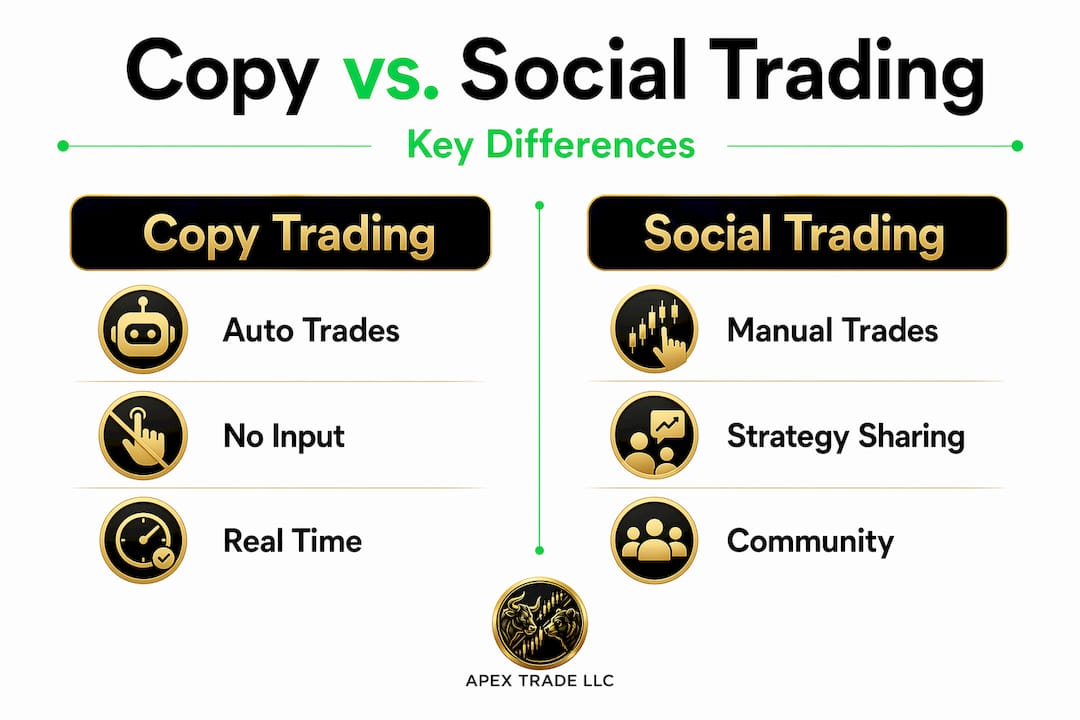
The table below captures the practical differences:
| Feature | Copy trading | Social trading |
|---|---|---|
| Trade execution | Automatic | Manual (follower decides) |
| Required market knowledge | Low | Moderate |
| Control over individual trades | Limited | Full |
| Best for | Passive replication | Learning and collaboration |
Platforms that support copy trading across stocks, forex, crypto, and CFDs give followers access to over 2.5 million investors copying trades in real time. The scale alone signals how mainstream the model has become.
Benefits of copy trading for individual traders
The clearest benefit is access. You do not need to understand candlestick patterns or central bank policy to participate in markets through copy trading. A beginner can allocate capital to a vetted provider and immediately gain exposure to strategies that took that provider years to develop.
Beyond access, copy trading delivers a few advantages that are genuinely hard to replicate through other means:
- Reduced emotional trading errors. Copy trading helps beginners avoid the fear and greed cycles that destroy most new traders. When the system executes automatically, you are not panic-selling during a dip.
- Real-time education. Watching a skilled provider's trade history teaches you more than any textbook. You see entry timing, position sizing, and exit discipline in action across real market conditions.
- Diversification across strategies. Copying multiple providers with different styles, such as one trend-follower and one range trader, means one bad month for a single strategy does not wipe out your entire allocation.
- Time efficiency. You do not need to sit in front of charts. The platform handles execution while you review results on your own schedule.
The educational value is especially meaningful for beginners who plan to eventually trade independently. Observing how experienced traders handle volatile periods builds intuition that paper trading simply cannot replicate.
Pro Tip: Set aside 15 minutes each week to review your copied providers' recent trades. Note what worked, what did not, and why. You will absorb trading psychology faster than any course teaches it.
Risks and challenges you cannot ignore
Here is the number that should be on every copy trading homepage but rarely is: 73% of copy traders lose money. That figure comes from real platform data and it reflects a structural reality, not a fringe outcome.
Understanding why most people lose is the most useful thing this article can do for you.
- Slippage and execution gaps. Your trade executes after the provider's trade is confirmed. In fast-moving markets, that delay means you may buy at a worse price and sell at a worse price than the provider. Over dozens of trades, slippage erodes returns in ways that are invisible until you compare your actual results to the provider's published performance.
- Hidden strategy risks. Some providers use martingale or grid strategies. These look excellent in calm markets because they generate frequent small wins. But they carry the risk of sudden, massive drawdowns that can eliminate months of gains in a single adverse move. If the provider does not disclose their strategy type, you may not realize the risk until it is too late.
- Fees compound the damage. Performance fees, spread commissions, and platform charges all reduce net returns. A provider showing a 15% annual return may deliver 8% to your account after costs.
- Popularity is not proof of skill. A provider with 10,000 followers has not been audited. They gained followers through marketing, good timing, or a short streak of profitable trades. Novices frequently follow unverified traders based on follower count rather than quantitative filters.
- Overreliance breeds complacency. When your account runs on autopilot, it is easy to stop checking in. Providers change strategies, get overconfident, or face market conditions their approach was never designed for.
Copy trading is not a passive income machine. It is an active investment that requires the same due diligence as any other financial decision.
The biggest mistake copy traders make is treating providers like magic boxes rather than business partners whose logic you understand and whose behavior you monitor.
How to choose a copy trading provider
Provider selection is where most copy traders either win or lose before a single trade is placed. The goal is to build a short list of candidates using quantitative data, then narrow down based on strategy transparency and risk controls.
Here is the process that actually works:
- Filter by drawdown first. Maximum drawdown tells you the worst losing streak a provider has experienced. Anything above 30% is a warning sign for most retail investors. This single filter eliminates the most dangerous providers immediately.
- Check consistency duration. A trader with three years of verified history carries far more credibility than one with three months of stellar returns. Short track records can reflect luck as easily as skill.
- Review the win rate in context. A 70% win rate sounds great until you realize the average win is $20 and the average loss is $150. Always look at the profit-to-loss ratio alongside the win rate.
- Understand the strategy type. Ask or research whether the provider uses trend following, scalping, swing trading, or higher-risk approaches like martingale. Match the strategy to your own risk tolerance.
- Diversify across providers. Spreading your capital across three to five providers with different styles reduces the impact of any one provider having a bad period.
- Document your reasoning. Write down why you chose each provider. This habit forces clearer thinking and makes it easier to evaluate whether your original logic still holds during a drawdown.
The table below shows what a basic provider screening might look like:
| Metric | Acceptable threshold | Red flag |
|---|---|---|
| Maximum drawdown | Below 25% | Above 40% |
| Track record length | 12+ months | Under 6 months |
| Profit-to-loss ratio | Above 1.5:1 | Below 1:1 |
| Strategy transparency | Fully disclosed | Undisclosed or vague |
Pro Tip: Use platform analytics tools that show equity curve history, not just total return. A smooth equity curve with steady growth is more reliable than a chart that spikes suddenly upward.
Getting started and managing your copy trading portfolio
Choosing the right platform is step one, and it matters more than most beginners realize. Look for platforms that offer verified provider track records, built-in risk controls, and clear fee structures. Security architecture also matters. Platforms using non-custodial wallet structures prevent the platform from accessing your funds directly, which significantly reduces counterparty risk.
Once you have chosen a platform, follow these practices:
- Start with an amount you can afford to lose entirely. Copy trading carries real risk, and your first few months are a learning period regardless of provider quality.
- Set a per-provider allocation limit. Never put more than 25 to 30% of your total copy trading budget with a single provider. If they blow up, your entire account should not go with them.
- Use stop losses at the account level. Most platforms allow you to set a maximum loss threshold per provider. Use it. This automatically disconnects you from a provider if losses exceed your limit.
- Review your portfolio monthly. Check whether each provider's performance still matches what attracted you to them. Markets change and so do trading strategies.
- Balance copying with learning. Use the trades you observe to build your own understanding of trading strategies. Copy trading should eventually accelerate your path to independent trading, not replace it permanently.
The portfolio approach treats copy trading like any diversified investment, where no single position defines your outcome.
My honest take on copy trading
I have watched a lot of people approach copy trading the same way: they find a provider with a great-looking recent return, allocate too much capital, and then do absolutely nothing for three months. When the drawdown hits, they either panic-copy something else or give up entirely.
What I have learned is that copy trading rewards the same habits as any other form of serious investing. The people who do well treat their provider list like a portfolio of employees. They review performance, they make cuts, and they document decisions. They do not chase whoever had the best month on the leaderboard.
The educational angle is real, but only if you actually engage with it. I found that watching how a skilled provider responded to a volatile week taught me more about risk management than any formal content I consumed. That only happened because I was paying attention, not just watching numbers move.
The hardest discipline in copy trading is not losing money. It is staying emotionally detached from both winning and losing streaks long enough to make rational decisions. That is the skill the platform cannot automate for you.
— James
Start copy trading smarter with Apextradellc
If you are ready to put this guide into practice, Apextradellc gives you the tools to do it without flying blind.
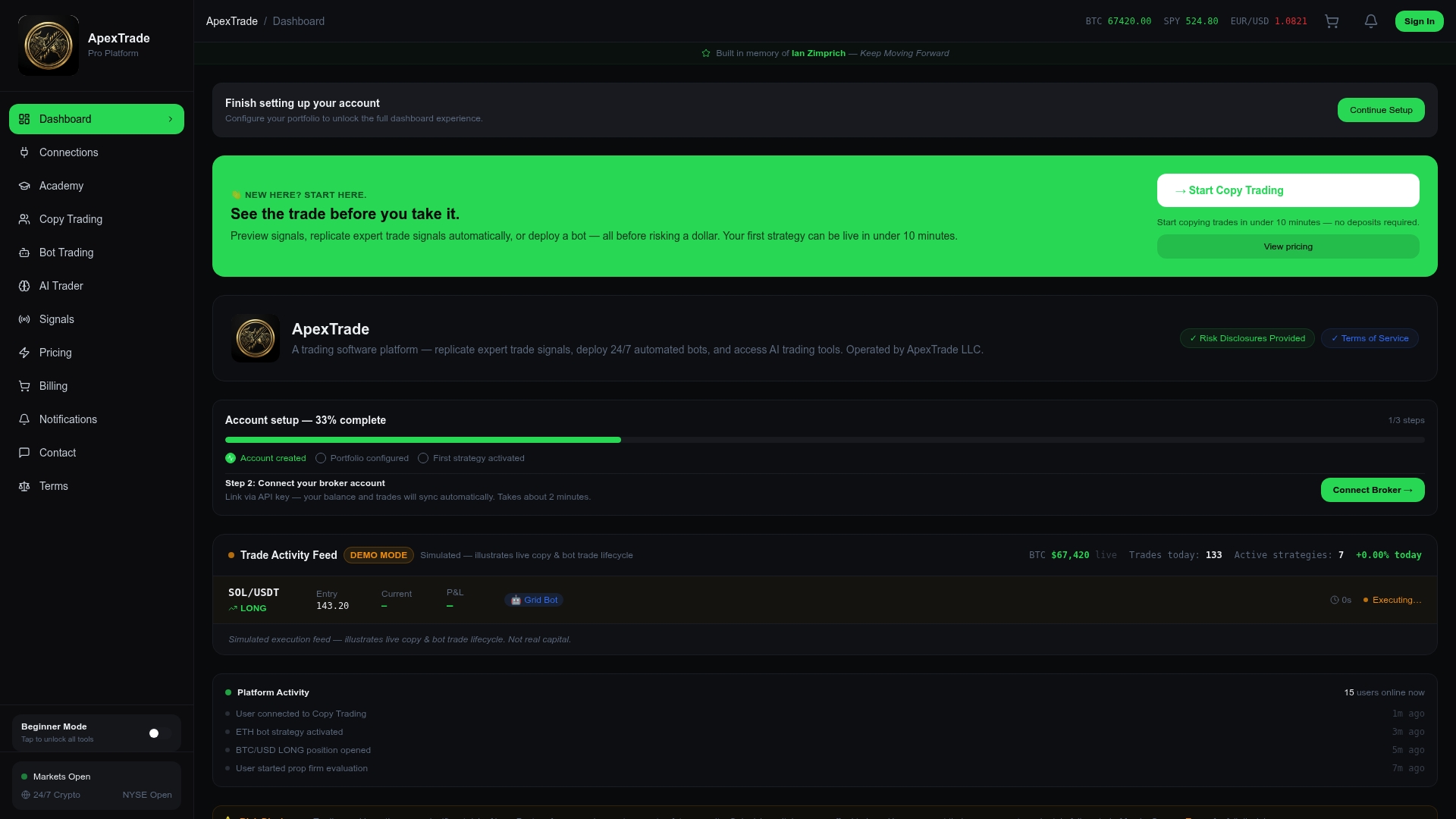
The Apextradellc copy trading platform lets you screen providers using real performance data including win rate, drawdown history, and equity curves through the platform's Engine Analytics tools. You can allocate capital across multiple providers, set automatic stop losses per provider, and track your full portfolio from a single dashboard. The platform supports crypto, forex, and stock markets around the clock, and its non-custodial wallet architecture means your funds stay under your control. Whether you are copying your first trader or refining an existing strategy, Apextradellc is built to support informed, risk-aware copy trading at every level.
FAQ
What is copy trading in simple terms?
Copy trading is a system where your account automatically replicates the trades of an experienced trader in real time, scaled to your allocated capital. You do not place trades manually.
What is the difference between copy trading and social trading?
Social trading is the broader category that includes discussion, strategy sharing, and observation. Copy trading is a specific function within social trading where trade execution is fully automated.
How much money do I need to start copy trading?
Most platforms allow you to start with a few hundred dollars, though starting with more gives you better proportional scaling across multiple providers. Always treat your initial allocation as money you can afford to lose while you learn.
Why do most copy traders lose money?
73% of copy traders lose money due to poor provider selection, slippage, hidden strategy risks, and treating the system as a passive income source rather than an active investment requiring regular oversight.
Can copy trading help me become a better independent trader?
Yes, if you actively observe the trades you are copying. Beginners gain significant value from watching how experienced traders handle risk and volatility, which builds intuition that accelerates independent trading skills over time.