
Most traders treat trading signals like lottery tickets. They receive an alert, feel a rush of confidence, click buy, and then wonder why their results are inconsistent. The problem is rarely the signals themselves. It's the absence of a trading signals workflow that turns those alerts into disciplined, repeatable execution. Without a structured process covering signal generation, scoring, risk controls, and execution mechanics, even the best signals produce erratic outcomes. This guide walks you through exactly how to build that system from the ground up.
Table of Contents
- Key takeaways
- Building your trading signals workflow: tools and prerequisites
- Step-by-step workflow: from signal generation to execution
- Validating and improving your workflow
- Common pitfalls in trading signals workflows
- My take on building a workflow that lasts
- Take your workflow further with Apextradellc
- FAQ
Key takeaways
| Point | Details |
|---|---|
| Workflow beats signal quality | A structured trading signals workflow outperforms random signal usage, even with moderate-quality signals. |
| Confluence improves reliability | Combining two to four complementary indicators reduces false signals and improves trade conviction. |
| Risk rules determine survival | Position sizing and kill switches matter more than win rate alone for long-term account health. |
| Validate before going live | Walk-forward testing and paper trading reveal real-world gaps that backtests alone cannot catch. |
| Monitor operational metrics | Tracking slippage, latency, and fill quality catches workflow degradation before it becomes costly. |
Building your trading signals workflow: tools and prerequisites
Before you write a single rule or execute a single trade, you need to define what you are actually trading and what data you need to trade it well. Skipping this step is how traders end up with sophisticated signal logic running on garbage data.
Start by defining your trading universe. Are you focused on forex pairs, crypto assets, equities, or a mix? Each asset class has different data rhythms, liquidity profiles, and volatility patterns. A forex trading signals workflow built for major pairs behaves very differently from one designed for mid-cap stocks. Locking in your universe keeps your data pipeline and signal logic coherent.
Data requirements by signal type:
- Price and volume feeds: Real-time or near-real-time tick data for technical signals. Make sure your provider timestamps data cleanly. Clean, time-aligned data prevents false confidence in backtests and live performance.
- Fundamental data: Earnings, revenue, macro indicators for longer-horizon signals.
- Sentiment data: News feeds, social volume, options flow for conviction overlays.
- AI-generated signals: Output from quantitative models or large language model (LLM) scoring layers.
For trading signals software, the core stack typically includes a broker API or execution platform (Interactive Brokers, Alpaca, Binance API), a backtesting framework like vectorbt or Backtrader, and a scripting environment in Python. You also need a logging database and an alert delivery channel like a webhook or Telegram bot. Hardware matters less than connectivity. Low-latency server hosting near exchange infrastructure is worth the cost once you move into automated execution.
| Tool category | Examples | Primary purpose |
|---|---|---|
| Broker API | Alpaca, Binance, IBKR | Order execution and account data |
| Backtesting engine | vectorbt, Backtrader | Strategy validation on historical data |
| Data provider | Polygon.io, Quandl | Clean price, volume, and fundamental feeds |
| Signal delivery | Webhooks, Telegram bots | Real-time trade alerts and workflow triggers |
| Logging and monitoring | PostgreSQL, Grafana | Execution tracking and performance visibility |
Getting these pieces connected before you build signal logic saves enormous debugging time later.
Step-by-step workflow: from signal generation to execution
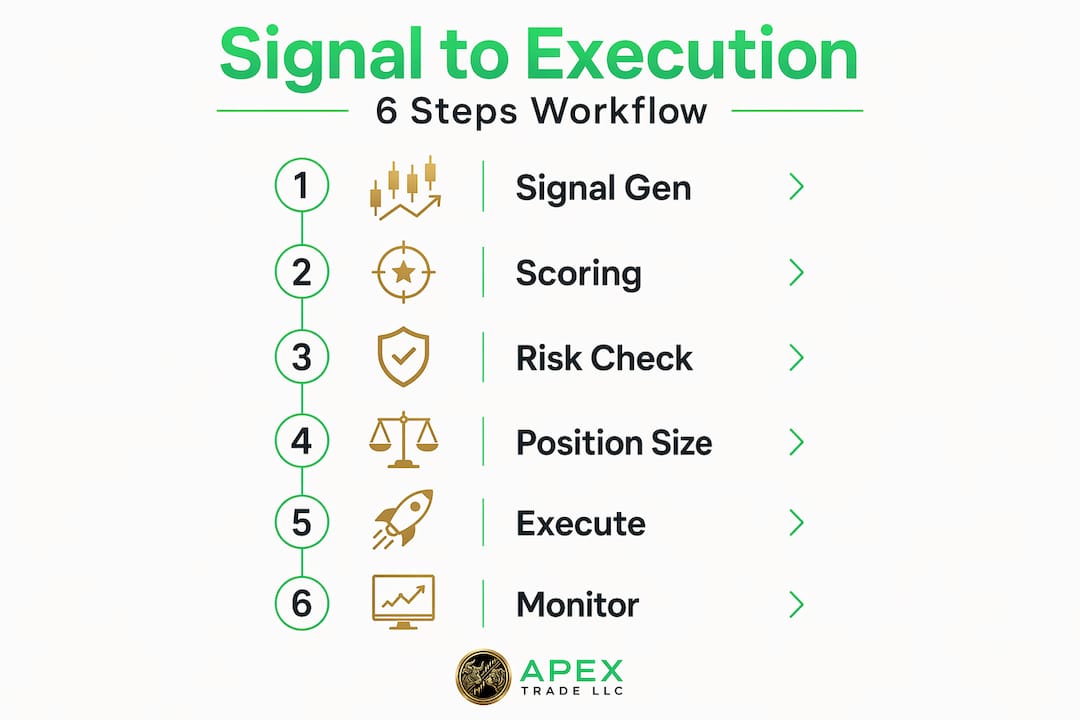
This is the core of the system. Think of it as a pipeline with six distinct stages. Each stage feeds the next, and each has its own quality controls.
Step 1: Signal generation using confluence
Generating raw signals starts with your indicator stack. Combining two to four indicators like ADX, RSI, and OBV to confirm price action reduces the noise that comes from relying on a single indicator. This is the Rule of Confluence in practice. When RSI shows oversold conditions and OBV confirms accumulation, that signal carries more weight than either condition alone. Build your signal generator to output a binary flag plus the raw values of each indicator so you can audit decisions later.
Step 2: Signal scoring and AI conviction layer
Once raw signals are generated, run them through a scoring system. Assign weights based on how predictive each indicator has been historically. An optional LLM-based scoring layer can add a conviction multiplier based on market context, news sentiment, or macro regime. Critically, this AI layer should act as a filter, not a trigger. During AI scoring outages, trades should execute at reduced conviction rather than stop entirely. Never make any external system a single point of failure.
Step 3: Risk management checks
No signal should reach execution without passing through risk rules. These are your guardrails. They include maximum position size relative to account equity, a daily loss limit or kill switch that halts trading after a defined drawdown, correlation checks to avoid building correlated exposure across positions, and sector or asset concentration limits. A 55% win-rate strategy can fail catastrophically if losing trades are oversized or if correlated exposures stack up during stress events.

Step 4: Position sizing
After passing risk checks, calculate position size using a fixed fractional model or Kelly criterion variant. Fixed fractional (risking 1% to 2% of equity per trade) is the most practical starting point. Kelly is theoretically optimal but requires accurate win-rate and payoff-ratio estimates, which fluctuate in live markets.
Step 5: Order execution
Send the order via your broker API. Use limit orders unless your strategy specifically requires market fills. Execution latency under 50 milliseconds is the professional standard for automated trading. Hosting your execution server close to broker infrastructure is the most reliable way to get there. Use webhook-triggered execution when your signal system lives outside your trading engine.
Step 6: Execution monitoring
After the fill, log everything: fill price, expected price, latency, slippage, and order status. Operational monitoring of fill quality and slippage provides early warnings of workflow degradation that financial losses may not surface until it's too late.
Pro Tip: Set up a real-time dashboard showing signal count, execution count, and fill quality side by side. When these three numbers diverge, something in the pipeline is broken.
| Pipeline stage | Key output | Quality check |
|---|---|---|
| Signal generation | Binary signal flag + indicator values | Confluence of two or more indicators |
| Signal scoring | Conviction score (0 to 1 scale) | Fallback mode if AI layer is unavailable |
| Risk management | Pass or reject flag | Kill switch thresholds defined |
| Position sizing | Trade size in shares or contracts | Capped at max position size rule |
| Execution | Filled order with timestamp | Latency and slippage within tolerance |
Validating and improving your workflow
Building the pipeline is only half the work. Proving it holds up under real market conditions is where most traders cut corners, and where most systems eventually fail.
The standard validation sequence runs like this. First, backtest the full workflow, not just the entry logic. Include your risk rules, stop losses, and exit conditions in the test. Backtesting the entire workflow including risk and execution assumptions yields realistic performance numbers. Win rate and drawdown must be evaluated together.
Next, apply walk-forward testing. This means optimizing your strategy parameters on one data segment, then testing the result on an unseen forward segment. A walk-forward efficiency ratio above 0.7 indicates a strategy that generalizes well. Below 0.3 signals overfitting. Rolling walk-forward windows are preferable because they keep strategy parameters relevant to current market conditions rather than anchoring to outdated regimes.
Set minimum performance thresholds before you allow a strategy to go live:
- Sharpe ratio above 1.0
- Maximum drawdown below 20%
- Win rate consistent with your risk-reward ratio (for example, a 1:2 risk-reward needs only a 40% win rate to be profitable)
- At least 100 trades in the test sample for statistical significance
Pro Tip: Version control your strategy parameters like software code. When you modify a parameter, log the date, reason, and before-and-after performance metrics. Markets change, and so does every strategy.
After backtesting and walk-forward validation, paper trade the system for at least four weeks under live market conditions. Paper trading reveals discrepancies between theoretical and actual performance that no backtest captures. Then run a small-capital live pilot before committing full allocation.
Common pitfalls in trading signals workflows
Even well-designed workflows break down in predictable ways. Knowing these failure modes in advance is far more useful than discovering them in a live account.
The most common mistake is treating every alert as a trade. Alerts that do not specify what to do next create emotional fatigue and inconsistent execution. Every signal that enters your workflow should trigger a defined set of checks, not a gut decision.
Over-reliance on a single indicator is the second most frequent problem. A well-designed indicator stack reduces ambiguity by being complementary rather than redundant. Using RSI plus MACD, for example, adds little because both are momentum oscillators that will fire simultaneously.
The other major pitfalls worth flagging:
- Skipping the paper trading phase because backtests looked strong enough
- Ignoring latency after deployment, especially when using third-party relay services
- Missing execution logs that would have caught slippage creep over weeks
- Failing to set kill switches before deploying capital, which leaves the system exposed to catastrophic drawdown events
- Assuming a strategy that worked in one market regime will survive a regime shift
"A robust trading workflow is a controlled operational system, not just a great entry signal." — Trading Bot Workflow: Idea to Live Execution
Markets evolve. Strategies that performed well in trending conditions may degrade sharply during low-volatility, mean-reverting regimes. Building monitoring into your workflow so you can detect these shifts early is what separates sustainable systems from ones that work brilliantly until they don't.
My take on building a workflow that lasts
I've seen traders spend months perfecting entry signal logic and then blow up accounts because they had no kill switch. The signal was not the problem. The absence of operational controls was. In my experience, the traders who survive the longest are not the ones with the cleverest signals. They are the ones who treat the entire system, from data ingestion to order fill, as a controlled process with defined failure modes.
The other lesson I have learned the hard way: your workflow needs fallback mechanisms at every layer. If your AI scoring service goes offline, the system should degrade gracefully, not freeze. If your broker API times out, you need a fallback order path or at minimum a halt and alert. I have seen live systems go dark at the worst possible moments because someone treated an external dependency as permanently reliable.
What actually works is disciplined process over perfect signals. A well-structured trading workflow with mediocre signals will outperform a brilliant signal stack with no risk controls over any meaningful time horizon. That is not conventional wisdom. That is what the numbers show when you run the comparison honestly.
The traders I respect most spend as much time on logging, monitoring, and reviewing execution quality as they do on finding new signals. Because that maintenance work is what keeps the system honest. Markets change. Your workflow has to change with them.
— James
Take your workflow further with Apextradellc
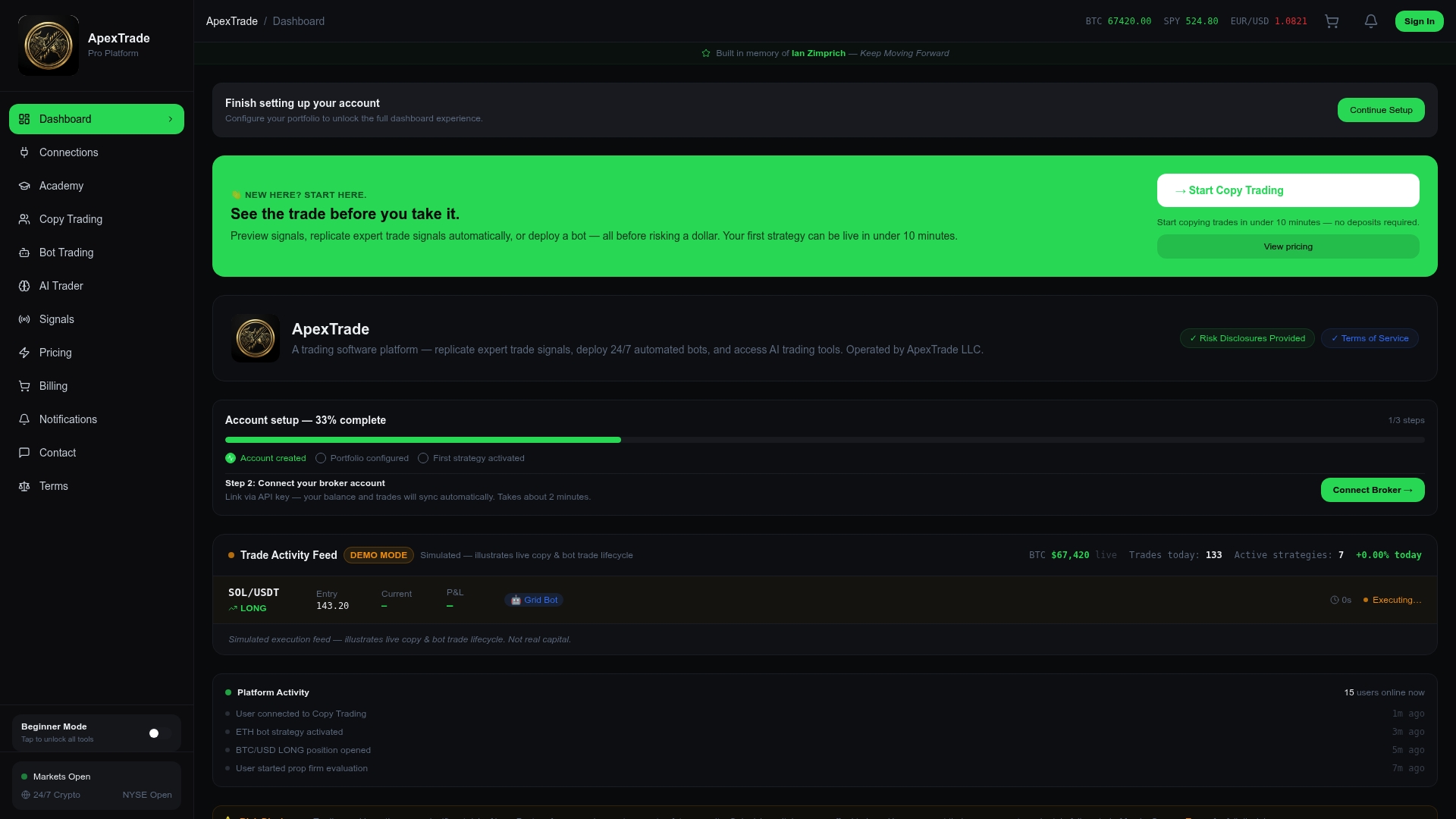
Building a trading signals workflow from scratch takes serious infrastructure. Apextradellc removes the heaviest parts of that burden. The platform's bot trading solutions are built specifically for automated signal execution across crypto, forex, and stock markets. Bots run 24/7, apply your defined parameters, and execute without emotional interference. For traders who prefer to skip the signal-building phase entirely, Apextradellc's copy trading service lets you replicate the workflows of proven traders, including their risk controls and position sizing logic. Both approaches work across multiple asset classes and integrate with existing accounts. If you want hands-on automation without building every layer yourself, Apextradellc is worth exploring.
FAQ
What is a trading signals workflow?
A trading signals workflow is a structured, repeatable process that takes raw trade signals from generation through filtering, risk checks, position sizing, and execution. It replaces ad-hoc decision-making with a defined pipeline that produces consistent, auditable outcomes.
How many indicators should I use in a trading signals workflow?
Research supports using two to four complementary indicators to confirm price action. Using more than four typically adds redundancy rather than reliability, and using just one creates signal noise that leads to overtrading.
How do I validate my trading signals workflow before going live?
Run a full-pipeline backtest including risk rules and exits, then apply walk-forward testing with a target efficiency ratio above 0.7, then paper trade for at least four weeks under live conditions before committing real capital.
What execution latency should I target for automated trading signals?
Professional automated trading systems target execution latency under 50 milliseconds. Hosting your execution server close to broker infrastructure via direct API integration is the most reliable way to achieve this consistently.
What causes a trading signals workflow to degrade over time?
Market regime shifts are the primary cause. A strategy optimized for trending markets may perform poorly during low-volatility periods. Regular walk-forward testing, operational monitoring, and version-controlled parameter updates are the primary defenses against gradual performance drift.